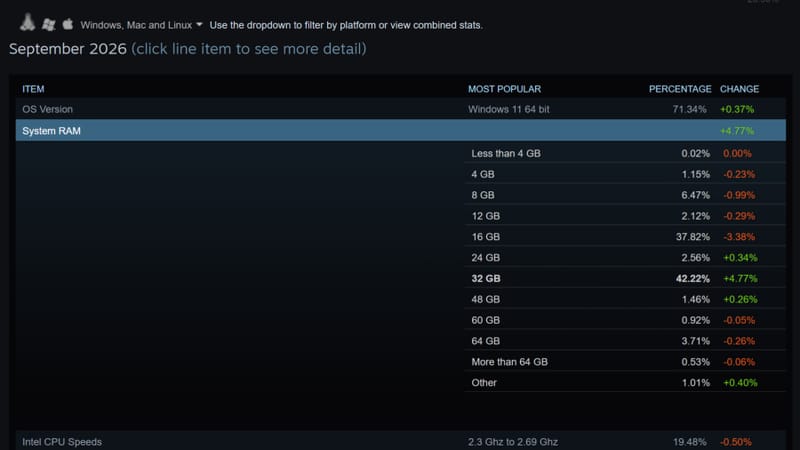
32GB RAM gaming PCs have overtaken 16GB configurations for the first time in Valve’s Steam Hardware Survey, a shift that lands in the middle of a global memory chip shortage that has sent DRAM prices climbing sharply. The September 2026 results, drawn from millions of PCs that opt into Valve’s monthly data collection, show 32GB now sitting at the top of the memory capacity chart, a milestone many expected to arrive eventually but not during one of the worst RAM shortages in recent memory.
Key takeaways
- ✓32GB RAM gaming PCs have overtaken 16GB as the top configuration in the September 2026 Steam Hardware Survey.
- ✓The shift happened despite a global memory chip shortage pushing DRAM prices sharply higher through 2026.
- ✓AMD's processor share in the survey climbed past 48 percent, closing in on long-time leader Intel.
- ✓Most 32GB upgrades likely happened before shortage-driven price spikes, reflecting purchases made months earlier.
- ✓Modern games, background apps and Windows 11 overhead are pushing baseline memory needs higher regardless of price.
The same survey round also flagged a notable move in the CPU market, with AMD’s processor share climbing past 48 percent among respondents, closing the gap on Intel considerably. Together, the two data points paint a picture of a gaming hardware landscape that is shifting faster than pricing pressure alone would suggest.
Table of Contents
What the Steam Hardware Survey actually shows
Valve’s Steam Hardware Survey samples a rotating cross-section of Steam users each month and aggregates anonymous data on CPUs, GPUs, memory, storage, operating systems and more. It is not a perfect census of every gaming PC on the planet, but with millions of participants it remains the closest thing the industry has to a running public census of what gamers actually own.
For years, 16GB of system memory held the top spot as the most common configuration, reflecting its status as the practical sweet spot for gaming since the mid-2010s. Seeing 32GB RAM gaming PCs finally pull ahead marks a genuine inflection point, not just a marginal shuffle in the rankings. It suggests that a large chunk of the Steam user base has already upgraded, built new systems, or bought pre-built machines that ship with double the memory once considered standard.

AMD’s rise to more than 48 percent CPU share in the same survey is just as notable. Intel has held the lead in Steam’s CPU breakdown for most of the survey’s history, so a gap this narrow signals a real and sustained shift in buying habits, likely tied to AMD’s recent Ryzen desktop and laptop lineups gaining traction with both DIY builders and system integrators.
Why memory prices are spiking right now
The timing makes the 32GB milestone more surprising, not less. Memory manufacturers have been diverting enormous production capacity toward high-bandwidth memory for AI accelerators, squeezing supply of conventional DDR modules used in consumer PCs. That supply crunch has pushed DRAM and NAND flash pricing up substantially through 2026, with knock-on effects across laptops, desktops and even game consoles that rely on the same chip families.
Read about DDR5 versus DDR4 pricing and performance for a sense of how memory costs have already moved even before this latest shortage, and why capacity upgrades were comparatively cheap not long ago. That earlier affordability is a big part of why the 32GB figure looks the way it does today.
Shortages of this kind tend to lag real-world buying behaviour by months. A PC bought or upgraded with 32GB back when prices were reasonable still shows up in this month’s survey the same way a brand-new, shortage-priced build would. The Steam numbers reflect the installed base, not just fresh purchases, so the result is less a sign that gamers are happily paying inflated prices and more a sign that a lot of upgrading happened before the squeeze really hit.

Why 32GB became the new baseline anyway
Several forces were already pushing memory requirements upward before the shortage began. Modern AAA games increasingly recommend 16GB as a minimum rather than a target, with some newer titles suggesting 32GB for smoother performance alongside background applications like Discord, browsers and streaming software. Windows 11 itself carries more memory overhead than its predecessors, and multitasking habits among PC gamers, including browsing, streaming and running multiple launchers at once, all add to the baseline load.
Pre-built system vendors have also shifted their default configurations. Many mid-range and high-end gaming desktops now ship with 32GB as standard rather than an optional upgrade, partly because dual-channel 2x16GB kits became the practical norm for new builds even before prices spiked. Builders choosing a gaming motherboard for a new build increasingly plan around four memory slots and 32GB from the outset, rather than treating it as a later upgrade.
Upcoming CPU platforms are likely to reinforce that trend further. Memory controllers and cache designs in next-generation chips, including details that have surfaced around Intel’s upcoming Nova Lake chips, point toward platforms built with higher memory bandwidth and capacity in mind, suggesting 32GB will keep gaining ground even as 64GB starts creeping into enthusiast conversations.
What it means for buyers and builders
For anyone planning a new build or upgrade right now, the survey result is a reminder that memory requirements rarely move backward. Even with prices elevated, treating 16GB as a long-term baseline is increasingly risky for newer titles. Buyers facing high DRAM prices have a few sensible options: lock in a 32GB kit now if the budget allows, delay a purchase until supply eases, or buy a single 16GB module with a clear upgrade path to add a second stick later once prices settle.
The AMD share gain matters for a similar reason. A tighter race between AMD and Intel usually means more competitive pricing and faster iteration on both sides, which is good news for anyone shopping for a new CPU in the months ahead regardless of brand loyalty. Combined, the two trends suggest a gaming PC market that is still investing in better hardware despite real cost pressure, rather than pulling back and settling for less.
Frequently asked questions
Why did 32GB overtake 16GB in the Steam Hardware Survey?
Many gamers upgraded or built new systems with 32GB before memory prices spiked, and newer games and Windows 11 push baseline memory needs higher than in previous years.
Is now a bad time to buy RAM because of the shortage?
Prices are elevated due to manufacturers prioritising AI-related memory production, so buyers on a tight budget may want to consider a single module with room to expand later rather than paying inflated prices for a full 32GB kit immediately.
Does AMD’s CPU share gain affect RAM choices?
Not directly, since both AMD and Intel platforms support the same DDR5 standards, but a more competitive CPU market generally pushes better overall platform pricing and features.
How accurate is the Steam Hardware Survey?
It samples a large rotating group of Steam users each month rather than every PC gamer, so it is a strong general indicator of trends rather than an exact market census.