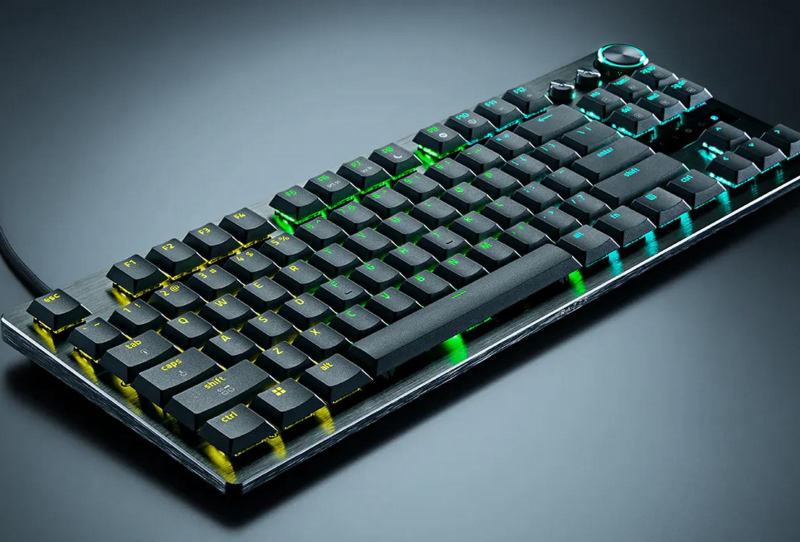
Razer has expanded its Huntsman V3 Pro TKL lineup with a new low-profile version that squeezes serious analog optical speed into a shallower, more travel-friendly frame. Called the Huntsman V3 Pro Low-Profile Tenkeyless 8KHz, Razer describes it as the first low-profile analog optical keyboard built specifically for esports. It is also, quite possibly, one of the longest product names currently sitting on a store shelf.
Name aside, the idea behind the board is straightforward. Razer wants to offer the same fast, precise switch technology found in its full-height Huntsman V3 Pro models, but in a slimmer chassis with shorter keycaps and reduced key travel. That combination has become popular among players who want a lower, flatter typing angle without giving up the responsiveness that competitive gaming demands.
Table of Contents
What Razer changed with the Huntsman V3 Pro TKL 8KHz
The new board keeps the tenkeyless layout that has made the standard Razer Huntsman V3 Pro TKL a popular pick for players who want a compact footprint without sacrificing a full set of function keys. Dropping the numpad frees up desk space for wider mouse swings, which matters more than it sounds for anyone playing at a high sensitivity.
What sets this version apart is the low-profile design paired with Razer’s analog optical switches. Rather than relying on a mechanical actuation point, these switches use a beam of light to track how far a key has travelled, letting the keyboard read input as a smooth range rather than a simple on-off click. Razer has used this technology in previous Huntsman V3 Pro boards, but never before in a shallower, low-profile housing built around it from the ground up.
The result, according to Razer, is a wired keyboard that keeps the fast response times its esports-focused range is known for, while trimming the physical distance a key has to travel before it registers. For fast-paced shooters and other twitch-reaction titles, that shorter distance can translate into a small but real head start.
Why analog optical switches matter for competitive players
Analog optical switches are not new to Razer’s lineup, but they remain one of the more interesting ideas in gaming keyboards. Because the switch can sense partial key presses rather than just a binary press or release, players can fine-tune how far a key needs to move before it triggers an action in supported games. That opens the door to features like adjustable actuation points and rapid trigger behaviour, where a key can reset and fire again almost as soon as it starts moving back up.
In practice, this suits genres where fractions of a second decide a match. A lighter actuation setting can help with rapid taps in a rhythm game or a fighting game combo, while a heavier one can reduce accidental presses during long sessions. Bringing that flexibility into a low-profile body is the genuine engineering step here, since shorter key travel usually leaves less room to work with for adjustable actuation ranges.
It is worth remembering that software support plays a big role in how useful this feels day to day. Razer’s Synapse software is what lets players actually set those actuation points and rapid trigger behaviours, so the hardware and the software need to work together for the analog features to matter in a real match rather than just on a spec sheet.
How it stacks up against the rest of the low-profile field
Low-profile mechanical and optical keyboards have become a genuine category over the last few years, not just a novelty. Razer’s own low-profile BlackWidow V4 already demonstrated the brand’s interest in flatter designs, but that board uses mechanical switches rather than analog optical ones, aimed more at everyday typing feel than esports-grade tuning.
| Feature | Huntsman V3 Pro TKL 8KHz (low-profile) | Standard Huntsman V3 Pro TKL |
|---|---|---|
| Switch type | Low-profile analog optical | Full-height analog optical |
| Layout | Tenkeyless | Tenkeyless |
| Connection | Wired | Wired |
| Key travel | Shorter than standard model | Standard mechanical travel range |
Against rivals, the comparison naturally lands on other tenkeyless esports boards such as Corsair’s K70 Pro TKL, which takes a more conventional mechanical switch approach rather than Razer’s optical light-based actuation. The difference matters mostly for players chasing the fastest possible response, where optical detection tends to have an edge over traditional mechanical contact switches simply because there is no physical debounce delay to account for.
What it means for buyers considering an upgrade
For anyone already invested in Razer’s ecosystem, this launch is an easy one to understand. It gives players who prefer a low, flat typing angle a way to get the same analog optical performance found in the brand’s higher-profile boards, rather than choosing between comfort and competitive features. Pairing a board like this with Razer’s Viper V4 Pro mouse would give a setup built almost entirely around minimising input delay.
The bigger picture matters too. Low-profile boards are no longer a niche side category chasing a slimmer look. Manufacturers are now bringing their flagship switch technology down into shallower housings rather than treating low-profile lines as a lighter, less capable alternative. That shift benefits anyone who wants the ergonomic and aesthetic upside of a flatter keyboard without settling for a watered-down feature set.
Whether the Huntsman V3 Pro TKL 8KHz becomes a genuine favourite among competitive players will depend on how the adjustable actuation and rapid trigger features feel in practice, something only hands-on time can really settle. On paper, though, it represents a sensible next step for Razer’s analog optical technology and a sign that low-profile design is being taken seriously at the top end of the gaming keyboard market.