Samsung has spent the better part of a decade refining the book-style foldable, and the Galaxy Z Fold 8 Ultra represents the most polished version of that formula yet. It sits above the standard Z Fold 8 and the compact Z Flip 8 as the largest, fastest, and most feature-packed device in Samsung’s folding phone family this generation. For anyone chasing the biggest screen, the strongest chipset, and the sharpest cameras Samsung currently offers in a foldable, this is the model that ticks every box.
What makes the Z Fold 8 Ultra interesting isn’t a dramatic reinvention. Instead, it takes the winning formula from last year’s Z Fold 7 and sharpens nearly every element, from the display brightness and processing power to the camera hardware and battery stamina. It’s an evolution rather than a revolution, but the improvements add up to a device that feels genuinely premium in the hand and remarkably capable for multitasking, content creation, and everyday productivity.
This review walks through the design, the standout features, and how the phone performs in real-world use, covering everything from the new Flex Titanium build to benchmark results and battery behaviour. Anyone weighing up whether the Ultra tier is worth stepping up to, or simply curious what Samsung’s flagship foldable brings to the table this generation, will find the details laid out below.
Table of Contents
Design and Functionality
At first glance, the Z Fold 8 Ultra looks like a natural continuation of the Z Fold 7’s book-style design. The port placement, the speaker location, and the position of the volume rocker and power button have all carried over unchanged, which suggests Samsung is confident it has already nailed the fundamentals of this form factor.
Colours and Finish
The headline visual update for this generation is the colour lineup. Buyers can choose between Cream, Graphite, and Violet Shadow, with a fourth shade, Green Shadow, reserved as an online exclusive. The unit used for this review arrived in Violet Shadow, a deep, muted purple that reads almost black indoors but reveals a rich violet tone along the spine when caught in direct sunlight.
It’s a more restrained palette than last year’s standout blue finish, but the Violet Shadow colourway leans into a quieter, more sophisticated aesthetic that suits the phone’s premium positioning. The matte rear glass also does a reasonable job resisting fingerprints compared with glossier foldables on the market.
Dimensions and Weight
Unfolded, the Z Fold 8 Ultra measures 158.5mm by 143.3mm by 4.1mm, giving it a wide, tablet-like canvas to work with. Folded shut like a paperback, it comes in at 158.5mm by 72.9mm by 8.9mm. Stepping up from the standard Z Fold 8 adds noticeable height to the closed footprint, since the regular model uses a shorter, wider design when folded.
Against rivals, the Motorola Razr Fold is slightly taller when closed, while the Pixel 10 Pro Fold is more compact but noticeably thicker. None of these differences are dramatic enough to change how the phone slips into a pocket, but they’re worth knowing if hand size or pocket space is a priority.
Weight sits at 215 grams, which is a touch heavier than the wide-format Z Fold 8 but virtually identical to last year’s Z Fold 7. The Razr Fold is marginally denser at 241 grams, while the Pixel 10 Pro Fold remains the heaviest of the group. In daily carry, the Ultra never feels unwieldy, though anyone upgrading from a traditional slab phone will notice the extra heft immediately.
Build Quality and Durability
Samsung introduced a new Flex Titanium structure with the Z Fold 8 series, and it’s arguably the most meaningful engineering change this generation. The titanium hinge assembly is more rigid than before, which allows the internal display to sit flatter when open, reducing the visibility of the crease that has long been a talking point for foldables.
Despite the flatter internal panel, the phone still doesn’t lie perfectly flat on a table when open, largely because of the raised camera module on the rear. It’s a minor quirk rather than a real annoyance, but it’s noticeable if the phone is placed screen-down on a hard surface.
Protection comes from Corning Gorilla Glass Ceramic 3 on the cover display and Corning Gorilla Glass Victus 2 on the rear panel, a combination that puts the Z Fold 8 Ultra roughly on par with other premium foldables using similar Gorilla Glass Ceramic coatings on their outer screens.
Water and dust resistance is rated at IP48, which is a sensible standard for a foldable but falls short of the full IP68 rating found on some rigid-body flagships. It’s a similar rating to what Motorola offers on the Razr Fold, though the Pixel 10 Pro Fold currently leads the foldable pack with a full IP68 certification. As with any foldable, submerging the device or exposing it to sand at the beach is best avoided regardless of the rating on paper.
Buttons, Ports and Layout
The button layout mirrors the rest of Samsung’s current smartphone range, with a physical volume rocker and a centred power button along the right edge. That power button doubles as a capacitive fingerprint reader, and it works reliably whether the phone is folded shut or fully open, which is a small but appreciated convenience for a device used in so many different physical configurations.
A USB-C port sits on the bottom edge, tucked beneath the speaker grille in the same position as the outgoing Z Fold 7. Charging cables and accessories from previous Samsung foldables should slot in without any fuss.
One small but amusing change is the nanoSIM tray on the top edge, which has been flipped compared with its position on the Z Fold 7. It’s not something most owners will ever notice, but it’s a reminder that Samsung continues to fine-tune even the smallest internal layout details between generations.
Overall, the hinge action feels smooth and confident, with just enough resistance to hold the screen open at various angles for hands-free viewing. Combined with the sturdier titanium frame, the Z Fold 8 Ultra feels like a device built to withstand years of folding and unfolding rather than a fragile novelty.
Key Features
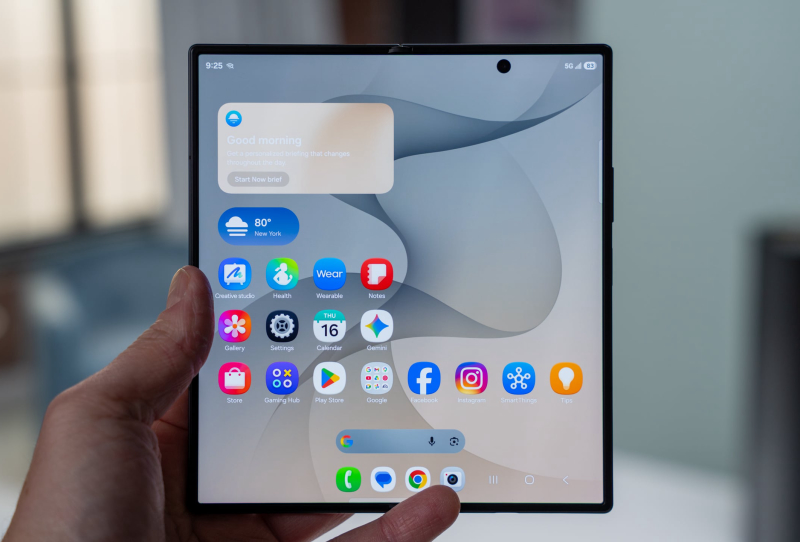
The Z Fold 8 Ultra’s defining feature is its dual-display setup, and Samsung has made meaningful gains on both screens this generation. The primary internal display is an 8.0-inch QXGA+ Dynamic AMOLED 2X panel with a resolution of 2,504 by 2,256 pixels, a modest sharpness bump over the Z Fold 7’s internal screen.
Displays
The cover display, used for quick tasks without unfolding the phone, is a 6.5-inch FHD+ Dynamic AMOLED 2X panel with a 2,520 by 1,080 pixel resolution. It’s sized and shaped closely enough to a conventional smartphone screen that switching between the two displays feels natural rather than jarring.
Both panels run at a 120Hz adaptive refresh rate, though only the internal display supports HDR10+ content, making it the better choice for streaming high dynamic range video. Peak brightness reaches 3,000 nits on both screens, a solid jump of 400 nits over the Z Fold 7’s maximum output, even though everyday viewing typically sits closer to 1,500 nits.
Samsung has also added an anti-reflective coating to the internal display this generation. It gives the panel a slightly more matte finish, though the difference is subtle rather than transformative, and fingerprints still build up quickly given how much of the surface gets touched during normal use.
The Flex Titanium structure mentioned earlier delivers a genuine, if modest, improvement to the crease: Samsung claims a 20 percent reduction in visibility, and that tracks with how the display looks in person. It hasn’t disappeared entirely, but it catches the eye far less than on earlier Z Fold generations.
Colour tuning on the internal display leans slightly warmer than some rival foldables, giving skin tones and video content a cosier look straight out of the box. Those who prefer a cooler, more neutral colour profile can adjust this in the display settings without much hassle.
Cameras and Chipset
Around the back, the Z Fold 8 Ultra houses a triple-camera system within a raised module, giving photographers flexibility across standard, wide, and telephoto perspectives. It’s the same reason the phone doesn’t sit perfectly flat when opened, but the trade-off is worthwhile given how much more versatile the camera setup becomes compared with single or dual-lens foldables.
Powering everything is Qualcomm’s 3nm Snapdragon 8 Elite Gen 5 for Galaxy, the same chipset found in Samsung’s latest Galaxy S26 range. It’s currently one of the most capable mobile processors available, and it’s paired with ample memory to keep Samsung’s multitasking-heavy software running smoothly.
Memory and Storage Options
The 256GB and 512GB storage configurations come standard with 12GB of RAM, which is plenty for everyday multitasking, split-screen apps, and Galaxy AI features. Buyers who want the largest 1TB storage tier can also step up to 16GB of RAM, a sensible option for anyone planning to lean heavily on multiple apps running simultaneously.
Beyond the raw hardware, Samsung’s software layer brings genuine value to the Ultra tier. Multi-window support, drag-and-drop file handling between apps, and Flex Mode for hands-free viewing all take advantage of the extra screen real estate in ways that a conventional phone simply can’t replicate.
Galaxy AI features are woven throughout the experience too, covering everything from note summarisation and live translation to photo editing tools that benefit from the larger canvas when reviewing and adjusting images. These aren’t exclusive to the Ultra model, but the bigger internal display makes them noticeably more pleasant to use.
Experience Using the Product and Performance
Everyday Usability and Ergonomics
Picking up the Z Fold 8 Ultra for the first time, the hinge action stands out immediately. It opens with a smooth, confident motion and holds firm at various angles, which makes propping the phone up for video calls or media playback effortless.
For quick tasks like checking notifications, replying to messages, or snapping a fast photo, the cover display works exactly as a conventional phone screen would, meaning there’s rarely a need to unfold the device unless a larger canvas is genuinely useful.
Unfolding the phone for more immersive tasks, such as reading long articles, editing documents, or browsing photos, reveals just how much extra space the internal display provides. Two-handed use feels natural given the width of the open display, while one-handed use of the cover screen remains just as easy as any standard smartphone.
The reduced crease is genuinely noticeable in daily handling, particularly under angled light where older Fold models would show a distinct shadow line. It hasn’t vanished, but it’s far less distracting than on previous Z Fold generations, and it should hold up well over months of regular folding.
Display Experience for Media and Multitasking
Streaming video on the internal display is a genuine highlight of owning this phone. The combination of HDR10+ support, high peak brightness, and the warmer colour tuning makes movies and shows look vibrant without appearing oversaturated.
Multitasking is where the Z Fold 8 Ultra really separates itself from a conventional smartphone. Running a messaging app alongside a browser, or a spreadsheet next to a notes app, feels natural thanks to the generous width of the unfolded display and Samsung’s mature multi-window software.
Flex Mode, which lets the phone sit half-open like a small laptop, comes in handy for video calls and hands-free video playback. Propping the phone on a desk in this configuration during a video call frees up both hands, which is a genuinely useful trick that rigid-body phones can’t offer.
Outdoor visibility benefits from the 3,000-nit peak brightness on both panels. Even on bright days, text and interface elements remain legible, and the difference compared with even brighter rival displays is barely perceptible once sunglasses are involved.
Benchmark Performance
Synthetic benchmarks back up the impression that this is Samsung’s fastest foldable yet. In Geekbench 6, the Z Fold 8 Ultra recorded a single-core score of 3,659 and a multi-core score of 10,739, comfortably ahead of the standard Z Fold 8’s 3,136 and 8,975 respectively.
Compared with last year’s Z Fold 7, which scored 3,024 single-core and 9,468 multi-core, the year-on-year gain is real but modest rather than dramatic. It’s the kind of improvement that shows up in benchmark charts more than in everyday snappiness.
Rival foldables trail behind on raw processing power. The Motorola Razr Fold, running an older Snapdragon 8 Gen 5 chipset, posted a single-core score around 2,617 and a multi-core score of 8,819, while the Pixel 10 Pro Fold and its Tensor G5 chipset landed at 2,320 and 6,288, putting it well behind the pack.
Graphics performance tells a similar story. The Z Fold 8 Ultra scored 6,221 points at 37.26fps in 3DMark’s Wild Life Extreme test, a result that translates directly into smoother frame rates for demanding games and graphically rich apps on the large internal display.
Gaming and Creative Workloads
Gaming on the unfolded display is a genuine treat given the extra screen real estate. Fast-paced titles benefit from the wider field of view, and the Snapdragon 8 Elite Gen 5 keeps frame rates consistent even during extended sessions.
Sustained performance holds up reasonably well too, with only mild warming noticeable during longer gaming stretches, and no dramatic throttling that would meaningfully impact frame rates over a typical play session.
For creative tasks, such as editing photos, sketching notes, or organising a large batch of images, the bigger canvas paired with the fast chipset makes the Ultra feel closer to a compact tablet than a phone, without sacrificing the pocketability of the cover display when folded.
Camera Performance in Daily Shooting
The triple rear camera system provides plenty of flexibility for everyday photography, letting users switch between wide, ultra-wide, and telephoto framing without needing to physically move closer or further from a subject.
One neat trick unique to foldables is using the larger internal display as a viewfinder while shooting selfies with the more capable rear cameras, folding the phone into a stand-like position to keep the shot steady. It’s a small feature, but one that consistently produces sharper results than a front-facing camera alone.
Low-light and video capture both benefit from the added processing headroom of the Snapdragon 8 Elite Gen 5, which handles noise reduction and stabilisation smoothly during handheld video recording.
Battery Life and Charging
Battery stamina is one of the quieter improvements this generation, with the Z Fold 8 Ultra comfortably lasting a full day of mixed use, including video streaming, multitasking, and camera use, without needing a midday top-up.
Wireless charging support adds convenience for anyone who prefers to place the phone on a charging pad overnight rather than fumbling with a cable, and wired charging via the USB-C port remains quick enough for a fast top-up before heading out.
Even under heavier workloads, such as extended gaming sessions or continuous video calls in Flex Mode, the battery holds up well, a clear sign that Samsung has tuned the software to make the most of the improved efficiency on offer.
Software Experience and AI Features
One UI feels tailor-made for this larger canvas, with app icons, widgets, and navigation gestures scaling intelligently between the cover and internal displays. Switching between the two never feels like using two different phones, which is a testament to how far Samsung’s foldable software has matured.
Galaxy AI tools are genuinely useful in daily life, whether that’s summarising a long email thread, translating a conversation in real time, or cleaning up a cluttered photo before sharing it. Having the extra screen space to review these AI-generated results makes the whole experience feel less cramped than on a standard smartphone.
Samsung’s long-term software support commitment also adds peace of mind for anyone considering this as a multi-year investment, ensuring the Z Fold 8 Ultra should keep receiving security patches and feature updates well beyond its first year of ownership.
How It Compares to Rivals
Against the standard Z Fold 8, the Ultra trades a slightly larger and heavier footprint for extra performance headroom, superior benchmark scores, and a marginally sharper display, making it the natural pick for anyone who prioritises raw capability over portability.
Against the Motorola Razr Fold and Pixel 10 Pro Fold, the Z Fold 8 Ultra holds a clear performance advantage thanks to its newer chipset, while offering a more balanced blend of display brightness, build quality, and camera versatility than either rival currently manages in a single package.
Conclusion
The Samsung Galaxy Z Fold 8 Ultra lands as the most technically accomplished foldable Samsung has ever produced. The faster Snapdragon 8 Elite Gen 5 chipset, brighter and sharper displays, and a noticeably flatter hinge thanks to the new Flex Titanium structure all combine to make this feel like a genuine flagship rather than an incremental refresh.
The improvements over the Z Fold 7 are real, even if some of them, like the crease reduction and resolution bump, are more evolutionary than revolutionary. What matters is that every individual upgrade nudges the experience forward, and together they add up to a foldable that feels faster, sturdier, and more refined in daily use.
Anyone who relies heavily on multitasking, content creation, or mobile gaming will appreciate the extra screen real estate and processing power this device brings to the table. The triple camera system and long-lasting battery only add to the case for treating this as a genuine productivity tool rather than just a novelty form factor.
For buyers who want the very best foldable Samsung currently makes, without compromising on performance, display quality, or build, the Z Fold 8 Ultra delivers convincingly across the board.