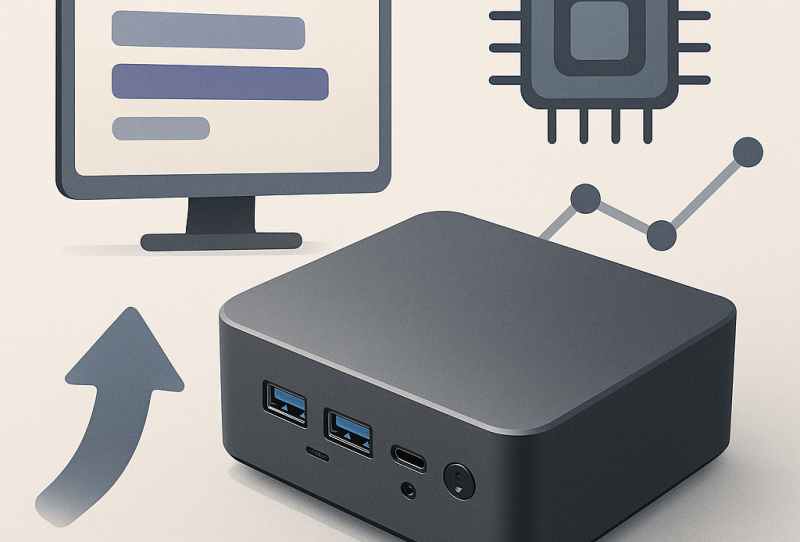
GMKtec has unveiled the EVO-X1 Pro, a mini PC that squeezes AMD’s Ryzen AI 9 HX 470 processor and its built-in Radeon 890M graphics into a compact chassis, while adding an OCuLink port that lets owners bolt on a full desktop graphics card down the track. It is a combination that pushes the mini PC category further into territory once reserved for full-size gaming towers.
Mini PCs have spent years chasing the balance between size and horsepower, and GMKtec has been one of the more aggressive brands closing that gap. The EVO-X1 Pro follows earlier EVO-X models from the company, but the pairing of a high-end mobile chip with an external GPU option marks a genuine step up rather than a minor refresh.
Table of Contents
What the GMKtec EVO-X1 Pro brings together
At the heart of the new machine sits the Ryzen AI 9 HX 470, part of AMD’s Ryzen AI 300 family built for demanding laptops and small-form-factor desktops. These chips pair strong CPU multitasking performance with a dedicated neural processing unit for on-device AI workloads, a feature increasingly expected in premium portable and compact hardware.
Graphics duties fall to the integrated Radeon 890M, one of the strongest built-in GPUs AMD currently offers. It has proven capable of handling modern games at modest settings and resolutions without any discrete card, which is exactly why it turns up in slim laptops as well as small-footprint desktops like this one. For everyday productivity, media editing, and light gaming, the Radeon 890M alone should cover plenty of ground.
What sets the EVO-X1 Pro apart from a typical mini PC, though, is the inclusion of an OCuLink port. That single addition changes what the machine is capable of long after the initial purchase.
Why the OCuLink port matters
OCuLink is a compact, high-bandwidth connector originally designed for enterprise storage before finding a second life among PC enthusiasts as a way to connect external graphics cards. Unlike Thunderbolt-based eGPU solutions, which can bottleneck a discrete card’s performance, OCuLink offers a more direct PCIe connection with less overhead.
In practice, that means an EVO-X1 Pro owner could eventually connect a desktop-class card, something in the vein of a discrete card like the ASUS Dual Radeon RX 7600, and get performance much closer to a full desktop build than a laptop-style eGPU enclosure would typically allow. For a mini PC this small, that is a significant capability to offer out of the box.
It also reflects a broader trend of manufacturers building flexibility into small-form-factor hardware, so buyers are not locked into whatever graphics performance ships in the box on day one. AMD’s own push to put capable graphics silicon into more devices, including AMD Radeon GPUs finding their way into other compact systems, shows how central graphics flexibility has become across very different product categories.
How it stacks up against previous mini PCs
GMKtec’s earlier EVO-X1 models relied purely on integrated graphics, which capped their appeal for anyone chasing serious gaming or GPU-accelerated workloads. Rival small-form-factor machines from other mini PC makers have generally followed the same pattern: strong CPUs, capable but limited integrated graphics, and no straightforward upgrade path.
The EVO-X1 Pro breaks from that formula by treating the OCuLink port as a built-in upgrade path rather than an afterthought. That is a meaningful differentiator in a market where most mini PCs are effectively locked to whatever graphics performance they ship with. It puts the EVO-X1 Pro in a smaller group of compact systems that can genuinely scale up over time rather than being replaced outright.
What buyers still don’t know
GMKtec has confirmed the processor, integrated graphics, and OCuLink connectivity, but has not yet detailed full specifications such as memory configurations, storage options, port layout beyond the OCuLink connector, or pricing and availability. Anyone weighing up the EVO-X1 Pro against existing mini PCs or small-form-factor builds will need to wait for those details before making a real comparison.
It is also worth remembering that OCuLink support does not include a graphics card in the box. Buyers keen on the upgrade path will need to source a compatible OCuLink enclosure or dock and a discrete GPU separately, adding to the overall outlay even if the base machine proves affordable.
Even with those gaps, the direction is clear. AMD’s Ryzen AI 300 series continues to give small-form-factor builders a genuine premium option, and GMKtec’s decision to add OCuLink shows mini PC makers are listening to enthusiasts who want more than a sealed box. Anyone tracking the category, or shopping GMKtec’s official site for upcoming listings, should keep an eye on how the EVO-X1 Pro is priced once full details land.