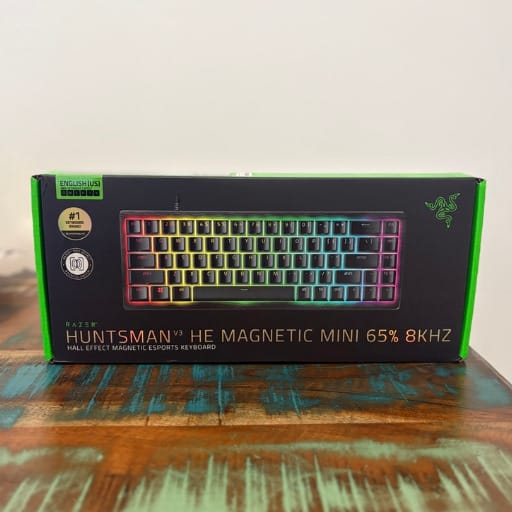
Razer has held onto optical switch technology for years, arguing it offered better accuracy than magnetic alternatives. That stance has finally shifted with the Razer Huntsman V3 HE, the company’s first keyboard built around Hall Effect magnetic switches, and the unit on the test bench here is the compact 65% layout rather than a larger tenkeyless or full-size frame. It arrives with adjustable actuation, Rapid Trigger, and an 8000Hz polling rate, all wrapped in a chassis designed for players who want speed without sacrificing desk space.
Review summary
Razer Huntsman V3 HE
The Razer Huntsman V3 HE brings Hall Effect magnetic switches to a compact 65% layout, pairing adjustable actuation and Rapid Trigger with 8000Hz polling for genuinely fast, tuneable performance. Build quality is solid throughout, with an aluminium top plate, factory-lubed switches and stabilisers, and sound-dampening foam contributing to a premium feel and quieter acoustics. It suits competitive players wanting portability and precision without stepping up to a full-size board.
Highlights
- ✓Hall Effect switches with 0.1mm–4.0mm adjustable actuation
- ✓Rapid Trigger, Snap Tap and Snap Flex for competitive responsiveness
- ✓8000Hz polling with around 0.60ms latency
- ✓Durable aluminium chassis with factory-lubed switches and stabilisers
- ✓Compact, portable 65% layout with two-year warranty
Magnetic switches have become one of the biggest trends in gaming keyboards over the past couple of years, and Razer’s decision to enter that space says a lot about where competitive demand has landed. Rather than reinventing the wheel with screens, dials, or unusual layouts, Razer has kept the Huntsman V3 HE straightforward, focusing entirely on switch performance, tuning flexibility, and build quality.
This review covers how the 65% Huntsman V3 HE feels to type and game on, how its Hall Effect switches and companion software hold up during extended sessions, and whether the compact form factor makes sense for players chasing both competitive advantage and a tidier desk setup.
Table of Contents
Design and Functionality
The 65% layout strips away the numpad and dedicated function row found on larger boards, leaving a compact footprint that still keeps arrow keys and a handful of navigation keys intact. This suits players who want more room for wide mouse swipes without giving up the keys competitive titles rely on most.
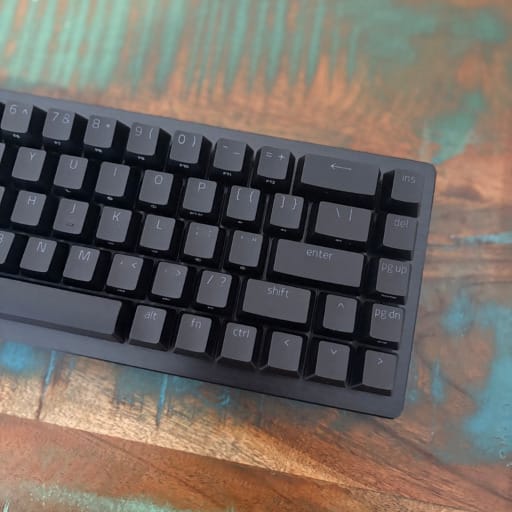
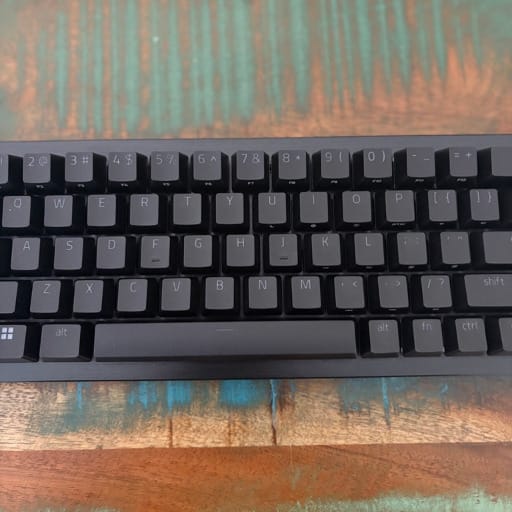
Razer has built the top plate from aircraft-grade aluminium, finished in the brand’s familiar black brushed style. It gives the keyboard a reassuring density in hand and helps the chassis resist warping under the kind of frequent, intense use competitive players put their gear through.
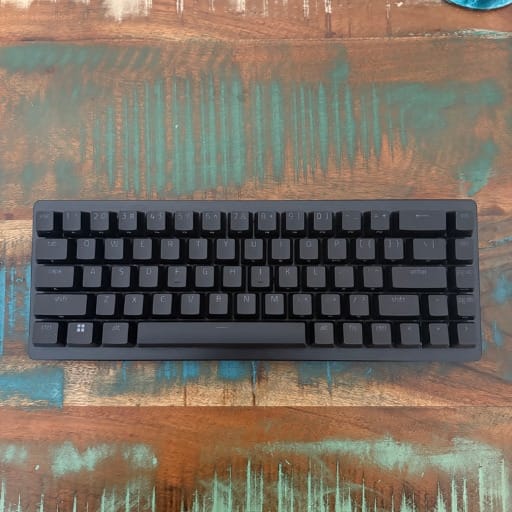
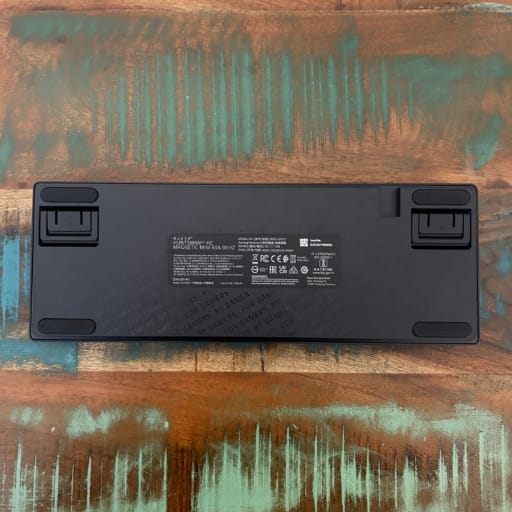
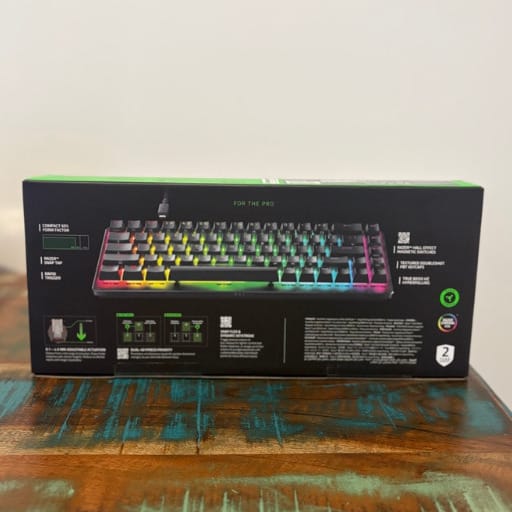
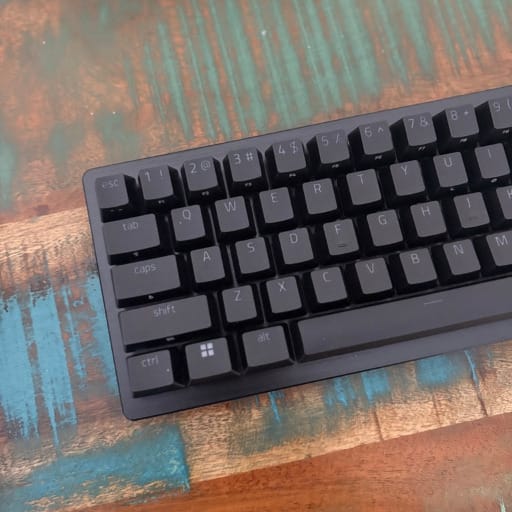
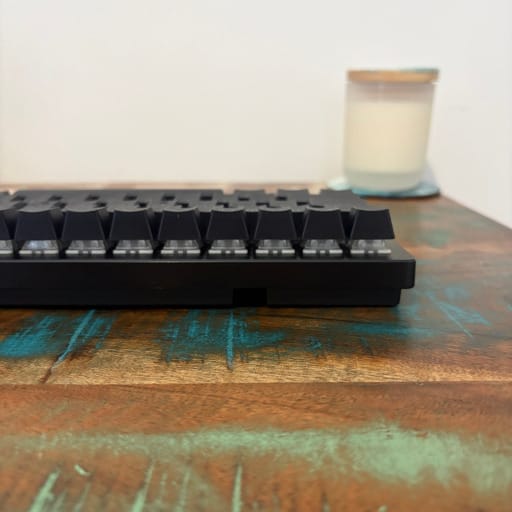
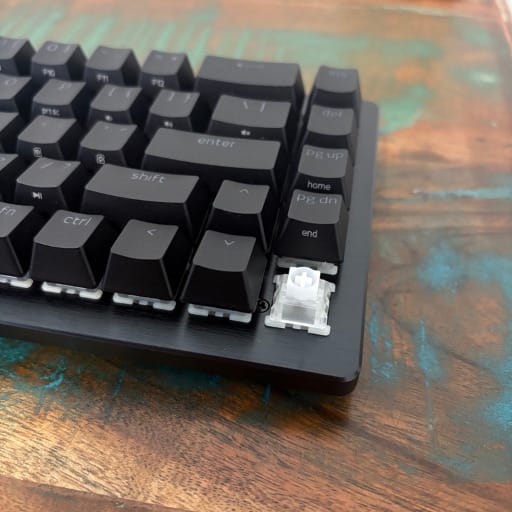
Underneath that aluminium plate sits a plastic bottom shell, assembled using a tray-mount system rather than a gasket-mounted design. The two halves are held together with screws rather than fragile plastic clips, which makes the whole unit feel more dependable during transport or disassembly.
Inside the case, a main circuit board screws directly into the metal plate, while a secondary daughterboard is fitted into the bottom shell. A ribbon cable and a small connector link the two boards together, a layout that keeps signal paths short and tidy.
Sound-dampening foam has been layered both between the plate and the main PCB and inside the bottom shell itself. This foam is there to control the acoustic profile of the switches and reduce the hollow resonance that can plague cheaper mechanical boards.
Keycaps on the Huntsman V3 HE use a shine-resistant coating paired with fadeproof legends, both aimed at keeping the board looking sharp after months of daily typing and gaming. Razer pitches this as offering a level of durability beyond regular keycaps, which matters for anyone who spends hours a day on the board.
Stabilizers on the larger keys, including the spacebar, shift and enter, are factory lubricated to cut down on the rattle that often shows up on longer keys. This attention to stabilizer quality is a detail that’s easy to overlook until it’s missing.
The compact 65% shape also makes the Huntsman V3 HE genuinely portable, an important factor for anyone planning to bring their own board to a LAN event or offline tournament. Less bulk means less to carry, and a smaller footprint means it slots into more bag configurations without a fuss.
Because the switches use magnetic sensing rather than a physical circuit path, Razer has engineered the board around a 100-million keystroke lifespan per switch. That’s a meaningful jump in longevity compared with many traditional mechanical switches, and it speaks to how the Hall Effect design reduces mechanical wear over time.
Razer Synapse handles the software side of the experience, and the interface has been built specifically to expose the extra tuning options that Hall Effect switches make possible. Actuation points, Rapid Trigger behaviour, and per-key profiles are all managed from within the same application Razer uses across its other peripherals.
The board connects over a detachable cable, keeping the compact footprint tidy on the desk and making cable replacement straightforward if it’s ever needed. This is a small thing, but it matters for anyone who likes to keep their setup neat or who travels with their gear.
Weight distribution across the chassis feels even, and the compact size means the board doesn’t shift around much during fast-paced sessions. A firm footprint matters just as much as switch feel when players are making rapid, repeated inputs under pressure.
Legends on the keycaps follow a standard layout, though Razer notes that keymapping legends can differ slightly depending on regional keyboard layout. This is a minor detail but worth knowing for anyone ordering based on a specific look.
The overall industrial design leans utilitarian rather than flashy, with per-key RGB lighting providing the visual flair rather than any unusual chassis shapes or add-ons. It’s a design philosophy that puts function first without feeling plain.
Build tolerances feel tight throughout the unit, with no obvious gaps between the top plate and bottom shell. That kind of fit and finish reinforces the sense that this is a keyboard built to survive rough handling rather than just look good sitting on a desk.
Taken together, the design leans into everything Razer has learned from its optical keyboard lineup while adapting the internals for magnetic switch technology. The 65% Huntsman V3 HE reads as a considered first step into Hall Effect switches rather than a rushed release.
Key Features
At the centre of the Huntsman V3 HE are Razer’s own Hall Effect Magnetic Switches, which use contactless magnetic sensing rather than a physical metal contact to register a keypress. This approach removes the wear point found in traditional switches and opens the door to a much wider range of actuation tuning.
Actuation distance can be adjusted anywhere from 0.1mm to a full 4.0mm, giving players an enormous range to dial in depending on their playstyle. Someone chasing the fastest possible inputs can push the actuation point right down, while someone who prefers a firmer, more deliberate press can extend it out.
Rapid Trigger mode is one of the headline additions, letting each key reset the instant it moves upward rather than waiting for a fixed reset point. In practice, this allows for faster repeated keystrokes than a standard mechanical switch can manage, which becomes noticeable in games that reward rapid counter-inputs.
Razer’s Snap Flex feature works alongside Rapid Trigger by triggering precise actions at the point of key release rather than just on press. It ships switched off by default, and needs to be turned on manually through Razer Synapse for anyone who wants that release-based precision.
Snap Tap, meanwhile, prioritises the most recent input between two assigned keys without requiring the previous key to be released first. This is particularly useful for movement keys, since it allows near-instant directional changes rather than the small delay that can come from waiting on a key release.
Dual-stage actuation lets a single key trigger two different actions, one when pressed and another when released, opening up extra input combinations without needing extra keys. It’s a feature aimed squarely at players who want to squeeze more functionality out of a compact layout.
Beyond dual-stage input, the Huntsman V3 HE supports up to four distinct actions at different keypress depths on a single switch, with the ability to cancel instantly between them. This kind of layered actuation gives the board a level of adaptability that fixed mechanical switches simply can’t match.
Dual-Keypress Priority is built specifically around WASD handling, letting the board register instant input from simultaneous keypresses as soon as one of the paired keys is released. This is designed to smooth out the kind of split-second directional switching that competitive shooters demand.
The standout performance figure is the 8000Hz HyperPolling Technology, communicating with a connected PC eight times more often per second than the 1000Hz standard still common across most peripherals. Razer’s own testing found this combination of Hall Effect switches and 8000Hz polling to be measurably faster than the nearest competitor at matched settings.
That translates into a latency figure of around 0.60 milliseconds from switch actuation to signal reaching the USB port, based on Razer’s testing across 20 measurements per keyboard. It’s a small number on paper, but in fast, split-second exchanges it can be the difference between landing a play and missing it.
Each switch is individually lubricated at the factory, aimed at keeping actuation smooth and consistent across the entire layout. Combined with the dense foam layer beneath the switches, this is also part of how Razer keeps the acoustic signature relatively muted rather than harsh.
Switch lifespan is rated at 100 million keystrokes, a considerable jump over the wear limits typically quoted for standard mechanical switches. For anyone gaming or typing heavily every day, that longevity figure adds real peace of mind over the life of the board.
Razer Synapse ties all of these features together, giving users a single place to set actuation points, toggle Rapid Trigger and Snap Flex, assign Snap Tap key pairs, and build out multi-action profiles. Profiles can be swapped depending on the game or task at hand, which suits players who jump between different titles and genres.
Razer backs the Huntsman V3 HE with up to two years of warranty coverage alongside access to its support channels, giving buyers a reasonable safety net for a keyboard built around fairly new switch technology. That kind of backing matters given how much of the appeal here rests on tuning options that are still relatively fresh to the market.
Experience Using the Product and Performance
Typing on the Huntsman V3 HE at its factory-set actuation point feels smooth and largely consistent across the layout, with the Hall Effect switches offering a clean glide from top to bottom. Most keys share a similar feel, though the tray-mount design means keys closer to the internal support posts feel marginally firmer than those further away.
That variance is subtle rather than distracting, and it’s the kind of thing only noticed when specifically hunting for it rather than something that disrupts regular typing or gaming sessions. It’s worth mentioning mainly because it’s a natural side effect of the tray-mount construction rather than a flaw unique to this unit.
Each switch uses a 40-gram spring, putting the actuation force in a similar bracket to a standard linear mechanical switch. That weight strikes a sensible middle ground, light enough for quick repeated presses but with enough resistance to avoid feeling mushy or accidental.
Dropping the actuation point down toward the lower end of the 0.1mm to 4.0mm range dramatically changes how the board feels in fast-paced games. Inputs register almost the instant a key is touched, which takes a short adjustment period but quickly starts to feel like a genuine competitive edge in twitchy shooters.
Rapid Trigger is where the Hall Effect design really shows its value during actual play. Because each key resets the moment it starts moving upward rather than at a fixed point, rapid taps and counter-strafing style movements land noticeably quicker than they do on a standard switch.
Switching Snap Flex on through Razer Synapse adds another layer to that responsiveness by triggering actions right at the point of release. It takes some practice to build muscle memory around, but for players used to tuning their gear down to the millisecond, it’s a welcome extra dial to play with.
Snap Tap makes the biggest difference on movement keys, letting a new directional input take priority instantly without waiting for the previous key to lift. Strafing and quick direction changes feel noticeably tighter once this is configured, particularly in fast shooters where movement timing matters as much as aim.
The 8000Hz polling rate is the kind of feature that’s hard to feel directly but easy to appreciate once explained. Because the keyboard checks in with the PC eight times more often per second than a standard board, the chances of a keypress slipping through the gaps between updates drop substantially.
In objective terms, that means fewer of the frustrating dropped inputs that occasionally show up on lower polling rate boards during high-intensity moments. It functions less like a raw performance boost and more like an insurance policy against mis-timed presses.
Sound-wise, the board sits in a satisfying middle ground, with a clean, fairly full tone rather than anything hollow or rattly. There’s a touch more depth on some of the outer keys, but nothing that stands out as an obvious inconsistency during normal use.
The spacebar carries a noticeably deeper thump than the rest of the board, a byproduct of the internal foam strips designed to prevent hollow resonance on such a large key. It doesn’t detract from the typing experience, but it is the most distinct acoustic difference across the whole layout.
Stabilizers under the spacebar and other larger keys stay smooth and rattle-free throughout testing, with no wobble or looseness creeping in even during longer sessions. That kind of consistency across the stabilized keys reflects well on Razer’s factory lubrication process.
Gaming performance across competitive shooters benefits most obviously from the combination of Rapid Trigger and adjustable actuation, since both features reward players who can fine-tune their setup around specific movement or aim techniques. Fast peeking, counter-strafing, and quick direction reversals all feel sharper once the actuation point is tuned to suit.
In slower-paced or more methodical titles, the extra sensitivity is less critical, but the board never feels like it’s working against the player either. Typing during downtime, whether that’s chat, notes, or general desktop use, remains comfortable thanks to the 40-gram springs and consistent switch feel.
Razer Synapse handles profile management smoothly, letting different actuation settings and Rapid Trigger configurations be saved and swapped depending on the game being played. Setting up a profile takes only a few minutes once the relevant sliders and toggles are understood.
Per-key actuation adjustment inside Synapse is a genuinely useful touch, letting players set movement keys to a lower actuation point for speed while leaving less frequently used keys at a higher point to avoid accidental presses. That flexibility is one of the clearer practical advantages Hall Effect switches have over fixed mechanical alternatives.
Dual-stage actuation, which allows a single key to fire two separate actions on press and release, adds genuine utility for anyone who wants extra functionality without needing more keys. It’s a feature that takes some setup time in software but pays off for players building out complex keybind layouts.
The multi-action support, capable of triggering up to four actions at different keypress depths, goes even further, though it’s a feature that suits advanced users more than everyday players. Setting it up requires some patience, but the payoff is a level of input control that few other keyboards on the market currently offer.
Compared with Razer’s optical-switch Huntsman V3 Pro TKL, the jump to Hall Effect switches brings a noticeably different feel underhand, with a smoother, more linear glide and far greater actuation flexibility. The optical board still has its strengths, but the tuning range on offer here is simply broader.
Against rival magnetic boards, including Attack Shark’s own take on magnetic switches, the Huntsman V3 HE holds its own on polling rate and software depth, even if the wider Hall Effect category is still maturing across multiple brands. It’s clear the whole segment is moving quickly, with new entrants regularly pushing actuation ranges and polling figures further.
The broader shift toward magnetic switches across the market, seen in boards like Keychron’s magnetic switch boards, suggests Hall Effect technology is quickly becoming a mainstream expectation rather than a niche feature. Razer’s entry into that space carries extra weight given how much influence the brand has across competitive gaming peripherals.
Pairing the keyboard with a lightweight gaming mouse such as Razer’s Viper V4 Pro mouse highlights how well the compact 65% layout works in practice, with plenty of extra desk space freed up for wide swipes at lower sensitivity settings. The smaller footprint genuinely changes how much room is available during fast tracking movements.
Extended sessions across several hours don’t introduce any noticeable fatigue beyond what’s typical for any mechanical-style keyboard, and the spring weight strikes a reasonable balance for both gaming and general typing. Wrists rest comfortably at the compact height of the chassis without needing an additional wrist rest accessory.
The detachable cable makes it simple to swap in a replacement if it’s ever damaged, and the connection stays stable throughout testing with no dropped signal or unexpected disconnects. That reliability matters more than it might seem, since even a brief disconnection during competitive play can be costly.
RGB lighting customisation through Synapse is straightforward, with per-key control available for anyone who wants to build custom lighting profiles or simply match a broader setup. It’s a feature that doesn’t affect performance, but it rounds out the overall package nicely for anyone who cares about aesthetics.
Portability continues to be one of the strongest practical advantages of the 65% layout, and packing the board for a LAN event or a trip to a friend’s setup is noticeably easier than it would be with a full-size board. The smaller size doesn’t feel like a compromise once the layout becomes familiar.
Switch durability, backed by that 100-million keystroke rating, should translate into a long service life even for players who spend hours gaming daily. It’s difficult to fully verify a rating like that within a review period, but the contactless magnetic design gives good reason to expect strong long-term reliability.
The support for third-party monitoring tools and Razer’s own diagnostic features inside Synapse gives players a way to double check actuation settings are behaving as expected, which is a handy safety net given how much customisation the board supports. It adds a layer of confidence for players relying on very low actuation points.
Across everything from casual typing to fast-paced competitive matches, the Huntsman V3 HE consistently delivers on the promise of magnetic switch flexibility without feeling like an unfinished first attempt. Razer has clearly leaned on its experience building optical switches to inform how this Hall Effect lineup has come together.
For players who value tuning depth as much as raw speed, the combination of adjustable actuation, Rapid Trigger, Snap Tap, and 8000Hz polling gives the Huntsman V3 HE a genuinely competitive feature set within the current Hall Effect keyboard market.
Conclusion
The Razer Huntsman V3 HE lands as a strong first step into Hall Effect switch technology, backing up its magnetic switches with genuinely useful tuning features like Rapid Trigger, Snap Tap, and per-key actuation control. The 65% layout adds real practical value too, freeing up desk space without sacrificing the keys competitive players lean on most.
Build quality across the aluminium top plate, tray-mount internals, and factory-lubricated stabilizers gives the board a sturdy, dependable feel that should hold up well through daily competitive use. The 8000Hz polling rate and sub-millisecond latency figures back up Razer’s positioning of this board as a genuine performance tool rather than just a marketing checkbox.
Razer Synapse ties the whole package together, giving players deep control over actuation points, dual-stage actions, and lighting without making the setup process feel overly complicated. That balance of depth and usability is exactly what a first Hall Effect release from a major brand needs to get right.
Anyone considering a move into magnetic switch keyboards, or simply looking to upgrade from an older mechanical board, will find plenty to like in the Razer Huntsman V3 HE, particularly in its compact 65% form. It’s a considered, well-built entry into a fast-growing category, and one that gives Razer a genuinely competitive foothold in the Hall Effect space.