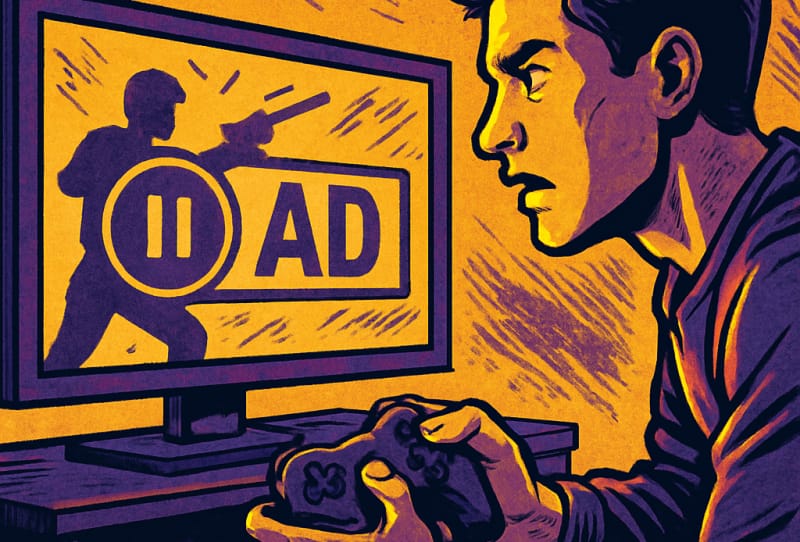
A newly surfaced Microsoft in-game ad patent describes a system that pauses a game mid-session to serve an advertisement, then rewards players with extra ad-free playtime for watching it through to the end. The filing, spotted by Respawn First, lays out a method for weaving ads into free-to-play games without the jarring interruptions that usually come with them.
Rather than firing off ads at random moments, the system Microsoft describes ties into the game engine itself. It waits for a natural break, then locks the game in a frozen state while the ad plays. Once the viewer finishes watching, the game hands back a fresh stretch of ad-free time before the cycle starts again.
Table of Contents
How the Microsoft In-Game Ad Patent Works
According to the application filed with the United States Patent and Trademark Office, the system starts every session with a block of guaranteed ad-free play. That window can be measured in minutes or tied to progress markers, such as clearing a level or defeating a boss.
Once that allowance runs out, the software looks for what the patent calls a “promoted content trigger event.” Instead of interrupting active combat or a critical moment, it waits for downtime that already exists in most games, including:
- The moment right after a boss fight ends
- The tail end of a cutscene
- A loading screen between levels
- The completion of a quest or mission
- The instant a player opens a pause or inventory menu
When one of those moments arrives, the game suspends the player’s interaction, plays the promoted audiovisual content, and only resumes once the ad has finished. Microsoft’s filing notes that machine learning helps decide exactly when to trigger the ad, presumably weighing factors like player behaviour and how the game is structured to pick a moment that feels least disruptive.

A Familiar Model, Built for a Different Audience
The mechanics described in the patent will feel familiar to anyone who has played an ad-supported mobile game. Titles in that category routinely show a short video after a round ends or once a timer runs out, often letting players skip the wait entirely by watching one. Microsoft’s version follows the same basic trade, playtime for attention, but ties the trigger to specific engine events rather than a blunt countdown clock.
That distinction matters because console and PC audiences have historically been far less tolerant of interruptive advertising than mobile players. A system that only appears during genuine lulls, rather than cutting off a player mid-jump or mid-conversation, is a much easier sell to a Xbox or PC crowd that has spent years avoiding ad-laden free-to-play titles.
It also lines up with moves Microsoft has already made elsewhere. The company has been testing an ad-supported free tier for Xbox Cloud Gaming, suggesting this patent isn’t an isolated idea but part of a broader push to find sustainable ways to offer games without an upfront cost.

What This Could Mean for Free-to-Play Gaming
It’s worth stressing that this remains a patent application, not a confirmed feature. Microsoft has not said whether the system has been built into any shipping game, and patents from major tech companies frequently describe ideas that never make it past the filing stage.
Still, the direction it points to is worth watching. A well-implemented version of this system could make ad breaks feel less like punishment and more like a fair exchange, especially for players who would rather sit through a short ad than pay for a game outright. Anyone downloading and installing free-to-play titles through Steam or picking up new releases while downloading games on a console already deals with some form of monetisation, whether that’s microtransactions, battle passes, or ads.
The flip side is the concern raised by critics of the free-to-play boom more broadly. When monetisation becomes the primary design consideration, some argue it pulls development focus away from originality and toward systems built to maximise engagement and ad views. A smarter ad-delivery system doesn’t resolve that tension, it just makes the ads themselves less annoying, which could quietly encourage more publishers to lean further into the free-to-play model rather than pull back from it.
For now, the Microsoft in-game ad patent is a glimpse at where the company’s thinking is headed rather than a feature players will see any time soon. Whether it ever reaches a real game, on Xbox, PC, or elsewhere, will depend on how Microsoft weighs the benefits of less intrusive ads against the broader criticism aimed at ad-driven free-to-play design. Players who want to keep games running smoothly and free of unwanted stutters, whether from ads or otherwise, can still take steps to keep gameplay running smoothly on their own systems in the meantime.