CD Projekt Red has published the full Witcher 3 Remastered PC requirements, breaking down exactly what hardware is needed across six distinct performance tiers ahead of tomorrow’s launch. The Witcher 3: Wild Hunt Remastered arrives on September 29 as a free upgrade for anyone who already owns the base game, and the newly released specs sheet finally answers questions that only a partial minimum and recommended listing had covered until now.
Key takeaways
- ✓The Witcher 3 Wild Hunt Remastered launches September 29 as a free upgrade for existing owners.
- ✓CD Projekt Red has published six PC requirement tiers, including new Ray Tracing and Path Tracing categories.
- ✓Minimum specs call for a Core i5-8400 or Ryzen 5 2600, 12GB RAM, and a GTX 1660.
- ✓Ultra settings at 1440p need a Core i7-13700K or Ryzen 7 7700X, 24GB RAM, and an RTX 3070 Ti.
- ✓Intel Arc graphics cards, including the A580 and B580, are officially supported across multiple tiers.
Previously, CD Projekt Red had only confirmed bare-bones minimum and recommended specifications, leaving plenty of unanswered questions about what it would take to run the remaster with ray tracing or the far more demanding path tracing mode switched on. The newly detailed breakdown fills that gap, giving PC players a clear picture of what to expect at every settings tier, from a modest 1080p experience right up to full path-traced lighting.
Table of Contents
What the six Witcher 3 Remastered PC requirements tiers cover
The updated specifications sheet splits requirements into six categories: Minimum, Recommended, Ultra, RT Minimum, RT Recommended, and Path Tracing. That is a notably more granular approach than the two-tier system most developers still rely on, and it reflects how much visual headroom the remaster has compared with the original 2015 release.
The first three tiers, which don’t involve ray tracing, come with fully detailed CPU, RAM, and GPU figures. Minimum targets 1080p resolution at 30 frames per second on the Low preset, asking for a Core i5-8400 or Ryzen 5 2600 processor, 12GB of RAM, and a GTX 1660, RX 5500 XT, or Arc A580 graphics card. CD Projekt Red notes that the GTX 1660 is actually capable of pushing past that baseline, reaching 60 frames per second or higher even at this entry-level tier.
Recommended settings step things up to 1080p at a steady 60 frames per second on the High preset. That calls for a Core i7-8700K or Ryzen 5 3600X, 16GB of RAM, and one of an RTX 2060 Super, RX 6600 XT, or Arc B580. Anyone chasing the Ultra tier, which runs at 1440p and 60 frames per second, will need considerably newer silicon: a Core i7-13700K or Ryzen 7 7700X, 24GB of RAM, and either an RTX 3070 Ti, RX 6800 XT, or an Arc B580 paired with Intel’s XeSS upscaling.
Ray tracing and path tracing push requirements further
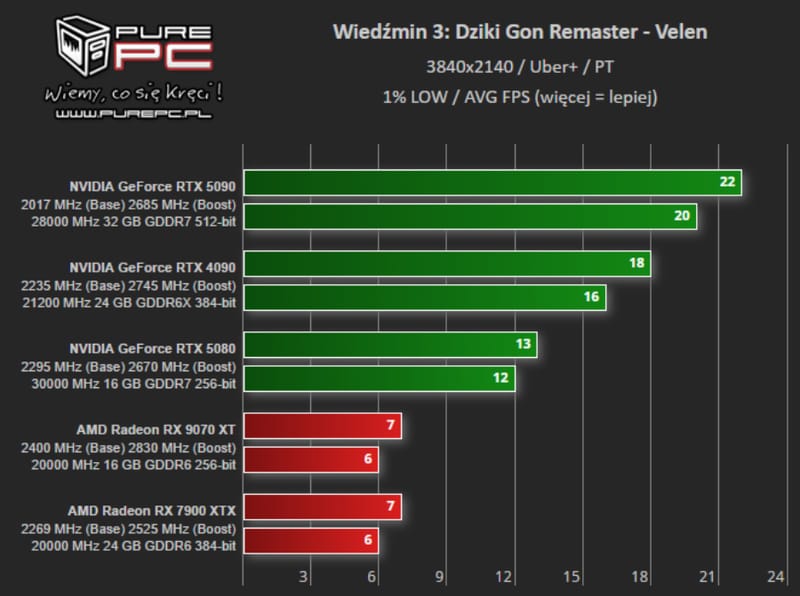
The remaining three tiers, RT Minimum, RT Recommended, and Path Tracing, exist specifically for players who want real-time ray-traced lighting or the full path tracing implementation the remaster supports. CD Projekt Red has confirmed these tiers as separate categories in the requirements sheet, acknowledging that ray-traced reflections and global illumination demand meaningfully more graphics horsepower than the rasterised Ultra tier above them.
That distinction matters because ray tracing and path tracing are computationally intensive in very different ways. Ray tracing calculates how light bounces off individual surfaces in real time, while path tracing goes further still, simulating full light transport throughout a scene. Both modes lean heavily on dedicated ray tracing hardware, which is why CD Projekt Red separated them from the standard preset tiers rather than folding them into Ultra.
For players without a recent RTX, Radeon RX 7000-series, or Arc B-series card, sticking to the non-ray-traced tiers will remain the more realistic path to a smooth frame rate, at least until frame generation and upscaling technology closes more of that performance gap.

Confirmed Witcher 3 Remastered PC requirements at a glance
| Tier | Target | CPU | RAM | GPU |
|---|---|---|---|---|
| Minimum | 1080p, 30 FPS, Low | Core i5-8400 / Ryzen 5 2600 | 12GB | GTX 1660 / RX 5500 XT / Arc A580 |
| Recommended | 1080p, 60 FPS, High | Core i7-8700K / Ryzen 5 3600X | 16GB | RTX 2060 Super / RX 6600 XT / Arc B580 |
| Ultra | 1440p, 60 FPS | Core i7-13700K / Ryzen 7 7700X | 24GB | RTX 3070 Ti / RX 6800 XT / Arc B580 (XeSS) |
Notably, Intel’s Arc lineup appears across every listed tier, a sign of how far Intel’s graphics drivers and hardware support have matured since the Arc A-series first launched. Both the older A580 and the newer B580 get official billing alongside long-established NVIDIA and AMD options, which is a solid vote of confidence for budget-focused Arc buyers.
What this means for existing Witcher 3 owners
Because the remaster is a free upgrade rather than a standalone purchase, the jump in hardware demands is likely to catch some long-time players off guard. The original Witcher 3 ran comfortably on far more modest hardware back in 2015, so anyone still using an older rig built around that era’s mid-range parts may need a meaningful GPU upgrade to hit even the Recommended tier.
That said, the tiered approach gives players plenty of flexibility. Someone with an ageing system can still expect a playable 1080p experience at Minimum settings, while enthusiasts with recent high-end builds finally have a clear target for enabling path tracing without guessing at compatibility. Given how demanding CD Projekt Red’s own Unreal Engine 5-powered Witcher 4 is shaping up to be, this remaster also doubles as a useful preview of the kind of hardware scaling the studio expects players to have going forward.
The timing lines up with a broader trend of major PC releases publishing far more granular requirement breakdowns than the traditional two-tier system, similar to how Fable’s recently revealed PC requirements spelled out separate targets for different resolutions. For players weighing a GPU upgrade specifically to hit the Ultra or ray tracing tiers, getting familiar with overclocking a gaming GPU safely could squeeze out a bit of extra headroom without needing to buy new hardware outright.
Frequently asked questions
When does The Witcher 3 Wild Hunt Remastered launch?
The remaster launches on September 29 and is available as a free upgrade for anyone who already owns The Witcher 3: Wild Hunt on PC.
What GPU do I need for Ultra settings in the remaster?
Ultra settings at 1440p and 60 frames per second call for an RTX 3070 Ti, RX 6800 XT, or an Arc B580 running Intel’s XeSS upscaling, paired with a Core i7-13700K or Ryzen 7 7700X and 24GB of RAM.
Do I need a ray tracing capable GPU to play the remaster?
No. The Minimum, Recommended, and Ultra tiers all run without ray tracing enabled. RT Minimum, RT Recommended, and Path Tracing are separate, optional tiers for players who specifically want ray-traced or path-traced lighting.
Are Intel Arc graphics cards supported?
Yes. CD Projekt Red lists Intel Arc GPUs, including the A580 and B580, as officially supported options across multiple requirement tiers alongside NVIDIA and AMD hardware.