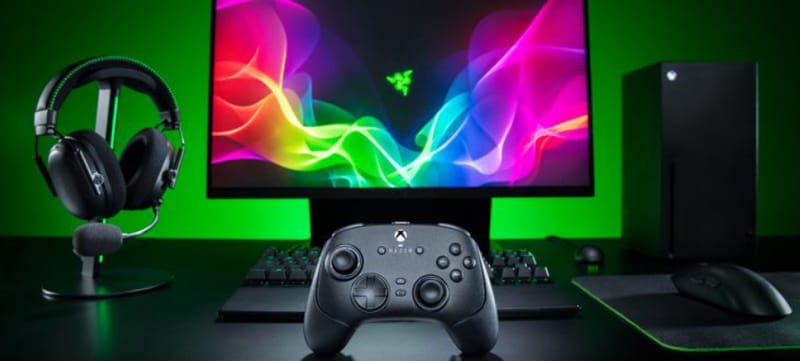
Razer Wolverine V4 Pro headlines a new two-model controller lineup the company has launched for Xbox and PC, built around capacitive thumbstick sensors and a polling rate of up to 8000Hz. Alongside the wireless Pro sits the wired Wolverine V4 Tournament Edition, a cheaper variant aimed at the same competitive crowd but without the premium model’s wireless connectivity and deeper customisation options.
Key takeaways
- ✓Razer's Wolverine V4 lineup includes the wireless Pro model and the wired Tournament Edition for Xbox and PC
- ✓Both controllers use capacitive thumbstick sensors paired with a 16-bit ADC chip for roughly 3000 steps of movement
- ✓PC connections support up to 8000Hz HyperPolling with sub-1ms response, while Xbox runs at up to 250Hz
- ✓Pro HyperTriggers allow actuation points to be adjusted from 1.3mm to 8.2mm via Razer Synapse
- ✓The Pro model adds swappable thumbstick caps and a removable faceplate for deeper customisation
Both controllers are pitched squarely at esports players and anyone chasing an edge in fast-paced shooters or fighting games. Razer has leaned heavily on sensor technology and input latency for this generation, arguing that the changes matter more in ranked matches than flashy cosmetic upgrades ever could.
Table of Contents
What’s new in the Razer Wolverine V4 Pro lineup
The headline change is the move to contactless capacitive sensors on the asymmetrical thumbsticks, paired with a 16-bit analogue-to-digital converter chip. Razer says this combination tracks roughly 3000 steps of stick movement, a notable jump in resolution over typical pad hardware. The company claims capacitive sensing resists magnetic interference better than Hall Effect or TMR sensors, two technologies that have become common in rival pads precisely because they solve stick drift.
Whether capacitive sensing proves as durable in the real world remains to be seen, since Hall Effect and TMR earned their reputation specifically by eliminating the wear-related drift that plagued older potentiometer sticks. Razer’s pitch is that capacitive sensors deliver similar drift resistance while reading finer movement, effectively trying to have it both ways.
Polling rates and connectivity explained
On PC, both the wired and wireless connections of the Wolverine V4 Pro support Razer’s HyperPolling technology at up to 8000Hz, with the company citing sub-1ms response times as a result. That figure sits well above the 1000Hz polling most controllers and even many gaming mice still ship with, though the practical benefit depends on whether a game engine and monitor refresh rate can actually take advantage of it.
Connect either controller to an Xbox Series X or Series S instead, and the ceiling drops to 250Hz, a limit set by the console’s own input pipeline rather than anything Razer can change. It is a useful reminder that headline performance numbers on these controllers are platform dependent, and PC players stand to get noticeably more out of the hardware than console players will.
Triggers, back buttons and customisation
Both models carry six mappable action buttons: four magnetic, removable back buttons plus two claw-grip bumpers positioned for players who rest their fingers on the triggers rather than the face buttons. Razer’s Pro HyperTriggers feature lets players switch between instant digital actuation and a full analogue pull, with the actuation point itself adjustable anywhere from 1.3mm to 8.2mm through the Razer Synapse software.
Build quality details carry across both controllers, including textured TPU side grips, PBT mecha-tactile face buttons, and an eight-way floating D-pad designed for cleaner diagonal inputs in fighting games. Four onboard memory profiles store custom button mappings, trigger settings and dead zones, which can be set anywhere between 0 percent and 15 percent depending on how twitchy a player wants their sticks to feel.
The Wolverine V4 Pro pulls ahead of the Tournament Edition on physical customisation, adding swappable thumbstick caps and a removable faceplate so owners can adjust stick height and grip feel or simply change the pad’s look. The Tournament Edition skips those options and its wireless mode, keeping things simpler and wired-only for players who prioritise a direct connection above all else.
How the Wolverine V4 compares
The new lineup replaces its predecessor, its predecessor, the Wolverine V3 Pro 8K, which already offered high polling rates but relied on more conventional stick sensors. The jump to capacitive sensing and a dedicated ADC chip is the clearest generational leap, alongside the expanded back-button customisation.
Against Microsoft’s own Xbox Elite controllers and Sony’s DualSense Edge, Razer’s pitch is speed and sensor precision rather than battery life or exclusive software ecosystems. Players who already own Razer’s compact Prio controller will recognise the brand’s broader push toward specialised, competition-focused hardware rather than one all-purpose pad.
| Feature | Wolverine V4 Pro | Wolverine V4 Tournament Edition |
|---|---|---|
| Connectivity | Wired and wireless | Wired only |
| PC polling rate | Up to 8000Hz | Up to 8000Hz |
| Xbox polling rate | Up to 250Hz | Up to 250Hz |
| Thumbstick sensors | Capacitive, 16-bit ADC | Capacitive, 16-bit ADC |
| Swappable thumbstick caps/faceplate | Yes | No |
| Back buttons | 4 magnetic, removable | 4 magnetic, removable |
What it means for Xbox and PC players
For PC players, the practical draw is the sensor upgrade and the extreme polling ceiling, assuming games and peripherals downstream can make use of it. Xbox owners get the same sensor benefits without the full polling advantage, since the console caps input rate regardless of what the controller is capable of. Anyone setting one up on PC for the first time may want to check a guide on fine-tuning controller settings on PC to get the most out of adjustable dead zones and trigger actuation points.
Buyers choosing between the two models are really deciding how much they value wireless freedom and physical customisation against a simpler, wired-only setup. Both share the same sensor technology and trigger system, so the Tournament Edition is not a watered-down experience, just a more focused one. Razer’s continued investment in controller hardware also lines up with the company’s wider peripheral push, visible in products like Razer’s DeathAdder V4 Pro mouse, where similar sensor and latency claims underpin the pitch to competitive players.
Frequently asked questions
What is the difference between the Wolverine V4 Pro and Tournament Edition?
The Pro model supports wireless connectivity and adds swappable thumbstick caps plus a removable faceplate, while the Tournament Edition is wired-only and skips those customisation options. Both share the same capacitive thumbstick sensors, polling rates and trigger technology.
Does the Razer Wolverine V4 Pro work on Xbox and PC?
Yes. Both the Wolverine V4 Pro and the Tournament Edition work on Xbox Series X|S and Windows PC, though the 8000Hz HyperPolling rate is only available on PC. Xbox connections are limited to 250Hz by the console’s own input system.
What are capacitive thumbstick sensors?
Capacitive sensors detect stick movement without physical contact between moving parts, similar in principle to Hall Effect or TMR sensors. Razer pairs them with a 16-bit ADC chip on the Wolverine V4 lineup, claiming around 3000 steps of movement resolution and strong resistance to drift.
Can the Wolverine V4 controllers’ triggers be adjusted?
Yes. Pro HyperTriggers let players switch between instant digital actuation and full analogue pulls, with the actuation point adjustable from 1.3mm to 8.2mm using Razer Synapse software.