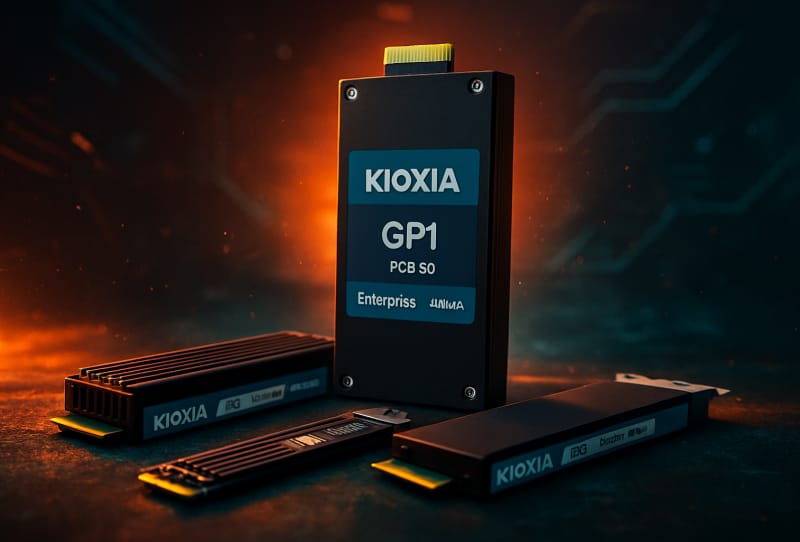
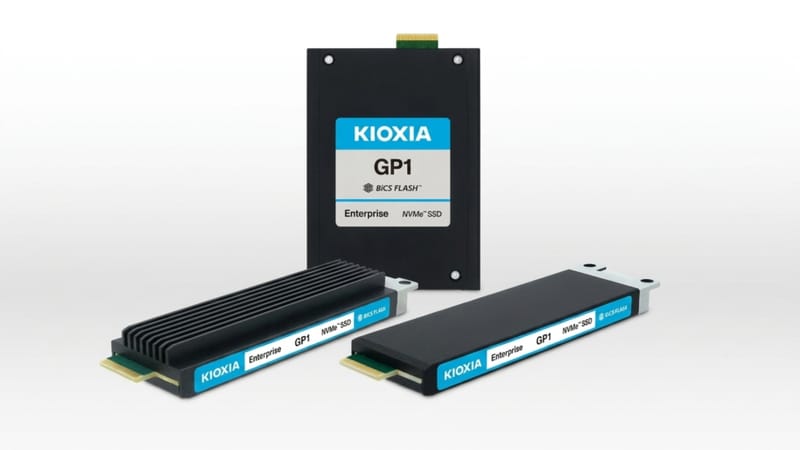
Kioxia has built the fastest solid-state drive it has ever produced. The new Kioxia PCIe 6.0 SSD, called the GP1, pushes random-read performance past 20 million IOPS, breaking the company’s own previous speed record and marking a serious step in its push to make flash storage a genuine rival to DRAM in AI data centres.
Key takeaways
- ✓Kioxia's new GP1 SSD uses PCIe 6.0 and exceeds 20 million random-read IOPS
- ✓The result beats Kioxia's own previous internal performance record
- ✓PCIe 6.0 doubles per-lane bandwidth over PCIe 5.0 using PAM4 signalling
- ✓Kioxia is positioning fast flash as a cheaper alternative to DRAM for AI workloads
- ✓The GP1 targets data centres and AI infrastructure rather than consumer PCs
IOPS, or input/output operations per second, measures how many individual read or write requests a storage device can handle every second rather than how much data it can move in one continuous stream. For AI training and inference workloads, where systems constantly pull small, scattered chunks of data rather than large sequential files, that number matters far more than headline sequential throughput. Twenty million IOPS is an enormous figure for any storage device, let alone one built on NAND flash rather than the faster but far more expensive DRAM chips found in system memory.
Table of Contents
Why the Kioxia PCIe 6.0 SSD matters for AI infrastructure
Modern AI workloads, particularly large language model training and retrieval-heavy inference, are increasingly bottlenecked by how fast data can be fetched rather than by raw compute power. DRAM has traditionally filled that gap because of its extremely low latency, but DRAM is expensive, power hungry, and limited in capacity per chip. Kioxia’s bet is that a new generation of ultra-fast flash can close enough of that performance gap to displace DRAM in at least some tiers of AI infrastructure, at a fraction of the cost per gigabyte.
That is the strategic logic behind the GP1. Rather than positioning it as a faster gaming or workstation drive, Kioxia is pitching the hardware directly at hyperscale operators and AI infrastructure builders who need enormous pools of fast, randomly accessible storage sitting closer to the processor than a traditional storage array. If flash can approach DRAM-like responsiveness at a lower cost, data centres can keep far more of a model’s working data within easy reach without paying DRAM prices for every gigabyte.
What PCIe 6.0 brings to the table
The GP1’s performance leap is tied directly to its PCIe 6.0 interface, the newest generation of the connection standard used to link storage, graphics cards, and other high-speed components to a system’s processor. Each new PCIe generation has roughly doubled the bandwidth of the one before it, and PCIe 6.0 achieves that jump partly through PAM4 signalling, a technique that encodes more data per clock cycle than the simpler signalling used in earlier generations.

| PCIe generation | Transfer rate per lane | Approximate x16 bandwidth |
|---|---|---|
| PCIe 4.0 | 16 GT/s | ~32 GB/s |
| PCIe 5.0 | 32 GT/s | ~64 GB/s |
| PCIe 6.0 | 64 GT/s | ~128 GB/s |
That extra headroom is what lets a single SSD controller push well past the limits of PCIe 5.0 hardware. Few consumer platforms currently support PCIe 6.0, which reinforces that the GP1 is built for enterprise servers and AI clusters rather than desktop PCs, at least for now.
Kioxia’s track record and the competitive picture
Kioxia, formerly known as Toshiba Memory before its 2019 rebrand, is one of the handful of companies that actually manufactures NAND flash wafers rather than simply packaging chips bought from someone else, alongside Samsung, SK hynix, Micron, and Western Digital’s flash joint venture. That manufacturing scale gives it room to experiment with controller design and flash architecture to chase records like this one.
Breaking its own prior record, rather than someone else’s, suggests Kioxia is running an internal roadmap toward ever-faster enterprise drives rather than chasing a single headline figure. Rivals including Samsung and SK hynix are pursuing similar strategies with their own high-IOPS enterprise SSDs, and the arrival of PCIe 6.0 storage controllers across the industry is likely to trigger a fresh round of competing performance claims over the next year or two.
What it means for buyers and the wider market
None of this changes what is available on store shelves today. The GP1 is aimed at data centre operators and AI infrastructure buyers, not gamers or home PC builders, and PCIe 6.0 motherboards and controllers for consumer systems remain a long way off. The more immediate relevance for everyday buyers is indirect: as flash manufacturers pour investment into faster, denser NAND to serve AI customers, that same underlying technology eventually filters down into cheaper, faster consumer SSDs a generation or two later.
The bigger story is about where the money and engineering effort in storage is heading. If Kioxia and its rivals can prove that flash-based storage can substitute for DRAM in enough AI workloads, it could reshape how data centres are built, with cost and power savings that ripple through to the price of running AI services more broadly.
Frequently asked questions
What is the Kioxia GP1 SSD?
The GP1 is Kioxia’s newest enterprise solid-state drive, built around a PCIe 6.0 interface and designed for data centre and AI infrastructure use rather than consumer PCs.
What does 20 million IOPS actually mean?
IOPS measures how many individual read or write operations a drive can process each second. Twenty million IOPS means the GP1 can handle an extremely high volume of small, random data requests, which is the kind of access pattern common in AI training and inference.
Can flash storage really replace DRAM?
Not entirely, since DRAM still offers lower latency. However, Kioxia and other manufacturers are working to close that gap enough that fast flash can take over some roles currently filled by far more expensive DRAM in AI data centres.
Will PCIe 6.0 SSDs come to consumer PCs?
Eventually, but not soon. PCIe 6.0 platforms are currently limited to enterprise and server hardware, and consumer motherboards typically adopt new PCIe generations a few years after the enterprise sector.