
AMDLSS5 2.0 is a free community mod that lets owners of AMD Radeon RX 9070 and RX 9070 XT graphics cards run NVIDIA’s DLSS 5 Neural Rendering upscaler, and its developer says the rebuilt version is noticeably faster than earlier releases. The headline claim is a 64 percent frame rate uplift over rival mods in one test scene, though that figure comes with some important caveats.
Key takeaways
- ✓AMDLSS5 2.0 runs NVIDIA's DLSS 5 Neural Rendering on AMD Radeon RX 9070 and RX 9070 XT cards
- ✓The new build uses a custom engine and no longer needs files from an earlier third-party mod
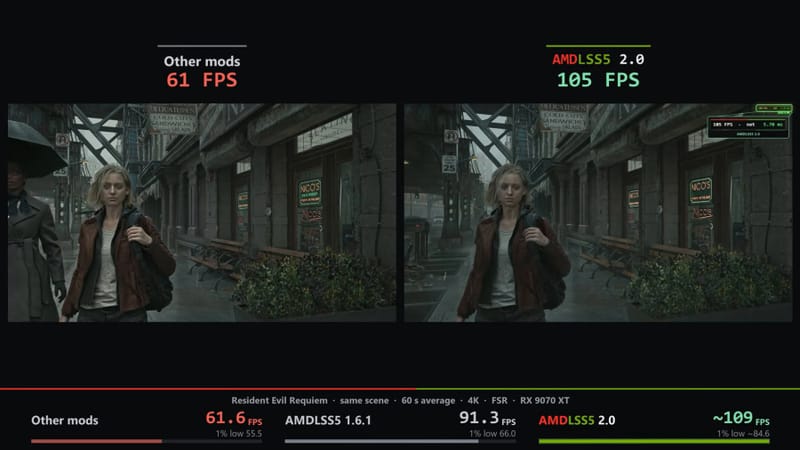
- ✓In Resident Evil Requiem at 4K, average frame rates rose from 91.3 to 101.2 FPS on an RX 9070 XT
- ✓1% low frame rates improved by roughly 19 percent compared with the previous version
- ✓Supported games now include PRAGMATA, Nioh 3 and GTA 5 Enhanced in offline Story Mode only
The mod is the work of a developer known as Wehaveall, who built a new rendering engine from scratch for this release. Earlier versions leaned on Daniel Blanco’s DLSS-NR-on-AMD project, the tool that first got DLSS 5 running on Radeon hardware back in September. Version 2.0 breaks that dependency entirely, running as a standalone package rather than borrowing files from someone else’s mod.
Table of Contents
How AMDLSS5 2.0 improves on earlier versions
The developer’s own benchmarks give a clearer picture than the marketing number alone. Testing a 60-second run of Resident Evil Requiem at 4K with FSR enabled on an RX 9070 XT, AMDLSS5 2.0 averaged 101.2 FPS with 1% lows of 78.5 FPS. The previous build, version 1.6.1, managed 91.3 FPS average and 66.0 FPS at the 1% low mark in the same test.
That works out to roughly an 11 percent gain in average frame rate and a steeper 19 percent improvement in the 1% lows, which is often the more meaningful number for how smooth a game actually feels. Lifting the worst-case frame times by that much suggests the new engine handles frame pacing more consistently, not just raw throughput.
| Build | Average FPS | 1% Low FPS |
|---|---|---|
| AMDLSS5 v1.6.1 | 91.3 | 66.0 |
| AMDLSS5 2.0 | 101.2 | 78.5 |
The widely quoted 64 percent figure comes from a separate comparison against unnamed “other mods,” which reportedly managed only 61.6 FPS in the same scene. It is worth treating that number cautiously, since it is a single developer’s result from one game on one GPU, and there is no baseline showing what running without Neural Rendering at all would score. Independent testing across more titles and hardware would help confirm whether the gains hold up broadly.
What DLSS 5 Neural Rendering actually does
DLSS 5 is NVIDIA’s latest upscaling and frame generation technology, and Neural Rendering is the component that uses machine learning to reconstruct detail and smooth out motion with less raw rendering work. It was built for NVIDIA’s own GeForce RTX cards, which is why getting it to run on Radeon hardware at all required a workaround rather than official support.
Mods like AMDLSS5 2.0 essentially trick supported games into accepting Radeon hardware as a valid target for NVIDIA’s neural rendering pipeline. The results so far show it can work, but performance and stability depend heavily on the specific GPU, game, and driver combination involved, which is why the project remains firmly in enthusiast and tinkerer territory rather than something a typical buyer should rely on.
Which games and GPUs are currently supported
Game compatibility has expanded with this release. AMDLSS5 2.0 now supports PRAGMATA, Nioh 3, and GTA 5 Enhanced, though the GTA 5 support comes with a significant catch: it only works in offline Story Mode, and requires disabling the BattlEye anti-cheat system. Anyone running the mod alongside a multiplayer-protected game should be aware that tampering with anti-cheat software can carry its own risks beyond just stability.
On the hardware side, RX 9060 series cards are expected to work based on their architecture but have not actually been tested by the developer. Support for older RX 7000 series GPUs exists only as an untested alpha build, meaning anyone on that hardware is effectively testing unverified code rather than using a proven feature.
Why this matters for Radeon owners and the GPU market
NVIDIA has long used software features like DLSS as a key selling point over AMD’s Radeon lineup, and mods such as this one chip away at that advantage, at least for technically inclined users willing to install unofficial tools. It also reflects a broader trend of community developers closing feature gaps faster than either company is willing to officially support across competitors’ hardware.
For most Radeon RX 9070 and RX 9070 XT owners, AMDLSS5 2.0 is worth watching rather than something to install immediately. It remains unofficial, unsupported by both AMD and NVIDIA, and tied to a narrow list of compatible games. Still, the frame rate gains over the previous build are real and measurable, and the shift to a self-contained engine suggests the project is maturing quickly. Anyone considering it should weigh the performance upside against the lack of official support and the anti-cheat complications in multiplayer titles.
Frequently asked questions
Is AMDLSS5 2.0 an official AMD or NVIDIA release?
No. It is an independent, community-built mod developed by someone known as Wehaveall, and neither AMD nor NVIDIA officially supports or endorses it.
Which Radeon GPUs work with AMDLSS5 2.0?
The RX 9070 and RX 9070 XT are the confirmed, tested cards. RX 9060 series cards should work but remain untested, and RX 7000 series support is only an untested alpha build.
Is it safe to use AMDLSS5 2.0 with online multiplayer games?
Caution is advised. GTA 5 Enhanced support only works in offline Story Mode with BattlEye disabled, and running mods alongside anti-cheat systems in online games can risk account bans or instability.
How much faster is version 2.0 than the previous release?
In the developer’s Resident Evil Requiem test at 4K, average frame rates rose about 11 percent and 1% low frame rates improved by roughly 19 percent compared with version 1.6.1.