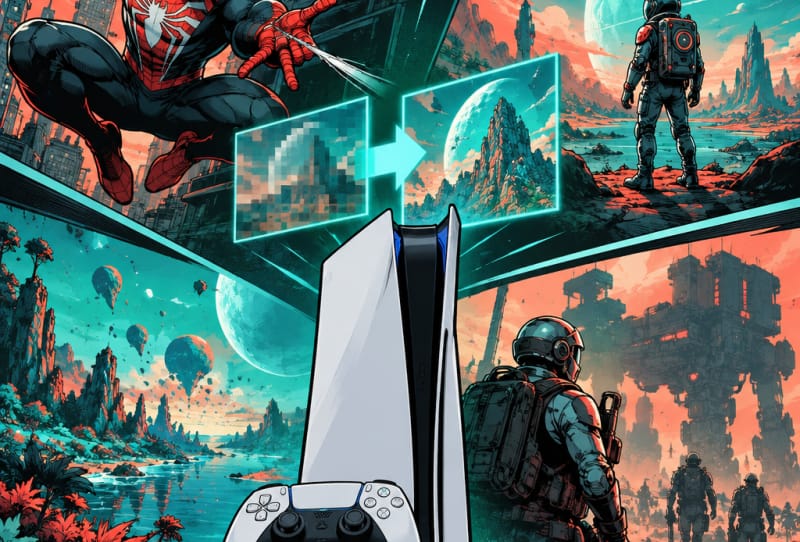
Sony is widening the rollout of its PS5 QSSR upscaler, with six more games set to pick up the lighter AI upscaling tool over the coming weeks. Marvel’s Spider-Man 2 is first through the door, with an update live now that adds QSSR to both its Fidelity and Performance modes, and five more titles are lined up behind it.
Key takeaways
- ✓Sony is adding the PS5 QSSR upscaler to six more titles, starting with Marvel's Spider-Man 2.
- ✓Control Resonant, No Man's Sky, ARC Raiders, The Finals and Hell Let Loose: Vietnam are also getting QSSR.
- ✓QSSR is a lighter version of the PS5 Pro's PSSR, built with AMD through Project Amethyst.
- ✓Digital Foundry testing found QSSR adds roughly 1.5 to 4.4 milliseconds of extra render time per frame.
- ✓The upscaler debuted in October with Marvel's Wolverine and Ghost of Yotei before this wider rollout.
The news comes straight from Sony, which published the full list on the PlayStation Blog rather than leaving it to leaks or speculation. That matters for base PS5 owners especially, since QSSR was built specifically to bring some of the image quality gains from the PS5 Pro down to the standard console without the Pro’s extra silicon.
Table of Contents
How the PS5 QSSR upscaler works
QSSR stands for Quick Spectral Super Resolution, and Sony first introduced it in October alongside Marvel’s Wolverine and Ghost of Yotei. It is essentially a trimmed-down sibling of PSSR, the AI upscaler exclusive to the PS5 Pro, developed through Sony’s ongoing Project Amethyst collaboration with AMD, which co-developed the technology through Project Amethyst.
Because QSSR shares the same interface as PSSR, developers that have already patched in Pro support can generally bolt on the lighter version without a major rework. Remedy’s Erik Jansson, who worked on Control Resonant, has compared the visual jump to what PSSR delivered when the PS5 Pro launched, pointing to sharper edges and a steadier image during motion as the main benefits for base console players.
Which games are getting the new upscaler
Marvel’s Spider-Man 2 leads the latest wave, with its update already live and QSSR available in both Fidelity and Performance modes. The rest of the lineup is staggered across the next few months, giving developers time to tune the feature for each engine.
| Game | Developer | Rollout timing |
|---|---|---|
| Marvel’s Spider-Man 2 | Insomniac Games | Live now |
| Control Resonant | Remedy Entertainment | December update |
| No Man’s Sky | Hello Games | Within the next few weeks |
| ARC Raiders | Embark Studios | Coming soon |
| The Finals | Embark Studios | Coming soon |
| Hell Let Loose: Vietnam | Black Matter | Upcoming patch |
Hello Games’ inclusion is notable given how long No Man’s Sky has kept evolving since launch, and the studio has already been busy this year with the game’s expansion into other formats, including its recent expansion to iPhone and iPad. Embark Studios bringing QSSR to both ARC Raiders and The Finals suggests the upscaler is proving straightforward enough to deploy across a live-service studio’s whole catalogue rather than a single flagship title.
The performance trade-off behind sharper visuals
Better image quality rarely comes free, and QSSR is no exception. Independent testing on Marvel’s Wolverine found the upscaler added roughly 1.5 to 1.8 milliseconds of extra render time per frame when scaling from 864p up to 1440p, compared with Insomniac’s own upscaling solution. Push the output target to 4K, however, and that overhead climbed to around 4.4 milliseconds.
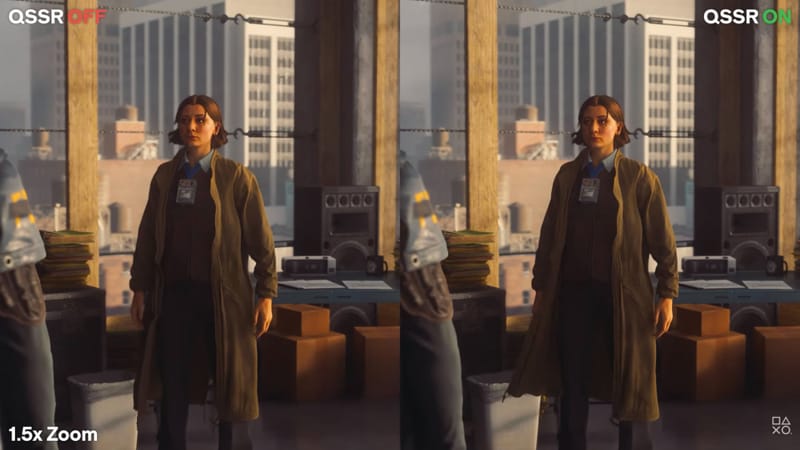
On a console with a fixed frame budget, a few milliseconds can be the difference between hitting a locked 60 frames per second and dropping below it. That is likely why Sony and its partner studios are offering QSSR as an option within existing Fidelity and Performance modes, rather than replacing the native upscalers outright, so players can choose sharper pixels or a steadier frame rate depending on what matters more to them.
What it means for base PS5 owners
For anyone without a PS5 Pro, this rollout is the clearest sign yet that Sony intends QSSR as a genuine tier of its upscaling stack rather than a one-off experiment. Expanding it across six very different games, from a licensed superhero blockbuster to an open-world survival title and two competitive multiplayer shooters, shows the company testing it across a broad spread of engines and frame-rate demands.
It also hints at where Sony’s hardware strategy is heading more broadly. Upscaling and frame generation have become central to how PlayStation balances visual fidelity against performance, a theme that shows up again in Sony’s broader work on PlayStation upscaling and frame generation technology uncovered in recent patent filings. If QSSR continues rolling out smoothly, expect more third-party and first-party studios to add it as a standard option in future PS5 updates, giving base console owners a meaningful slice of the image quality improvements that used to be reserved for Pro buyers.
Frequently asked questions
What is the PS5 QSSR upscaler?
QSSR, or Quick Spectral Super Resolution, is Sony’s lighter AI upscaling tool for the standard PS5. It shares its technical foundation with PSSR, the upscaler built for the PS5 Pro, but is designed to run on the base console’s hardware.
Which games currently support QSSR?
Marvel’s Wolverine and Ghost of Yotei were the first titles to get it in October. The latest wave adds Marvel’s Spider-Man 2, Control Resonant, No Man’s Sky, ARC Raiders, The Finals and Hell Let Loose: Vietnam.
Does QSSR slow down games on base PS5?
Testing on Marvel’s Wolverine showed QSSR adds extra render time per frame compared with a game’s native upscaler, ranging from roughly 1.5 milliseconds at 1440p output up to about 4.4 milliseconds at 4K.
Is QSSR the same as PSSR on PS5 Pro?
No. PSSR is the full version built for the PS5 Pro’s extra hardware, while QSSR is a scaled-down variant made to work within the base PS5’s more limited performance budget.