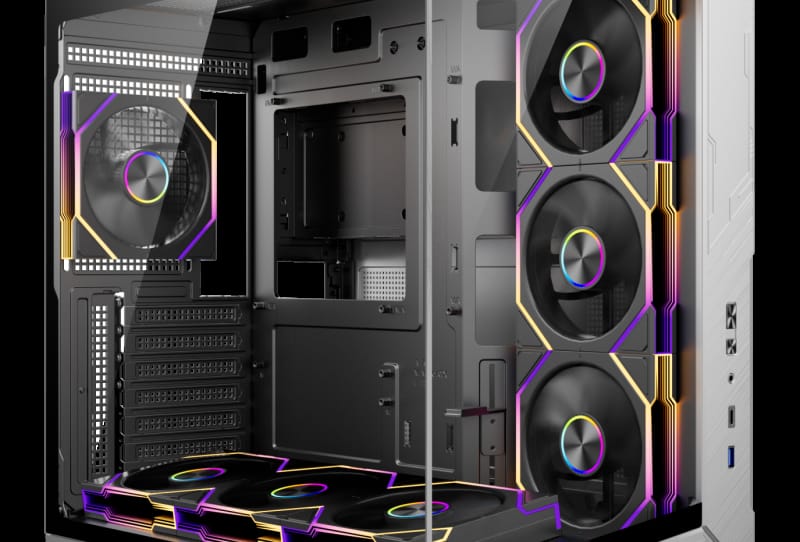
The ESGAMING ZERO MAX case has arrived with an unusual trick for keeping a graphics card cool: an eight-degree angled duct built into the bottom intake, designed to aim incoming air more directly at the GPU rather than letting it drift upward through the chassis. The mid-tower comes in black or white, fits graphics cards up to 415mm long, and supports as many as ten 120mm fans plus a 360mm radiator in the roof.
Key takeaways
- ✓The ESGAMING ZERO MAX case uses an 8-degree angled bottom duct aimed at the graphics card
- ✓It supports graphics cards up to 415mm long and CPU air coolers up to 160mm tall
- ✓The chassis fits ATX, Micro-ATX and Mini-ITX boards, up to ten 120mm fans and a 360mm roof radiator
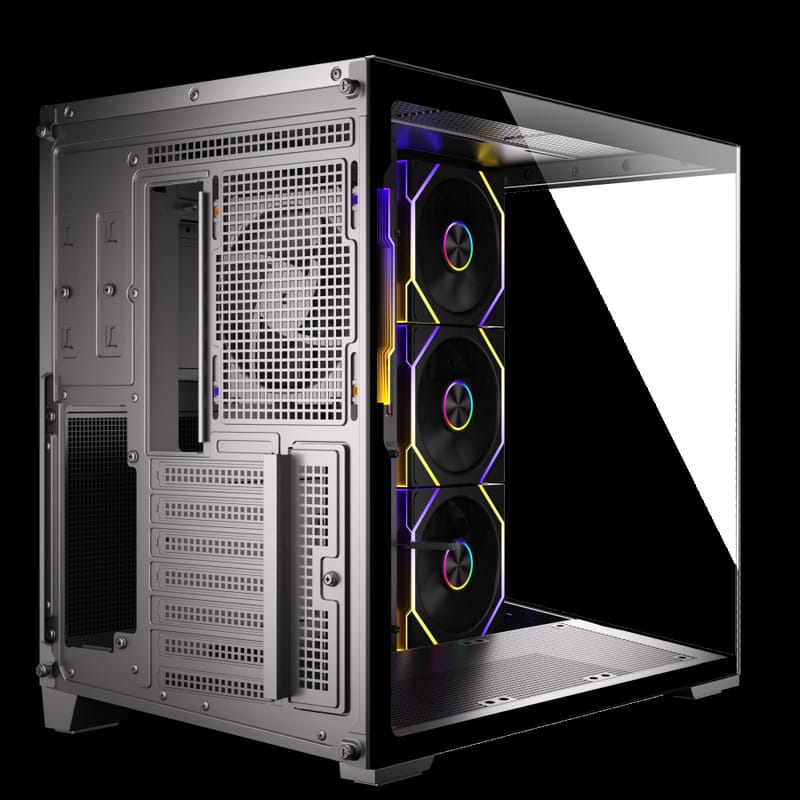
- ✓Front and left 4mm tempered glass panels give a 270-degree view of the internal build
- ✓ESGAMING claims more than 200,000 ZERO MAX units sold, mostly exported to South America, the Middle East and Southeast Asia
It is a straightforward idea with an obvious appeal for anyone who has watched a high-end graphics card throttle under a glass side panel. Whether the tilted duct actually lowers temperatures by a meaningful margin is still an open question, because ESGAMING has not published any thermal or noise figures alongside the announcement.
Table of Contents
How the angled intake is meant to work
Conventional case intakes sit flat along the front or bottom of the chassis, pulling air in and leaving it to find its own path past the components. The ESGAMING ZERO MAX case instead builds a physical duct under the motherboard tray, tilted by eight degrees, with three fan mounts positioned directly beneath where a graphics card typically sits.
The pitch is that a slightly angled airstream reaches the GPU’s intake fans more directly than air rising straight up, which should, in theory, reduce the amount of warm air recirculating around the card. It is a sensible concept on paper, and other case makers have experimented with similar directed-airflow designs over the years. Without independent testing, though, it is hard to say how much difference the angle makes against a well-ventilated flat-intake case running the same fan count.
No numbers yet to back the claim
ESGAMING has not released delta-temperature results, decibel readings, or comparisons against its own earlier cases. That omission does not necessarily mean the design underperforms, but it does mean buyers are currently taking the claim on faith rather than evidence. Reviewers who get hands-on units will be the ones to settle how the duct performs under sustained load.
Specifications and build compatibility
Beyond the airflow design, the ESGAMING ZERO MAX case is built to handle fairly large systems. Motherboard support spans ATX, Micro-ATX, and Mini-ITX, so it suits everything from a compact build to a full-tower-style layout, and the 415mm of graphics card clearance leaves room for most current flagship cards with space to spare.
| Spec | Detail |
|---|---|
| Motherboard support | ATX, Micro-ATX, Mini-ITX |
| Max GPU length | 415mm |
| Max CPU cooler height | 160mm |
| Fan mounts | Up to ten 120mm fans |
| Radiator support | Up to 360mm in the roof |
| Storage | Two 3.5-inch bays, one 2.5-inch bay |
| Front panel glass | 270-degree view, 4mm tempered glass side panel |
| Front I/O | USB 3.0, USB-C at 20Gbps, HD audio |
One figure worth flagging for anyone planning a build around a tall air cooler is the 160mm height limit, which rules out some of the larger dual-tower coolers on the market. Liquid cooling fans better here, with room for a 360mm radiator up top alongside the ten total 120mm fan positions spread through the chassis. ESGAMING has not confirmed how many fans ship in the box by default, which leaves buyers guessing at out-of-the-box cooling performance.
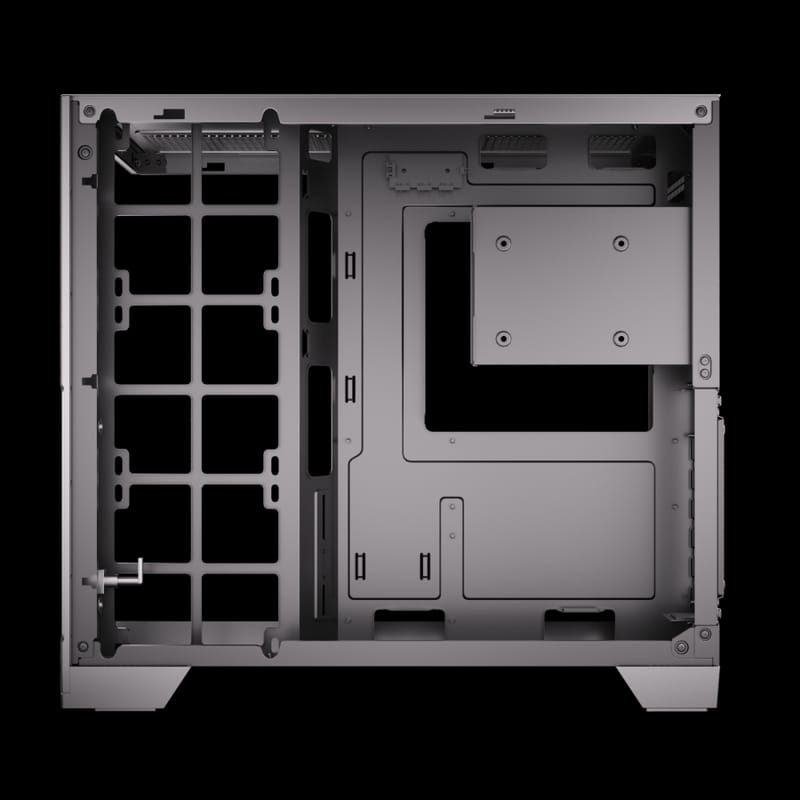
Storage is modest but sensible for a case built around GPU showcasing rather than drive bays: two 3.5-inch mounts for bulk storage and a single 2.5-inch slot for an SSD. The power supply sits vertically on the right-hand side of the case, a layout increasingly common in cases chasing a clean, cable-free look through the glass.
Design, glass panels, and front I/O
ESGAMING describes the front and left panels as delivering a 270-degree panoramic view of the build, using 4mm tempered glass on the side panel. Dust filters cover the top and bottom intakes, which should help keep the angled duct from clogging with dust over time, a sensible inclusion given how central that bottom intake is to the whole design.
Front connectivity covers USB 3.0, a USB-C port rated at 20Gbps, and standard HD audio, which is a reasonable set of ports for a case at this tier. The black and white colourways give builders some flexibility to match the chassis with the rest of their components, rather than forcing a single aesthetic.
Why this matters for GPU-focused builds
Graphics cards have grown physically larger and thermally hungrier with each generation, and case airflow has struggled to keep pace in many designs that were never built with a 400mm-plus card in mind. A case specifically engineered to direct air at the GPU, rather than just providing generic ventilation, reflects where demand in the market has shifted. Building a case around GPU demand keeps climbing as a design constraint rather than an afterthought is a reasonable response to that trend.
Jack Meng, founder of ESGAMING, said the company set out to rethink how airflow is handled in conventional case designs, combining the tilted duct with panoramic glass and strong hardware compatibility for esports players and PC building enthusiasts. ESGAMING says it has two decades in the PC industry making cases, power supplies and cooling hardware, and that ZERO MAX sales have passed 200,000 units, with exports concentrated in South America, the Middle East and Southeast Asia.
Those sales figures suggest the design has already found an audience, even without independent thermal benchmarks to validate the airflow claims. For builders weighing up a case purchase now, the practical question is less about the marketing pitch and more about how graphics card bandwidth and cooling affect performance in real builds, and whether a tilted duct noticeably changes GPU temperatures compared with a well-ventilated conventional layout. Reviewers with access to tools built to monitor GPU temperatures and VRAM use should be able to answer that once test units start circulating.
Frequently asked questions
What makes the ESGAMING ZERO MAX case different from a standard mid-tower?
The main difference is the bottom intake, which sits on an eight-degree angled duct rather than a flat vent, aiming to push air more directly at the graphics card instead of letting it rise naturally through the chassis.
What is the maximum graphics card length supported?
The ESGAMING ZERO MAX case supports graphics cards up to 415mm long, which covers the vast majority of current flagship and mid-range cards.
Does the case support liquid cooling?
Yes. It supports up to ten 120mm fans across the chassis and a 360mm radiator mounted in the roof, though the 160mm limit on CPU air coolers makes liquid cooling the better option for larger setups.
Has the airflow design been independently tested?
Not yet. ESGAMING has not released temperature or noise figures to support the angled duct’s cooling claims, so independent reviews will be needed to confirm how much of a difference the design makes.