Anker MindBase has landed as the company’s boldest smart home play yet, folding a hub, a local server and an on-device AI agent into a single box that also happens to function as a NAS. Rather than leaning on the cloud, the device runs its own AI Core compute card and a system Anker calls the TrueSmart AI Agent, aiming to keep both automation and data firmly inside the home.
The timing matters. Smart home hubs have spent years chasing cloud subscriptions and voice assistants that phone home for every request. MindBase flips that script, promising local processing, local storage and compatibility with a sprawling list of devices, all without forcing owners into a single ecosystem.
Table of Contents
What the Anker MindBase Actually Does
At its core, the Anker MindBase is built to control almost 100 existing Anker products alongside any Matter-certified smart home gear from other brands. It also plays nicely with Apple’s HomeKit, which means households already invested in Apple’s smart home tools should be able to slot it in without ripping out existing infrastructure.
What sets it apart from a typical hub is the storage angle. MindBase supports up to 48TB of local capacity and works as a fully-fledged network-attached storage device, handling files, photos and video without routing them through a third-party server. That puts it in similar territory to similarly positioned NAS boxes like the UGREEN NASync DXP4800 Plus, though MindBase is clearly aimed at a broader, less technical audience than dedicated NAS hardware typically attracts.
The AI side of the equation focuses heavily on security. Anker says the on-device agent evaluates events as they happen, weighing up risk and choosing how to respond, whether that’s simple observation, triggering lights, issuing a verbal warning or actively deterring an intruder. Because the processing happens on the device itself rather than in the cloud, Anker is positioning privacy as a core selling point rather than an afterthought.
Underpinning all of this is the AI Core compute card, a removable module that handles the heavy lifting for object recognition, voice processing and automation logic without sending raw footage or audio off-site. Anker has designed the card to be upgradeable down the track, which suggests future MindBase revisions could get a compute boost without owners needing to replace the entire hub. It’s a similar philosophy to modular NAS systems, where storage and processing can be scaled independently rather than locking buyers into a fixed spec for the life of the device.
Setup is expected to run through the Eufy app, the same interface long-time Anker and Eufy customers will already be familiar with from existing cameras and doorbells. That should keep the learning curve relatively shallow for anyone upgrading from a standalone Eufy camera or a basic Wi-Fi router setup, even if the underlying hardware is considerably more capable than a typical hub.
New Eufy Security Hardware Joins the Lineup
MindBase doesn’t arrive alone. Anker’s Eufy brand is rolling out a matching security kit that includes a TrackLight Cam S1, an S4 Video Doorbell and a Smart Security Shield sensor, all designed to feed data straight back into the hub for local analysis.
The Smart Security Shield is arguably the most interesting piece. It uses radar rather than a camera to spot strangers approaching a property from up to 15 metres away, which sidesteps some of the privacy concerns that come with always-on video at a boundary line.
Alongside the MindBase-specific kit, Anker is also introducing several standalone Eufy products aimed at general home security. The table below breaks down what’s coming and how the hardware differs.
| Product | Key feature | Availability |
|---|---|---|
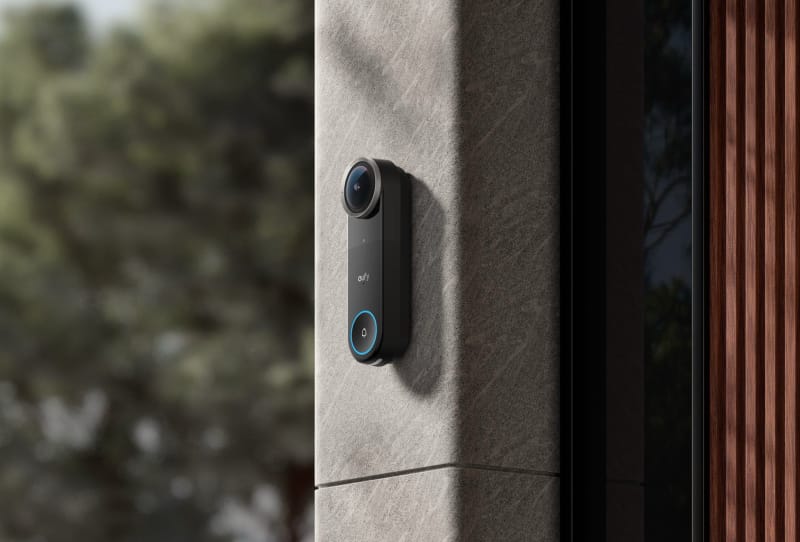
| Eufy Video Doorbell S4 | Wired doorbell with 9-megapixel lens, 3K resolution, 180-degree field of view | Late September, priced at $300 USD |
| Eufy Window Camera E10 | Indoor-mounted camera for rentals, 25-degree tilt, anti-glare optics, 2.5K resolution | Later this year, priced at $70 USD |
| Eufy Fall Detection Sensor | Camera-free mmWave radar sensor for detecting falls, two-way communication | Not yet announced |
| Eufy NVR Security System E50 | 8-channel NVR with four hybrid PTZ dual-lens cameras (2K wide-angle, 4K PTZ) | Available now, from $999 USD |
Pricing and availability for the MindBase hub itself, along with the Fall Detection Sensor, have not been confirmed yet. Anker hasn’t said when either will reach Australian retailers, or what local pricing might look like once it does. Given how Anker and Eufy hardware typically rolls out to Australia a few months after a US or global reveal, local buyers may be waiting until early next year for confirmed pricing and stock.
How It Stacks Up Against Other Smart Home Hubs
The smart home hub category has been crowded for years, but most entrants pick a lane: either they’re a controller for lights and locks, or they’re a security camera brand with a companion app. MindBase is trying to do both jobs at once, plus storage duties usually reserved for other combined hub-and-camera systems on the market.
That’s an ambitious combination. Google and Amazon have both pushed cloud-first hubs with varying degrees of local processing, while Apple’s own home hub efforts, reportedly in development with Siri-based AI, remain unreleased. Anker’s approach of shipping local AI and local storage together, rather than promising it as a future software update, gives MindBase a genuine point of difference right now.
The trade-off is likely to be raw AI horsepower. Cloud-based systems can lean on data centre-scale compute for image recognition and predictive automation, something a single compute card inside a home hub can’t easily match. Anker’s bet is that most households will happily trade a bit of AI sophistication for the certainty that footage and files never leave the house.
There’s also the question of subscription fatigue. Many rival ecosystems still require an ongoing cloud storage plan to unlock full camera history or advanced detection features, even after the hardware has been paid for. By building storage directly into MindBase, Anker is effectively removing that recurring cost from the equation, at least for anyone happy to manage their own local backups rather than relying on an off-site cloud copy.
What It Means for Buyers Considering a Home Hub
For anyone weighing up a new smart home setup, MindBase raises the bar for what a single hub can be expected to do. Combining hub, NAS and AI security brain into one device removes the need to juggle separate boxes from separate brands, provided a household is comfortable staying inside Anker’s Eufy-heavy ecosystem.
Households already running a NAS for backups or media, of the kind covered in a full guide to setting up home NAS storage, may find MindBase appealing as a way to consolidate hardware rather than adding yet another device to the network cupboard. The Matter and HomeKit support also means it shouldn’t demand a full teardown of existing smart home gear to get started.
Anyone currently comparing options would do well to think about three things before committing: how much local storage the household actually needs given Eufy camera footage can add up quickly, whether existing devices are Matter-certified or will need replacing, and how comfortable the household is with managing its own backups rather than relying on a cloud subscription as a safety net.
Until Anker confirms pricing and a release window, MindBase remains more promise than product for local buyers. The new Eufy hardware, on the other hand, has firmer dates attached, giving an early sense of how seriously Anker is investing in on-device AI across its entire security lineup, not just the flagship hub.
Frequently asked questions
What is Anker MindBase?
Anker MindBase is a combined smart home hub, local NAS storage device and on-device AI security system. It uses an AI Core compute card and Anker’s TrueSmart AI Agent to control smart home devices and analyse security events locally, rather than relying on cloud servers.
How much storage does Anker MindBase support?
MindBase supports up to 48TB of local storage capacity, allowing it to function as a fully-fledged network-attached storage device for files, photos and video alongside its smart home hub duties.
Is Anker MindBase compatible with other smart home brands?
Yes. MindBase controls almost 100 existing Anker products and is compatible with any Matter-certified smart home device, as well as Apple’s HomeKit, so it can generally be added to an existing smart home setup without replacing everything already in place.
When will Anker MindBase be available in Australia?
Anker has not yet confirmed pricing or a release date for MindBase in Australia. Some related Eufy hardware, including the Video Doorbell S4 and NVR Security System E50, already has confirmed pricing and availability overseas, which may offer a rough guide to local timing once MindBase itself is confirmed.