The ASRock B860 LiveMixer WiFi has been developed with content creators in mind, prioritising connectivity and versatility over raw power delivery. It’s designed to support demanding creative workflows where multiple devices and accessories need to be connected at once.
This motherboard brings forward a wealth of ports and compatibility options, ensuring smooth integration with capture cards, storage devices, and peripherals. With these capabilities, it stands out as a practical choice for streamers and creators who rely on reliable connections.
While the LiveMixer shares some similarities with other boards in ASRock’s B860 lineup, it has its own focus on features that matter most to creative professionals. Its design reflects a thoughtful balance between performance and accessibility, tailored for modern content production needs.
Table of Contents
Design and Functionality
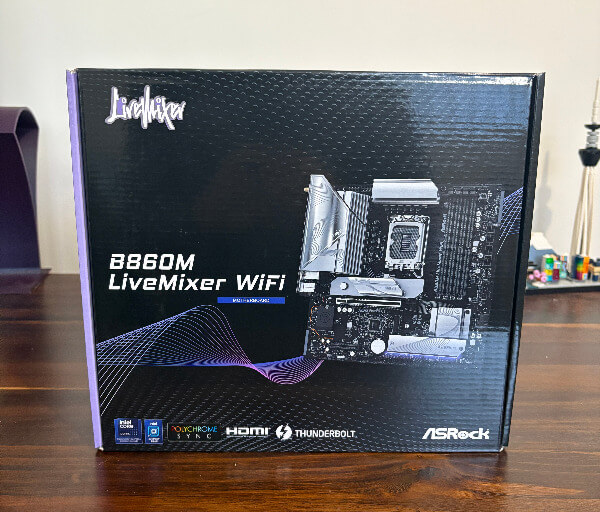
The ASRock B860 LiveMixer WiFi comes in a striking black and purple package, reflecting its unique identity in the B860 series. Inside, the motherboard is carefully secured in an anti-static sleeve, with accessories neatly arranged for quick setup.
Included in the box are essential items such as SATA cables, WiFi antennas, a thermistor cable, and documentation. These additions make it straightforward to get the system running while offering flexibility for different builds.
The board is built around Intel’s LGA1851 socket and B860 chipset, offering compatibility with the latest Core Ultra Series 2 CPUs. The six-layer PCB with reinforced copper helps deliver stability for both everyday tasks and heavy workloads.
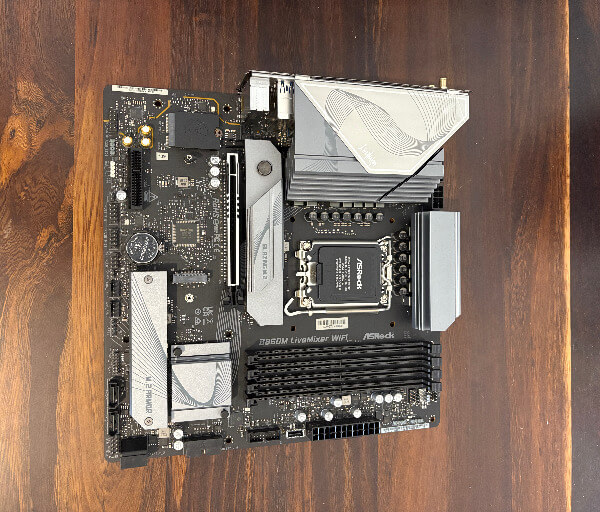
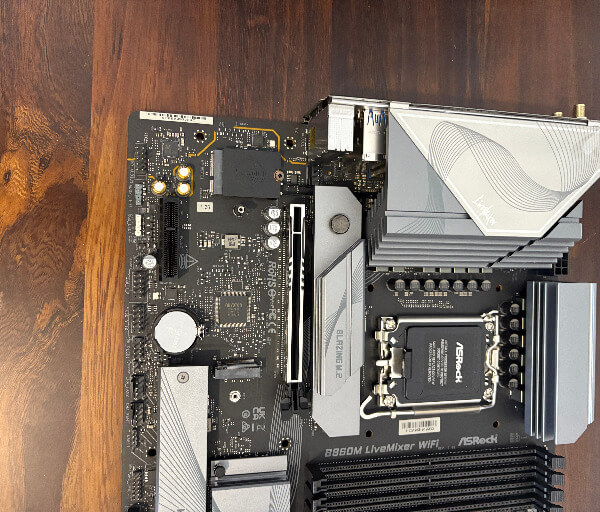
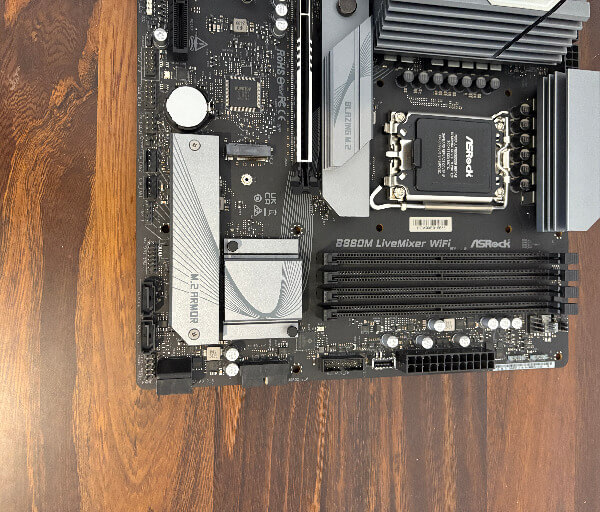
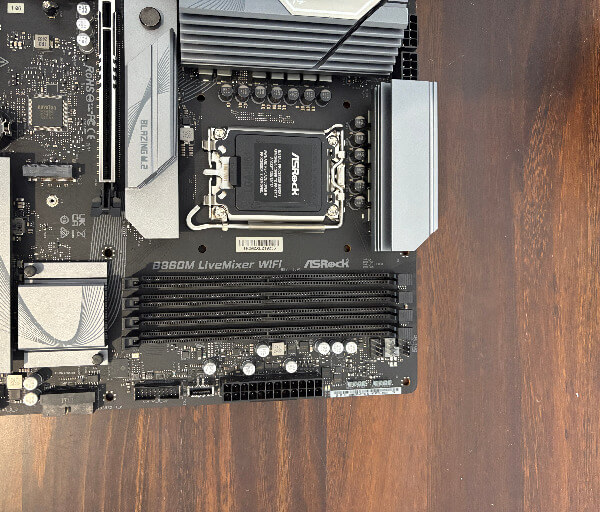
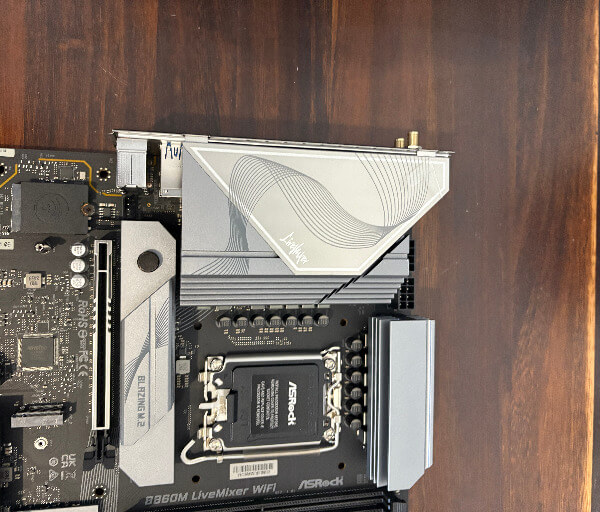
A simplified power delivery design has been chosen, with 12+1+1+1 phases supported by SPS MOSFETs. Large grey heatsinks cover the VRMs, providing sufficient cooling without the need for additional heat pipes.
Four DDR5 DIMM slots are positioned neatly, supporting up to 256GB of memory. The board is engineered to handle high frequencies, making it suitable for memory overclocking and XMP profiles.
For storage, the LiveMixer features three M.2 NVMe slots with heatsink covers and thermal pads. The primary Gen5 slot connects directly to the CPU for maximum performance, while two additional Gen4 slots provide further flexibility.
Alongside M.2, four SATA ports are included for traditional storage devices. This blend of modern and legacy storage support gives builders the freedom to mix drives according to their needs.
Expansion options are well considered, with three PCIe slots available. The top slot runs at PCIe Gen5 x16, while the others are tied to the chipset, catering to GPUs and additional cards.
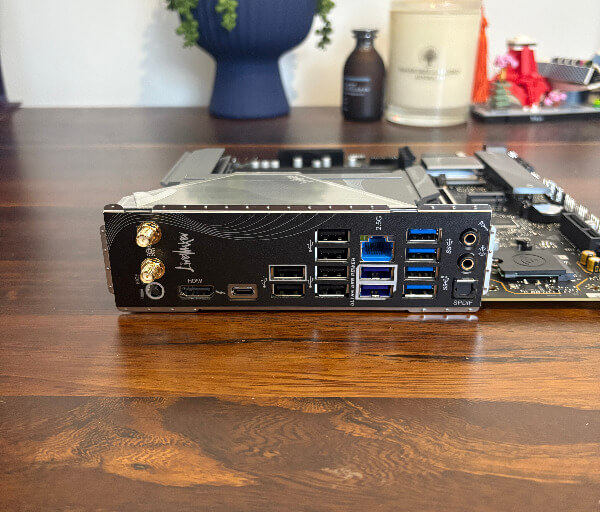
The rear I/O shield is pre-installed and designed for an easy fit during installation. ASRock has made adjustments to ensure the panel sits flush in most cases, reducing the chances of alignment issues.
From an aesthetic perspective, the board adopts a bold layout that differentiates it from standard designs. Its colour scheme and functional layout align it with creators who value both practicality and individuality in their builds.
Key Features
One of the most notable aspects of the LiveMixer is its immense connectivity. With a total of 22 USB ports spread across the board, creators can connect cameras, microphones, storage devices, and controllers without compromise.
The inclusion of Thunderbolt 4 ensures high-speed data transfer and support for modern displays. This makes the board highly adaptable to both professional editing setups and live streaming environments.
Networking is covered with a Dragon 2.5Gb LAN port alongside Intel WiFi 6E and Bluetooth 5.3. Whether wired or wireless, users benefit from stable and fast connections ideal for streaming or collaborative work.
The audio solution is powered by the Realtek ALC1220 codec, delivering clean and immersive sound. With 7.1 channel support and S/PDIF output, it is well-suited for creators who value accurate audio monitoring.
Storage options are equally strong, with a PCIe Gen5 M.2 slot for blistering SSD speeds. The additional Gen4 slots and four SATA ports further expand capacity for large project files.
The memory design supports DDR5 up to 8666MHz (OC), with Intel XMP 3.0 profiles for simplified tuning. This ensures users can fully exploit the potential of modern DDR5 kits.
A thoughtful cooling layout includes multiple fan headers and an AIO pump connector with smart speed control. This gives users the tools to fine-tune airflow and cooling based on their workload.
BIOS Flashback and ASRock’s Auto Driver Installer simplify setup and updates. These features make it easy to keep the system current without needing advanced technical knowledge.
Technical Specifications
CPU & Chipset
- Supports Intel Core Ultra Series 2 processors (LGA1851).
- Intel B860 chipset.
- Intel Hybrid Technology, Turbo Boost Max 3.0, Thermal Velocity Boost, and Adaptive Boost Technology supported.
- Integrated NPU for dedicated AI acceleration.
Power Delivery & Build
- 10+1+1+1+1 power phase design using Dr.MOS.
- Enlarged heatsink armour for cooling.
- 20K long-lasting black capacitors for durability.
- Flexible integrated I/O shield.
Memory
- Dual channel DDR5 memory technology.
- 4 × DDR5 DIMM slots, non-ECC unbuffered.
- Up to 256 GB total capacity.
- Speeds up to 8666+ MHz (OC), with Intel XMP 3.0 support.
- Supports CUDIMM modules.
Graphics & Display
- Intel Xe LPG integrated graphics architecture.
- 1 × HDMI 2.1 port, supporting up to 4K 120 Hz.
- 1 × Thunderbolt 4 port, supporting up to 8K 60 Hz or 5K 120 Hz.
- HDR and HDCP 2.3 supported.
Expansion & Slots
- 1 × PCIe 5.0 ×16 slot (CPU).
- 1 × PCIe 4.0 ×4 slot (chipset).
- 1 × M.2 Key-E slot for WiFi/BT module.
Storage
- 1 × Blazing M.2 PCIe Gen5 ×4 slot (CPU).
- 2 × Hyper M.2 PCIe Gen4 ×4 slots (chipset).
- 4 × SATA 6 Gb/s ports.
- RAID 0, 1, 5, and 10 supported for SATA drives.
USB Connectivity
- 1 × Thunderbolt 4 Type-C (rear).
- 1 × USB 3.2 Gen1 Type-C (front).
- 10 × USB 3.2 Gen1 Type-A (6 rear, 4 front).
- 10 × USB 2.0 (6 rear, 4 front).
- All ports support ESD protection.
Networking
- Dragon 2.5 Gigabit LAN (RTL8125BG).
- Intel WiFi 6E (802.11axe).
- Bluetooth 5.3.
- MU-MIMO support.
Audio
- Realtek ALC1220 7.1 channel HD audio codec.
- S/PDIF output.
- Nahimic audio support.
- Individual PCB layers for left and right audio channels.
Internal Connectors
- Thermistor cable header.
- SPI TPM header.
- Power LED and speaker header.
- 1 × RGB LED header.
- 3 × addressable LED headers.
- 2 × CPU fan headers (smart control).
- 3 × chassis fan headers (smart control).
- 1 × AIO pump fan header (smart control).
- 24-pin ATX power connector.
- 2 × 8-pin 12V CPU power connectors.
- Front panel audio connector.
- 2 × USB 2.0 headers (support 4 ports).
- 2 × USB 3.2 Gen1 headers (support 4 ports).
- 1 × USB 3.2 Gen1 Type-C header (front panel).
Rear I/O Panel
- 2 × Antenna ports.
- 1 × HDMI port.
- 1 × Optical S/PDIF out port.
- 1 × Thunderbolt 4 Type-C port.
- 6 × USB 3.2 Gen1 ports.
- 6 × USB 2.0 ports.
- 1 × RJ-45 LAN port.
- 1 × BIOS Flashback button.
- 1 × Line-out jack (gold plated).
- 1 × Microphone input jack (gold plated).
Software & BIOS
- AMI UEFI BIOS with 256Mb support and GUI.
- ASRock EZ Mode, Full HD UEFI, My Favorites.
- BIOS Flashback, Auto Driver Installer, Instant Flash.
- ASRock utilities including A-Tuning, Dragon LAN, Polychrome SYNC.
Form Factor
- ATX form factor.
- Dimensions: 30.5 cm × 24.4 cm (12 in × 9.6 in).
Experience Using the Product and Performance
Setting up the ASRock B860 LiveMixer WiFi is straightforward thanks to its clear layout and pre-installed I/O shield. The Auto Driver Installer further simplifies the process, making the initial configuration smooth and efficient.
During everyday use, the board shows excellent responsiveness. Boot times are quick, and navigating through applications feels seamless with modern hardware installed.
The BIOS interface is clean and easy to use, offering both beginner-friendly menus and advanced tuning options. Switching between modes allows users of all skill levels to find what they need quickly.
When testing memory, the LiveMixer handled high-speed DDR5 modules without stability concerns. XMP profiles were applied effortlessly, delivering improved bandwidth for demanding creative workflows.
The PCIe Gen5 M.2 slot stands out during file transfers, offering extremely fast read and write speeds. Large media projects load quickly, which is a huge benefit for content creators working with 4K or 8K files.
The two additional Gen4 M.2 slots provide further storage flexibility. Combined with the SATA ports, it’s easy to configure a system that balances speed and capacity.
In gaming scenarios, the PCIe 5.0 x16 slot ensured that the graphics card operated at full potential. Frame rates were consistent, with no signs of bandwidth bottlenecks.
USB connectivity shines on this board, with more than enough ports for multiple devices. Even with capture cards, microphones, external drives, and accessories connected, performance remained stable.
The Thunderbolt 4 port adds tremendous value for professionals who need to connect high-speed storage or external displays. Its ability to support dual 4K or a single 8K monitor enhances productivity in editing tasks.
Networking performance is equally strong, with the Dragon 2.5G LAN offering low-latency connections. Streamers benefit from consistent stability, reducing the risk of interruptions.
Wireless connectivity through Intel WiFi 6E proved to be reliable, even on a crowded network. Bluetooth 5.3 added seamless pairing with peripherals, keeping cables to a minimum.
Audio quality through the Realtek ALC1220 codec is clear and detailed. Using high-quality headphones or speakers, the output remained consistent with accurate channel separation.
Cooling performance is well-managed by the available fan and pump headers. The smart fan control feature automatically adjusted speeds to maintain a quiet yet efficient system.
Under load, the VRM heatsinks managed temperatures effectively. Even during extended stress tests, the system remained stable and showed no signs of overheating.
For content creation, transferring raw video files between drives was fast and uninterrupted. The multiple M.2 slots helped distribute workloads, preventing bottlenecks.
Streaming setups benefitted from the wide range of USB ports. Capture cards, audio interfaces, and cameras worked together without conflict or signal dropouts.
The BIOS Flashback feature is a welcome addition for long-term support. It provides peace of mind that future updates can be installed easily, even without a CPU present.
In multitasking environments, the system handled demanding workloads with ease. Video editing, rendering, and live streaming could run side by side without stuttering.
RGB control through ASRock Polychrome SYNC worked smoothly. It allowed easy personalisation of lighting, which complemented the bold design of the board.
System troubleshooting is simplified with onboard diagnostic LEDs. These indicators made identifying setup issues much faster during initial builds.
Long-term stability testing showed consistent reliability. The LiveMixer handled weeks of varied use without performance degradation or unexpected behaviour.
The B860 LiveMixer WiFi delivers a strong balance of performance, stability, and connectivity. It is clearly tuned for users who need both speed and expansion in their systems.
Conclusion
The ASRock B860 LiveMixer WiFi proves itself as a motherboard designed with creators and streamers in mind. Its exceptional connectivity and wide range of ports set it apart from more traditional options.
Performance is reliable across different workloads, whether it’s gaming, content creation, or live streaming. The inclusion of high-speed storage support, strong networking, and quality audio adds to its versatility.
Its thoughtful design ensures stability while providing room for upgrades in memory, storage, and expansion cards. The pre-installed I/O shield and helpful software features further enhance the overall experience.
For those who prioritise connectivity and demand a stable platform for creative tasks, the LiveMixer stands as a smart choice. It brings together performance and practicality in a package that’s well-suited for modern workflows.