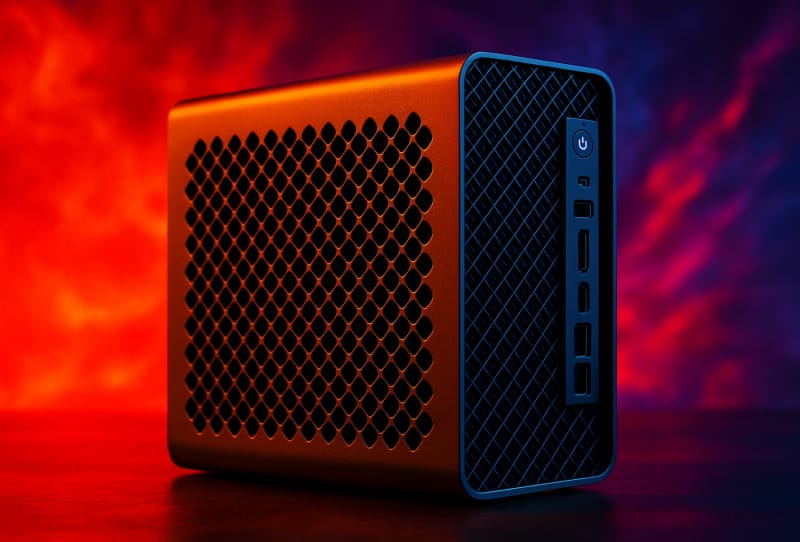
The FEVM RTX 5090 mini PC lineup has arrived in two flavours, the FA80G and FN80G, both squeezing desktop-class processors and Nvidia’s most powerful mobile graphics chip into a chassis smaller than a shoebox. FEVM, a relatively new name in the small-form-factor space, is chasing the same trend that has pushed several manufacturers to cram full-fat gaming hardware into cases that once only held basic mini PCs for browsing and office work.
The FA80G runs on AMD silicon, topping out at a Ryzen 9 9950X3D, while the FN80G swaps in Intel, going as high as a Core Ultra 7 270KP. Both can be configured with an Nvidia GeForce RTX 5090 Mobile GPU, and both fit that hardware into a 2.6-litre enclosure measuring just 180 by 168 by 88 millimetres. That is a remarkably small footprint for components that would normally demand a full tower case with dedicated airflow channels. For context, a typical mid-tower desktop case runs to somewhere between 30 and 50 litres, which puts the scale of FEVM’s engineering challenge into perspective. Of the two, the FA80G is the one drawing most of the early attention, largely because the AMD Ryzen 9 9950X3D pairing gives it a distinct edge in games and applications that lean on the chip’s 3D V-Cache design.
Table of Contents
What’s inside the FA80G and FN80G
Both machines start from a more modest baseline than the headline configuration suggests. The entry point for each is Nvidia’s RTX 5060, with buyers able to step up through a desktop RTX 5060 Ti or an RTX 5080 Laptop GPU before reaching the flagship RTX 5090 Mobile option. That range gives FEVM a genuine ladder of price and performance tiers rather than a single showcase build that most people will never actually configure.
In the RTX 5090 Mobile variant, the GPU is capped at 150 watts, with combined CPU and GPU power draw limited to 250 watts across the whole system. That is a considerable power budget for a case this size, and it explains why FEVM has put so much emphasis on the cooling design rather than just the component list. It also means buyers shouldn’t expect the mobile RTX 5090 to match a full desktop RTX 5090 clock for clock, since the desktop card can draw well over 500 watts on its own; the appeal here is closer to laptop-class performance ceilings squeezed into a system you can leave permanently on a desk.
On the FA80G specifically, the Ryzen 9 9950X3D pairing is the headline draw. It’s a 16-core, 32-thread chip with AMD’s stacked 3D V-Cache, a design that has consistently punched above its power draw in gaming workloads compared with equivalent Intel parts. Slotting a chip like that alongside an RTX 5090 Mobile GPU, rather than the integrated graphics FEVM relied on in its earlier FAEX1, is what pushes the FA80G into genuine small-form-factor gaming PC territory rather than the compact office and media box category most mini PCs occupy. In practical terms, the FA80G is being positioned as FEVM’s flagship AMD build, with the GPU tier chosen at checkout acting as the main lever buyers pull to balance budget against raw performance.
| Model | CPU options | GPU options | Chassis volume |
|---|---|---|---|
| FEVM FA80G | Up to AMD Ryzen 9 9950X3D | RTX 5060 up to RTX 5090 Mobile | 2.6 litres |
| FEVM FN80G | Up to Intel Core Ultra 7 270KP | RTX 5060 up to RTX 5090 Mobile | 2.6 litres |
Neither model ships with memory or storage installed. Both are sold as barebones units, meaning buyers need to supply their own RAM and SSDs before the system is usable, a common approach among boutique mini PC builders that lets them offer a wider range of configurations without holding excess stock of every memory and storage combination. Buyers configuring either machine should also check the maximum supported DDR5 speed and capacity, along with the number of M.2 slots on offer, since these details typically shape how future-proof the finished build ends up being. For the FA80G in particular, pairing the Ryzen 9 9950X3D with faster DDR5 kits tends to matter more than on Intel platforms, since AMD’s architecture is generally more sensitive to memory speed and latency, especially in gaming workloads where the 3D V-Cache is already doing a lot of the heavy lifting.
Buyers weighing up a FA80G build should also consider a few practical points before ordering:
- Confirm the maximum DDR5 speed the motherboard supports, since running memory below its rated speed can leave real performance on the table with the 9950X3D.
- Check how many M.2 slots are available and whether they support PCIe Gen4 or Gen5 drives, particularly if you plan on running multiple large game libraries.
- Factor the cost of a Windows licence, RAM and an SSD into the total budget, since the barebones price only covers the chassis, motherboard, CPU and GPU.
- Consider power supply and desk placement, given the system can draw up to 250 watts combined and will benefit from clear space around its intake and exhaust vents.
- Check which GPU tier is actually in stock at the time of ordering, since the RTX 5090 Mobile configuration is likely to be the most constrained option given how tight supply has been for Nvidia’s top-tier mobile silicon.
- Look for details on port selection and connectivity, such as Wi-Fi standard, Ethernet speed and the number of USB and display outputs, since these can vary between regional listings of the same FA80G chassis.
Cooling and noise inside a tight chassis
FEVM claims its cooling solution keeps the CPU below 85 degrees Celsius and the GPU below 80 degrees Celsius under load, while staying under 42 decibels of fan noise. Those are respectable figures for hardware pulling up to 250 watts combined, particularly given how little internal volume there is to move air through and dissipate heat. For comparison, 42 decibels sits somewhere between a quiet library and a running refrigerator, which suggests FEVM is aiming for a system that stays usable on a desk rather than one that needs to be tucked away in another room.
Thermal management is arguably the harder engineering problem in a build like this, more so than simply sourcing a desktop CPU and a mobile GPU. Cramming components this powerful into 2.6 litres leaves little room for airflow, and any shortfall in the heatsink or fan design shows up quickly as thermal throttling, which would undercut the entire point of fitting a 9950X3D or RTX 5090 Mobile into the box in the first place. Independent reviews and sustained-load benchmarks will ultimately be the real test of these figures, since manufacturer thermal claims are usually measured under best-case conditions rather than the kind of extended gaming or rendering sessions most buyers actually put a machine through. This is a point worth flagging specifically for the FA80G, since the Ryzen 9 9950X3D can draw meaningfully more sustained power than mid-range chips when boosting under load, which puts extra pressure on FEVM’s cooler to keep both the CPU and GPU within their stated limits at the same time rather than one at the expense of the other.
Buyers coming from larger desktop towers should also temper their noise expectations slightly. A 42-decibel ceiling is reasonable for a system this dense, but fan curves on compact machines like the FA80G often ramp up more aggressively than in a roomy tower, simply because there is less thermal mass to absorb short bursts of load before the fans need to respond. Whether that translates into a noticeably “busier” sound profile during variable workloads, such as alt-tabbing between a game and a browser, is the kind of detail that tends to only show up once reviewers get a retail unit on a bench.
How the FA80G and FN80G stack up
FEVM is not new to this category. The company previously released the FAEX1, a mini PC built around AMD’s Ryzen AI Max 395 chip, better known by its Strix Halo codename, fitted into a one-litre enclosure. That earlier machine leaned on an integrated GPU for its graphics performance, whereas the FA80G and FN80G take a different approach entirely, pairing desktop or high-end mobile CPUs with a genuine discrete GPU capable of RTX 5090-class performance.
That shift puts these new models in more direct competition with other small-form-factor gaming rigs rather than the ultraportable mini PC crowd. Other mini workstation makers have gone down a similar path, chasing desktop-grade performance in shrunken cases, and RTX 5090 pricing has already been climbing well above MSRP on the desktop card itself, which makes the mobile variant an interesting alternative for buyers who want similar graphics horsepower without competing for scarce desktop cards. AMD’s own Ryzen AI Halo push at IFA 2026 shows how seriously the chipmaker is taking this compact high-performance segment, and Acer’s small-form-factor RTX Spark desktop is chasing a comparable audience from a different angle.
Positioned against the FN80G, the FA80G’s main selling point is the AMD platform’s gaming-focused cache design, while the FN80G leans on Intel’s Core Ultra 7 270KP for buyers who prefer that ecosystem or have specific software that favours Intel’s architecture. Since both share the same chassis, cooling design and GPU options, the choice between them largely comes down to CPU platform preference rather than any difference in build quality or thermal headroom. Buyers torn between the two might reasonably default to the FA80G if their workload is gaming-first, given the 9950X3D’s cache advantage in that specific use case, and lean toward the FN80G only if they have a concrete reason to prefer Intel’s platform, such as software compatibility or a specific feature tied to the Core Ultra chipset.
What it means for buyers
The barebones format means the FA80G and FN80G will suit builders who already have spare DDR5 memory and an NVMe SSD sitting around, or those who want to pick a specific speed and capacity rather than accept whatever a manufacturer bundles in. It also means the final price and performance depend heavily on what gets installed, so shoppers will need to budget for memory and storage on top of the base unit.
For anyone chasing genuine gaming or content creation performance in a footprint that fits on a shelf rather than under a desk, the FA80G and FN80G represent a meaningful step up from typical mini PCs, most of which rely on integrated graphics. Whether the cooling claims hold up under sustained load in real-world reviews remains to be seen, but on paper, FEVM has built one of the more ambitious compact systems to combine a full desktop CPU with Nvidia’s flagship mobile GPU silicon. As with any newer boutique brand, buyers eyeing the FA80G specifically should weigh the appeal of its compact, high-end spec sheet against the more limited track record FEVM has compared with established mini PC makers, and factor in warranty terms and after-sales support alongside raw performance when deciding whether it’s the right fit.
Frequently asked questions
What is FEVM?
FEVM is a boutique mini PC manufacturer that specialises in small-form-factor systems combining desktop-class or high-end mobile processors with discrete Nvidia graphics. It has previously released compact machines such as the FAEX1, built around AMD’s Ryzen AI Max 395 chip, and has now moved into discrete GPU territory with the FA80G and FN80G.
What’s the difference between the FEVM FA80G and FN80G?
The main difference is the CPU platform. The FA80G is built around AMD hardware, topping out at a Ryzen 9 9950X3D, while the FN80G uses Intel silicon, with a Core Ultra 7 270KP as its highest option. Both share the same 2.6-litre chassis and the same range of Nvidia GPU options, from the RTX 5060 up to the RTX 5090 Mobile.
Do the FEVM mini PCs come with RAM and storage included?
No. Both the FA80G and FN80G are sold as barebones units, so buyers need to supply their own DDR5 memory and NVMe SSD before the system can be used. This keeps the base price flexible but means shoppers should factor in the extra cost of memory and storage when budgeting.
How does the RTX 5090 Mobile in these mini PCs compare to a desktop RTX 5090?
The RTX 5090 Mobile GPU in the FA80G and FN80G is capped at 150 watts, with total system power limited to 250 watts, whereas a desktop RTX 5090 card can draw well over 500 watts on its own. That means performance will sit below a full desktop RTX 5090, but the mobile variant offers a way to get similar graphics architecture and features in a far smaller, quieter package without competing for scarce desktop card stock.
Is the FEVM FA80G worth choosing over the FN80G for gaming?
For gaming-focused buyers, the FA80G’s Ryzen 9 9950X3D generally has the edge, since its 3D V-Cache design tends to help frame rates in cache-sensitive titles more than Intel’s Core Ultra 7 270KP does in the FN80G. Because both share the same chassis, cooling system and GPU options, the decision mostly comes down to whether AMD’s gaming-oriented cache advantage matters more to you than any Intel-specific software or platform preference.