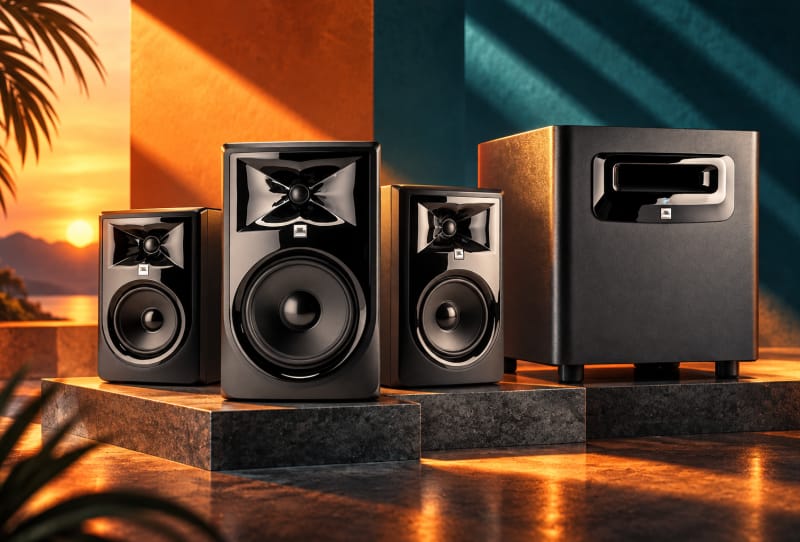
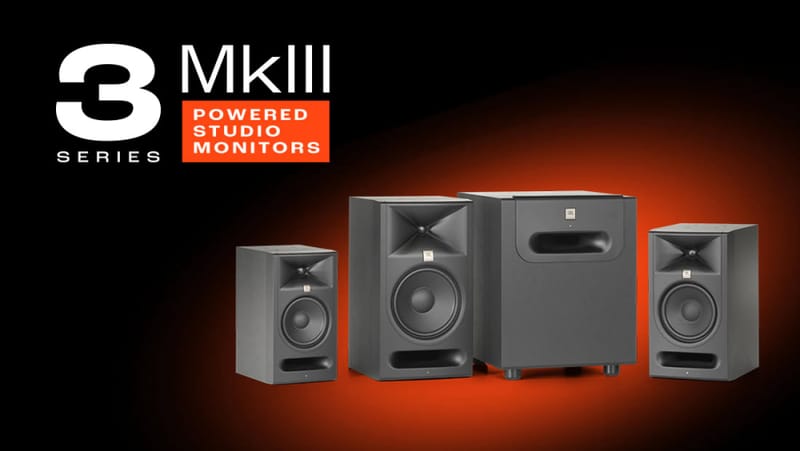
HARMAN Professional Solutions has unveiled the JBL 3 Series MkIII, a full redesign of its popular powered studio monitor range aimed at everyone from bedroom producers to podcast studios. The lineup covers three monitors, the 305P, 306P and 308P MkIII, plus a matching 310S MkIII powered subwoofer, and HARMAN describes it as the most extensive overhaul the 3 Series platform has had since it launched.
Key takeaways
- ✓HARMAN has launched the JBL 3 Series MkIII, its biggest redesign of the platform yet.
- ✓The lineup includes the 305P, 306P and 308P MkIII monitors plus the 310S MkIII subwoofer.
- ✓Upgrades include redesigned acoustic systems, new Class D amplifier modules and simplified room tuning controls.
- ✓Integrated mounting options support setups from basic stereo to 2.1, surround and immersive monitoring.
- ✓The 3 Series has long been a go-to for project studios, podcasters and content creators.
That matters because the 3 Series has quietly become one of the default recommendations for anyone setting up a first proper monitoring system, whether that’s for music production, streaming, video editing or voiceover work. A ground-up refresh of the acoustic design and electronics, rather than a minor spec bump, signals JBL wants to keep that position as competition from other budget studio monitor brands has intensified.
Table of Contents
What’s actually changed in the JBL 3 Series MkIII
According to HARMAN, the MkIII generation introduces redesigned acoustic systems across all three monitor sizes, new Class D amplifier modules, simplified room optimisation controls and integrated mounting hardware. Each of those changes targets a different real-world problem that owners of the previous generation regularly ran into.
Redesigned acoustics generally mean reworked waveguides, driver materials or cabinet bracing to tighten dispersion and reduce cabinet resonance, both of which affect how accurately a monitor reproduces a mix. New Class D amplification should bring efficiency gains and more consistent power delivery across the lineup, which is particularly useful as the subwoofer is now folded into the family rather than treated as an optional extra bought elsewhere.
The simplified room optimisation system is arguably the most practical change for home studio owners. Earlier monitors in this price bracket often buried EQ and boundary compensation switches on the rear panel in a way that discouraged casual users from touching them at all. A clearer, more approachable set of controls makes it easier to correct for a monitor sitting close to a wall or on a cluttered desk, which is the single biggest factor that ruins accurate listening in untreated rooms.
Meet the lineup: 305P, 306P, 308P and the 310S subwoofer
JBL’s model numbering has traditionally hinted at the size of each monitor’s low-frequency driver, with the 305, 306 and 308 designations corresponding to roughly 5-inch, 6.5-inch and 8-inch woofers in earlier 3 Series generations. If that convention carries through to the MkIII range, buyers get a clear size and output ladder to choose from depending on room size and how much low-end extension they need before reaching for a subwoofer.
| Model | Type | Typical use case |
|---|---|---|
| JBL 305P MkIII | Compact powered monitor | Desktop production, podcasting, nearfield mixing |
| JBL 306P MkIII | Mid-size powered monitor | Project studios wanting more headroom and bass extension |
| JBL 308P MkIII | Larger powered monitor | Bigger rooms, mastering, or louder monitoring needs |
| JBL 310S MkIII | Powered subwoofer | 2.1, surround and immersive monitoring setups |
The addition of a dedicated subwoofer to the refreshed family is notable in itself. It lets a 3 Series owner build out a proper 2.1 setup, or step up to surround and immersive monitoring, without having to shop outside the JBL Professional catalogue for a compatible low-frequency unit.
Why the 3 Series redesign matters beyond the spec sheet
Studio monitors in this price and size category sit at an awkward intersection. They need to be accurate enough that mixing decisions translate well to other systems, yet affordable and compact enough for spare bedrooms, desks and small content studios rather than treated control rooms. The original 3 Series built its reputation precisely by hitting that balance, and the MkII generation that followed became a familiar sight in countless home setups.
A redesign pitched as the biggest in the platform’s history suggests HARMAN sees room to improve on that formula rather than simply refresh the industrial design. Integrated mounting options are a good example of a change aimed squarely at the kind of flexible, multi-purpose rooms where these monitors actually live, where a pair might need to sit on stands one week and go wall-mounted the next as a desk gets reorganised.
It also reflects a broader shift in home and project studio gear, echoing the same push toward more precise, more accessible monitoring tools seen recently with products like OLLO Audio’s X2 Studio Headphones. Demand for genuinely accurate listening tools at non-professional prices has grown alongside the rise of home content creation, and manufacturers are responding with dedicated product lines rather than treating budget monitoring as an afterthought.
What it means for buyers considering an upgrade
Anyone currently running the previous 3 Series generation, or shopping for a first pair of proper studio monitors, now has a clearer upgrade path. The simplified room optimisation controls should make it easier to get accurate results without specialist acoustic knowledge, and the option to add the 310S MkIII subwoofer later means a system can grow as a room or workflow changes.
HARMAN has not detailed pricing or exact release timing for the individual models, so anyone interested should keep an eye on official JBL Professional channels for availability in local markets. What is clear is that the 3 Series MkIII is positioned as a meaningful step forward rather than a cosmetic refresh, and that should matter to the wide range of producers, streamers and podcasters who have relied on this family for years.
Frequently asked questions
What is the JBL 3 Series MkIII?
It is the third generation of JBL Professional’s popular powered studio monitor range, covering the 305P, 306P and 308P monitors plus the new 310S powered subwoofer, redesigned with new acoustics and amplification.
How is the MkIII different from the previous 3 Series MkII?
HARMAN describes it as the most extensive redesign of the platform to date, with reworked acoustic systems, new Class D amplifier modules, simplified room optimisation controls and integrated mounting hardware.
Does the JBL 3 Series MkIII include a subwoofer?
Yes. The 310S MkIII is a dedicated powered subwoofer designed to pair with the monitors for 2.1, surround and immersive monitoring setups.
Who are the JBL 3 Series MkIII monitors designed for?
They are aimed at home and project studio owners, including music producers, podcasters, streamers and video editors, who need accurate monitoring without a full professional control room setup.