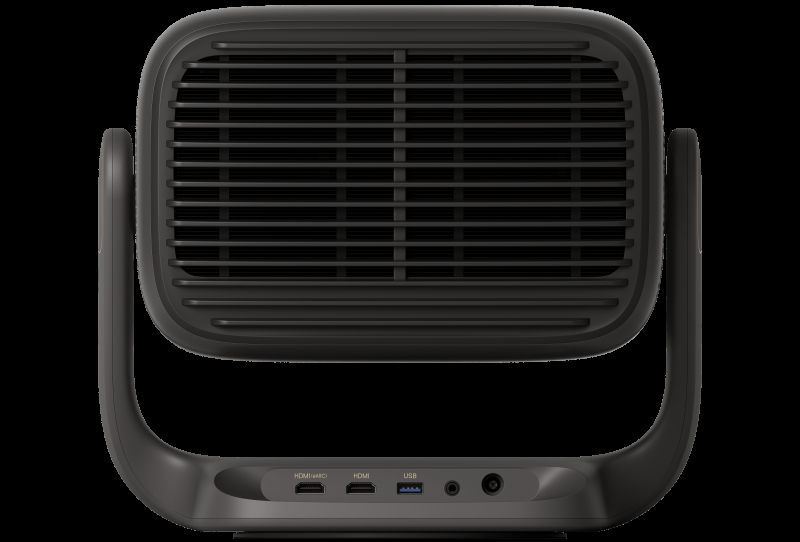
The JMGO Iris Ultra Max projector has arrived outside China, bringing a genuinely unusual pitch for anyone building a living room setup around gaming and sport rather than just movies. It combines 4K resolution with a smooth 120Hz refresh rate, variable refresh rate support, and a contrast system JMGO claims can hit 10,000:1 native, all wrapped in an all-in-one Google TV projector that handles its own smart platform without an external box.
That combination matters because projectors have historically struggled with two things at once: brightness and contrast. Push the lamp harder for a punchy, well-lit image and blacks tend to wash out into grey. JMGO says its new dual-iris system is designed to solve exactly that problem, and it has paired the approach with a triple-laser light engine rated at 6,500 ISO lumens. For buyers searching specifically for the JMGO Iris Ultra Max, this is the headline trade-off the projector is trying to solve: a bright enough image for a well-lit lounge room without sacrificing the deep blacks that make sport and cinematic content look convincing.
Table of Contents
How the JMGO Iris Ultra Max projector tackles contrast
Contrast has long been the Achilles heel of bright projectors, and JMGO’s answer is to use two separate physical apertures rather than one. Each iris sits at a different point along the internal optical path, and together they control light scatter and brightness with far more precision than a single iris allows. The result, according to JMGO, is that native 10,000:1 contrast figure, a notable jump for a projector this bright.
In practical terms, a dual-iris design like this works by dynamically narrowing or widening the light path depending on what is on screen. A dark, moody scene can have stray light physically blocked before it ever reaches the lens, while a bright sports broadcast or daytime shot can open both apertures fully to maximise output. Single-iris projectors have to compromise between these two extremes, which is why native contrast figures on rival models often sit well below the 10,000:1 JMGO is claiming here.
Brightness on its own has become something of an arms race in the projector world. A year ago, 6,000 ISO lumens from an all-in-one unit was considered cutting edge. Heading into IFA 2026, that figure looks like it is becoming the baseline expectation, with 4K images running at a steady 120Hz for fast motion becoming the next battleground. The Iris Ultra Max arrives right in the middle of that shift, aiming to lead rather than follow.
Whether the extra brightness holds up under real viewing conditions remains an open question. JMGO’s own N3 Ultimate, an earlier flagship, reportedly suffered from colour distortion when pushed to peak brightness, which is a useful reminder that headline lumen figures do not always translate into a clean, accurate picture. Independent reviews of the Iris Ultra Max will be the real test, particularly around skin tones during sport broadcasts and shadow detail in darker gaming scenes, two areas where over-driven brightness tends to expose weaknesses first.
Specs, gaming features and flexible placement
Beyond brightness and contrast, the Iris Ultra Max is built around flexibility. It sits on a motorised pan-and-tilt gimbal, letting owners reposition the image with remote-style control rather than physically moving the unit. That is paired with a 0.88 to 1.7:1 optical zoom range and generous lens shift, at plus or minus 130 percent vertically and 53 percent horizontally, giving installers unusually wide latitude over where the projector sits relative to the screen.
This level of placement flexibility is worth dwelling on, because it is one of the more practical everyday advantages of the Iris Ultra Max over cheaper fixed-lens projectors. A motorised gimbal combined with wide lens shift means the unit can sit off to the side of a room, on a low shelf, or even behind furniture, and still be steered onto a screen or wall without needing to physically relocate the hardware or use digital keystone correction, which typically softens image quality.
| Feature | Specification |
|---|---|
| Resolution | 4K |
| Refresh rate | 120Hz with VRR and ALLM |
| Brightness | 6,500 ISO lumens |
| Native contrast | 10,000:1 via dual-iris system |
| Light source | Triple-laser engine |
| HDR support | Dolby Vision at 4K 120Hz |
| Optical zoom | 0.88 to 1.7:1 |
| Lens shift | V ±130% / H ±53% |
| Placement | Motorised pan-and-tilt gimbal |
| Smart platform | Google TV built in |
The inclusion of VRR and ALLM is a clear signal of who JMGO is chasing with this release. Variable refresh rate keeps motion smooth without tearing during fast gameplay, while auto low latency mode strips out unnecessary processing delay when a console or PC is plugged in. Layer Dolby Vision HDR at 4K 120Hz on top, and the Iris Ultra Max is squarely aimed at buyers who want a big-screen alternative to a gaming monitor, not just a home cinema box for film night.
For sports fans specifically, the same feature set does double duty. A high native contrast ratio helps stadium lighting and pitch detail look natural rather than blown out, while the 120Hz panel and triple-laser brightness keep fast-moving action, such as a football match or motorsport broadcast, looking sharp rather than smeared. It is a rare projector spec sheet that reads equally well for a Saturday afternoon match and a late-night gaming session.
How it stacks up against rivals
JMGO is not alone in chasing this space. Rival brands have been pushing their own big-screen ambitions at the same events, including Epson’s own new projector lineup and the standalone launch of Epson’s EB-XQ2030B projector, both unveiled ahead of Integrate 2026. Where those models lean more toward business and installation use cases, the Iris Ultra Max is pitched more directly at home entertainment, with its Google TV integration and gaming-first feature set doing the talking.
For anyone already invested in gear built for competitive gamers, a low-latency, high-refresh projector like this fills a gap that traditional home cinema projectors rarely address. Most projection systems still prioritise cinematic accuracy over responsiveness, leaving gamers to either compromise on lag or stick with a monitor. JMGO’s approach suggests the two use cases no longer need to be mutually exclusive.
What it means for buyers
The Iris Ultra Max is scheduled to begin shipping from October 19, giving early adopters a concrete date to plan around, though the real value of its brightness and contrast claims will only become clear once independent testing rolls in. Colour accuracy at peak output is the detail worth watching closely, given JMGO’s own history with the N3 Ultimate.
Still, the feature set on paper is compelling. A genuinely bright, 120Hz, 4K projector with proper VRR and ALLM support, wrapped in a Google TV package that needs no external streaming box, addresses a real gap for anyone wanting a big-screen setup that handles sport, movies and gaming equally well. Buyers weighing it up should look for hands-on reviews that specifically test brightness uniformity and colour stability before committing, along with real-world input lag figures when the projector is paired with a console or gaming PC.
Frequently asked questions
What makes the JMGO Iris Ultra Max different from other 4K projectors?
Its main point of difference is the dual-iris optical system paired with a triple-laser light engine, which JMGO says allows it to hit 6,500 ISO lumens of brightness alongside a native contrast ratio of 10,000:1. Most bright projectors sacrifice contrast for output, or vice versa, so combining both at this level in an all-in-one Google TV unit is unusual.
Is the JMGO Iris Ultra Max good for gaming?
On paper, yes. It supports 4K at 120Hz, variable refresh rate and auto low latency mode, along with Dolby Vision HDR at that same 120Hz refresh rate. Together these features are designed to minimise input lag and motion blur, making it a genuine big-screen alternative to a gaming monitor rather than a projector built purely for film playback.
Does the JMGO Iris Ultra Max need a separate streaming device?
No. It runs Google TV built directly into the projector, so it can handle streaming apps and general smart TV functions on its own without an external box such as a Chromecast or set-top device plugged into an HDMI port.
When does the JMGO Iris Ultra Max ship?
JMGO has set a shipping start date of October 19. As with any newly launched projector, buyers are advised to wait for independent reviews covering brightness uniformity and colour accuracy at peak output before making a final purchase decision.