Roblox unveiled a sweeping upgrade to its Roblox AI game creation tools at this year’s Roblox Developer Conference, promising faster building, smarter non-player characters and a much wider audience for whatever developers make. The announcements, delivered at the company’s annual event for creators, cover everything from natural-language game building to a dedicated payment card for people earning money on the platform.
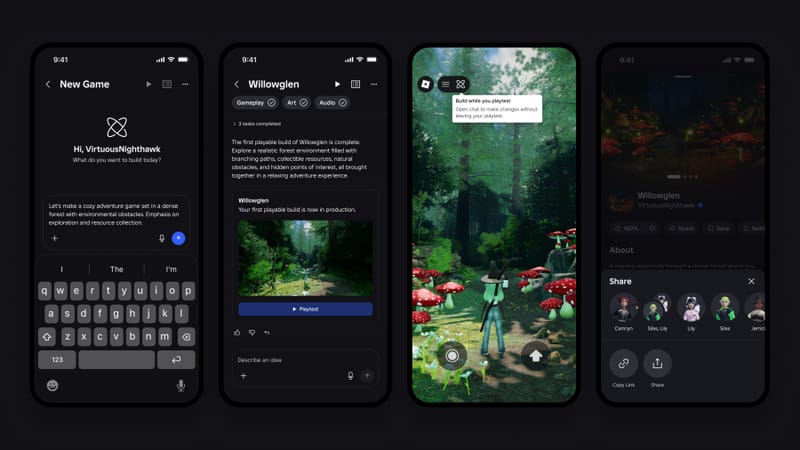
The headline change is the broader rollout of Build, Roblox’s generative AI tool that lets creators describe a game in plain language and have the system generate it. Build launched quietly in New Zealand in July. It’s now expanding to Serbia and Singapore, alongside desktop access for creators who want a bigger screen to work with, a new asset library, and finer iterative control over what gets generated. Later this year, a prompt-based scene-generation feature will arrive, eventually making its way into Roblox Studio itself.
Table of Contents
Roblox games are no longer staying inside Roblox
Perhaps the more consequential shift is where these games will actually run. Roblox confirmed that creators will soon be able to package their games as standalone apps for mobile, PC and consoles, with Roblox effectively acting as the underlying engine rather than the destination. By the end of the year, players will also be able to join a game straight from a browser link, no app download required.
That’s a notable change in direction for a company that has spent over a decade pulling players into its own walled garden. Instead, Roblox appears to be betting that letting developers distribute more freely will grow the overall pie, even if some of that play happens outside the core app. It mirrors a broader industry pattern of platforms loosening distribution control once their creator economy becomes valuable enough to protect.
Smarter NPCs and quality-of-life features
Non-player characters are getting a functional upgrade too. Later this year, NPCs will be able to playtest a game automatically, giving developers a way to catch bugs or balance issues without needing a human tester on hand. Roblox is also adding an offline mode so players in areas with patchy connectivity can keep playing, and a persistent Friends chat tab that follows players between games, complete with voice typing support.
Discovery is changing as well. An updated recommendation algorithm will steer younger users toward shorter, quicker games while suggesting longer, more involved experiences to older players. On the creation side, Roblox’s engine now supports 2D game development with an orthographic camera, animated image containers and direct sprite-sheet import, opening the platform to genres it has traditionally handled poorly. Inside the Moments short-video feed, players will also be able to tap an avatar in a clip and buy the items it’s wearing.
| Feature area | What’s new |
|---|---|
| Creation | Build AI tool expands to Serbia and Singapore, gets desktop access, asset library, scene generation |
| Distribution | Games publishable as standalone mobile, PC and console apps; browser join by year-end |
| NPCs and social | Playtesting NPCs, offline mode, persistent Friends chat with voice typing |
| Discovery | Age-tailored recommendations; shoppable Moments video feed |
| Monetisation | Roblox Wallet with same-day payouts; Roblox Card launching next year |
Creators get paid faster, with a card on the way
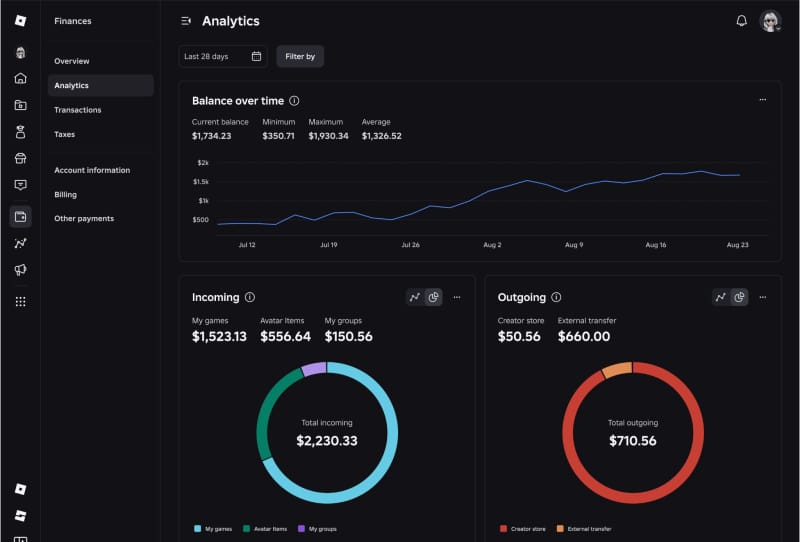
Roblox used the conference to highlight just how much money is now moving through its creator economy. The company says developers have collectively earned more than $5 billion since 2013, with $1.7 billion of that coming in the past 12 months alone. To make that money easier to access, Roblox is launching a Wallet that pays creators in real currency by the end of each business day, with the option to transfer funds to an external bank account.
The Wallet is being built in partnership with Airwallex, initially for US-based users aged 18 and over, with global expansion planned down the track. A companion Roblox Card, allowing creators to spend earnings directly wherever the card is accepted, is slated to launch next year.
Why this matters beyond Roblox’s own numbers
Roblox CEO David Baszucki noted that players spent more than 29 billion hours on the platform last quarter alone, across 180 countries. That scale is exactly why the shift toward AI-assisted creation and looser distribution matters. Lowering the skill barrier to build a game, while widening where that game can be played, is a direct play for more of the time people spend gaming generally, not just on Roblox itself.
It also puts Roblox in more direct competition with traditional game engines and storefronts, since a title built with Build could theoretically reach players who never open the Roblox app at all. For hobbyist developers, the combination of AI-assisted tools and faster, more flexible payouts lowers both the technical and financial barriers to treating game-making as a side income rather than a hobby. Whether that translates into genuinely original games, rather than a flood of similar AI-prompted experiences, is the question the next year of releases will likely answer.
For players, the practical upshot is more games appearing in more places, from console storefronts to a simple browser tab, without needing to set up a Roblox account first. Combined with smarter NPCs and an offline mode for patchy connections, the platform is clearly trying to remove friction on every side of the experience, not just for the people building the games but for everyone who eventually plays them.