Steam Deck Verified games have officially crossed a major threshold, with more than 30,000 titles now carrying Valve’s Verified or Playable badge across Steam Deck and SteamOS. It is a number that would have seemed unthinkable when the handheld first launched in 2022, and it says a lot about how quickly Linux gaming has matured in just a few years.
The figure comes from SteamDB, the community-run tracker that pulls directly from Valve’s own compatibility data. According to its listings, Steam now counts 30,023 games rated either Verified or Playable for Steam Deck and SteamOS. ProtonDB, the independent site that crowdsources compatibility reports and cross-references Valve’s own ratings, puts the number slightly lower at 29,988. The small gap between the two isn’t unusual, since each source updates on a slightly different schedule and applies its own verification checks before a title is added to the count.
Table of Contents
How the Steam Deck Verified games milestone breaks down
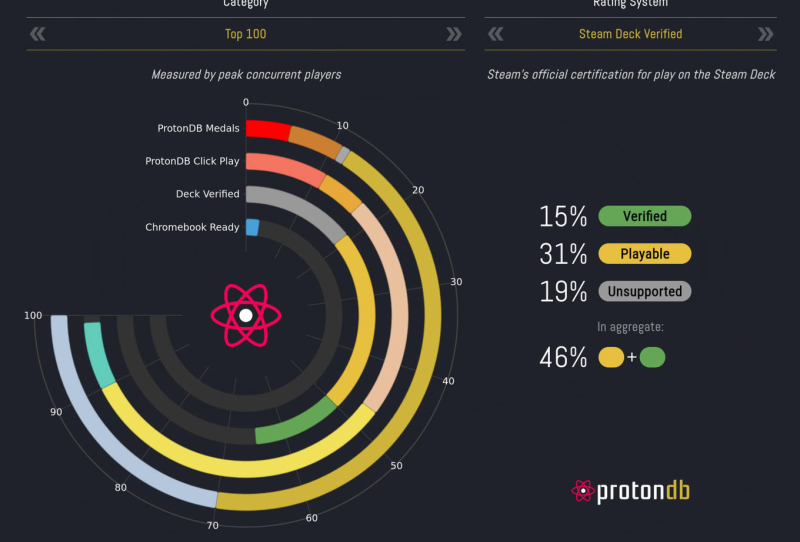
Raw totals only tell part of the story. ProtonDB also tracks how compatible the most popular games actually are right now, which matters more to someone deciding whether a handheld PC can replace a console or a gaming laptop. Of the ten most-played games on Steam by concurrent player count, 40 percent are rated Verified or Playable. Widen that to the top 100 most-played titles, and the share climbs to 46 percent.
Those numbers matter because they reflect what people are actually playing, not just what happens to be in Valve’s back catalogue. A huge library of Verified indie games is nice, but a Steam Deck owner is far more likely to care whether the latest live-service shooter or open-world release actually runs. The trending data suggests that, for roughly half of the games people are currently loading up, the answer is yes.
What Verified, Playable and Unsupported actually mean
Valve uses a simple four-tier rating system to judge how well a game runs on Steam Deck hardware without any tinkering. Understanding the difference helps explain why the 30,000 figure is meaningful rather than just a big round number.
| Rating | What it means for players |
|---|---|
| Verified | Works great out of the box, with readable text, proper controller support and no manual tweaks needed |
| Playable | Runs fine but may need small adjustments, such as an on-screen keyboard for text entry or manual control mapping |
| Unsupported | Known issues prevent the game from running properly on Steam Deck |
| Unknown | Not yet tested or rated by Valve or the community |
The 30,023 figure from SteamDB combines the top two tiers, meaning every one of those games either works flawlessly or needs, at most, a minor workaround. That is a meaningfully higher bar than simply “the game launches.”
Why Proton changed the equation for Linux gaming
None of this would have been possible without Proton, Valve’s compatibility layer that translates Windows game code so it runs on Linux-based systems like SteamOS. Before Proton matured, Linux gaming was a niche pursuit reserved for people willing to fight with configuration files and community patches. Steam Deck forced the issue in a way nothing else had, because Valve needed a reliable way to guarantee that thousands of existing Windows games would work on a Linux-powered handheld from day one.
That pressure pushed publishers and engine makers to consider Linux compatibility during development rather than as an afterthought, if they considered it at all. Independent testing has previously found that close to 90 percent of Windows games can run on Linux systems through Proton, a figure that would have been unimaginable a decade ago. The Steam Deck Verified games count is really a visible, ongoing scoreboard for that broader shift.
What the milestone means for buyers and the wider industry
For anyone weighing up a Steam Deck or a rival SteamOS handheld, the practical upshot is straightforward: the odds of a new purchase working properly have never been better. A library of 30,000-plus compatible titles covers the overwhelming majority of what a typical PC gamer already owns, and the trending data shows that popular new releases are increasingly likely to join that list rather than sit on the sidelines.
The milestone also puts pressure on developers who haven’t yet tested their games against Proton, since compatibility badges have become a genuine purchasing signal on Steam’s storefront. It reinforces Valve’s long-term bet that a healthy Linux gaming ecosystem benefits the whole platform, not just Steam Deck owners. As more handhelds built on SteamOS reach the market, that 30,000-game benchmark is likely to keep climbing rather than plateau.