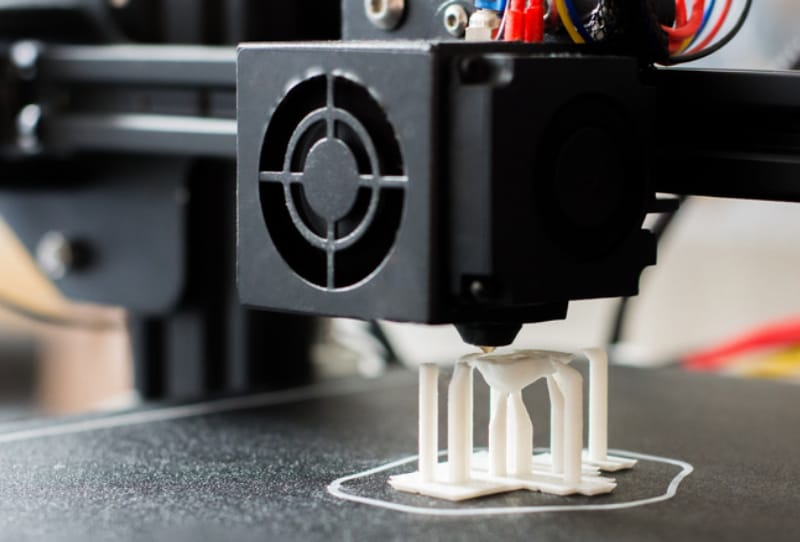
3D printer bedroom safety depends largely on ventilation, the type of filament or resin used, and sensible fire precautions, not simply on which room the machine sits in. A printer running for hours in a small, closed bedroom can quietly raise levels of ultrafine particles and volatile compounds well above what’s comfortable to breathe overnight. A home office faces a similar issue, just usually with better airflow and fewer hours of exposure while someone sleeps nearby.
Key takeaways
- ✓FDM printers release ultrafine particles and VOCs that build up in small, closed rooms over hours of printing.
- ✓ABS and ASA filaments emit more styrene-related fumes than PLA, which is comparatively milder.
- ✓Resin printers pose a different hazard: uncured resin is toxic to touch and its fumes need active ventilation.
- ✓Heated beds and hotends create a genuine fire risk, especially during unattended overnight prints.
- ✓Enclosed printers with built-in filtration reduce, but don't eliminate, the need for good airflow.
3D printers have become common enough that plenty of hobbyists, students and small businesses now run them in spare bedrooms, studies or home offices rather than a garage or workshop. That convenience is real. So is the need to understand what a printer actually releases into a room, and why placement, material choice and basic fire awareness matter more than most buyers realise when they first unbox a machine.
Table of Contents
What actually comes out of a 3D printer
Most desktop 3D printers use fused deposition modelling, known as FDM, which melts a plastic filament and extrudes it layer by layer. That melting process, often at temperatures between 190 and 260 degrees Celsius, releases ultrafine particles and volatile organic compounds (VOCs) into the surrounding air. These particles are far too small to see and often don’t produce a strong smell, which makes it easy to underestimate how much a printer is adding to the air over a long print.
Researchers studying indoor air quality have found that particle emissions tend to spike early in a print, when the nozzle first heats up, and then settle into a steadier but still measurable output for the rest of the job. In a small bedroom with the door closed, that output has nowhere to go. Over several hours, concentrations can climb well above levels considered acceptable for a space where someone is also sleeping. Government health bodies publish broader guidance on indoor air quality and volatile organic compounds that applies just as well to a printer as it does to paint fumes or new furniture.
Filament and resin don’t carry the same risk
Not every filament behaves the same way once it’s heated. PLA, the most common beginner material, is derived from plant starch and tends to produce a comparatively mild, slightly sweet smell with lower VOC output than other plastics. ABS and ASA, both popular for their strength and heat resistance, release styrene and related compounds at higher concentrations, which is why they’re generally recommended only with decent ventilation or an enclosure. Nylon sits somewhere in between, releasing caprolactam fumes that some people find irritating in enclosed spaces.
Resin printers, which use SLA or DLP technology to cure liquid resin with UV light, introduce an entirely different hazard. Uncured resin is toxic on skin contact and shouldn’t be handled without gloves, and the curing and cleanup process releases its own fumes that need active extraction rather than just an open window. Anyone running a resin printer in a bedroom needs a far more deliberate ventilation setup than someone running PLA on an FDM machine.
| Material | Main emission concern | Relative risk indoors |
|---|---|---|
| PLA | Low VOC output, mild odour | Lower |
| ABS / ASA | Styrene and related compounds | Higher |
| Nylon | Caprolactam fumes | Moderate to higher |
| Resin (SLA/DLP) | Toxic uncured resin, curing fumes | High, different profile |
Fire and electrical risks nobody budgets for
Heated beds and hotends run genuinely hot, often between 60 and 110 degrees Celsius for the bed and well over 200 degrees at the nozzle. A jammed extruder, a worn thermistor or a cheap power supply can all push a printer toward thermal runaway, where heating continues uncontrolled. It’s an uncommon failure on modern machines with proper safeguards, but it’s exactly the scenario that makes leaving a printer running unattended overnight, in a room full of bedding and fabric, a genuinely risky habit rather than a convenience.
Buying a printer with recognised safety certification from bodies like UL is one of the simplest ways to reduce that risk, since certified machines are tested for thermal cutoffs and electrical safety under realistic failure conditions. Regulators are starting to pay closer attention to 3D printers more broadly too. California’s new law targeting 3D-printed firearm components is aimed at a different issue entirely, but it signals that lawmakers now see home 3D printers as devices worth regulating, not just hobbyist novelties.
Building a safer print space at home
The simplest fix is airflow. A cracked window, an extraction fan, or printing in a room that isn’t sealed overnight all make a measurable difference to how much particulate and VOC exposure builds up. Keeping the printer away from curtains, bedding and anything flammable, and sitting it on a hard, non-combustible surface, further reduces the consequences if something does go wrong mechanically.
Enclosed printers help considerably, since a sealed chamber traps more fumes and particles than an open frame design, especially when paired with carbon and HEPA filtration. Machines like enclosed machines like the Bambu Lab A2L, the Creality K2 Combo and the QIDI Q2 all build filtration and containment into the design, which matters more in a bedroom than in a garage. None of that replaces common sense, though. Avoid unattended overnight prints in a room someone sleeps in, fit a smoke alarm nearby, and treat a home office or a well-ventilated space as the better long-term location if printing becomes a regular habit rather than an occasional project.
Frequently asked questions
Is it safe to sleep in the same room as a running 3D printer?
It’s not ideal for long prints, since particle and VOC levels build up over several hours in a sealed room. Short prints with good ventilation are lower risk, but a dedicated space away from where someone sleeps is the safer long-term option.
Does PLA filament produce harmful fumes?
PLA generally produces lower VOC levels than ABS, ASA or nylon, and many people find it has a mild, inoffensive smell. It still releases ultrafine particles during printing, so ventilation is worthwhile even with PLA.
Do resin printers need different safety precautions than filament printers?
Yes. Uncured resin is toxic to handle directly and needs gloves, while curing and cleanup release fumes that call for active extraction rather than just an open window, unlike most FDM filament printing.
Can a 3D printer actually catch fire?
It’s uncommon on certified machines with proper thermal protection, but heated beds and hotends run hot enough that a fault, especially during an unattended overnight print, can pose a genuine fire risk.