JBL has built an entire ecosystem around the idea that a Bluetooth speaker should be tough enough to survive a weekend away and small enough to disappear into a bag, and the JBL Grip is the latest addition to that lineup. Reviewed here in its white finish, this cylindrical little speaker slots in between the tiny Clip 5 and the larger Flip 7, aiming to give listeners a grab-and-go option that still sounds like it means business. It is a speaker built for the in-between moments, the bike ride, the backyard hangout, or the desk at home when a phone speaker just will not cut it.
Review summary
JBL Grip
The JBL Grip is a compact, rugged Bluetooth speaker that fits neatly between the Clip 5 and Flip 7, offering a distinctive upright design, IP68 durability, and a genuinely useful ambient light strip. Sound quality is solid for its size, with the passive radiators giving surprising low-end presence, while the JBL Portable app adds equaliser control and Auracast flexibility for pairing with other JBL speakers. It performs well as a grab-and-go option for everyday outdoor and casual indoor use.
Highlights
- ✓IP68 waterproof and dustproof rating
- ✓Distinctive upright design with ambient light strip
- ✓Solid bass from dual passive radiators
- ✓Auracast and stereo pairing support
- ✓Seven-band EQ via JBL Portable app
What immediately sets the Grip apart from other compact JBL models is its upright, can-shaped design and the integrated ambient light strip running down its back. It is a small but deliberate point of difference that gives the Grip its own identity rather than making it feel like a shrunken Flip or an inflated Clip. Paired with JBL’s familiar rugged build quality, it feels like a speaker designed for people who want personality alongside portability.
This review looks at how the JBL Grip handles everyday use, from its physical design and control layout through to its sound signature, battery life, and the features unlocked through the JBL Portable app. The aim is to work out whether this newest member of JBL’s portable family earns its place, or whether it simply overlaps with speakers the brand already makes exceptionally well.
Table of Contents
Design and Functionality
The JBL Grip takes its name seriously. Rather than following the squat, rounded shape of the Flip or Charge series, it stands upright like an energy drink can, a design language JBL has not used before in its portable speaker range. In white, the speaker has a clean, almost minimalist look that should suit a wide range of settings, from a kitchen bench to a picnic table.
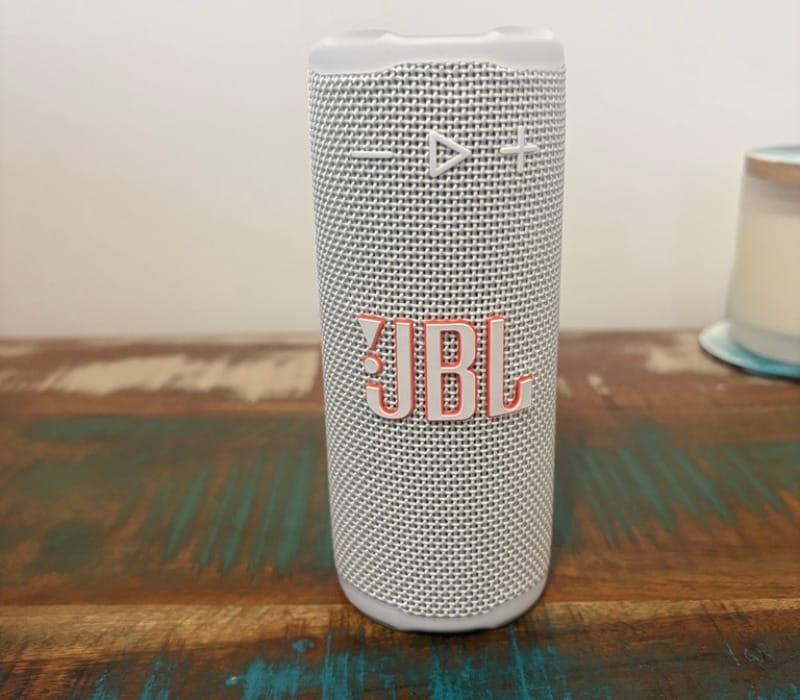
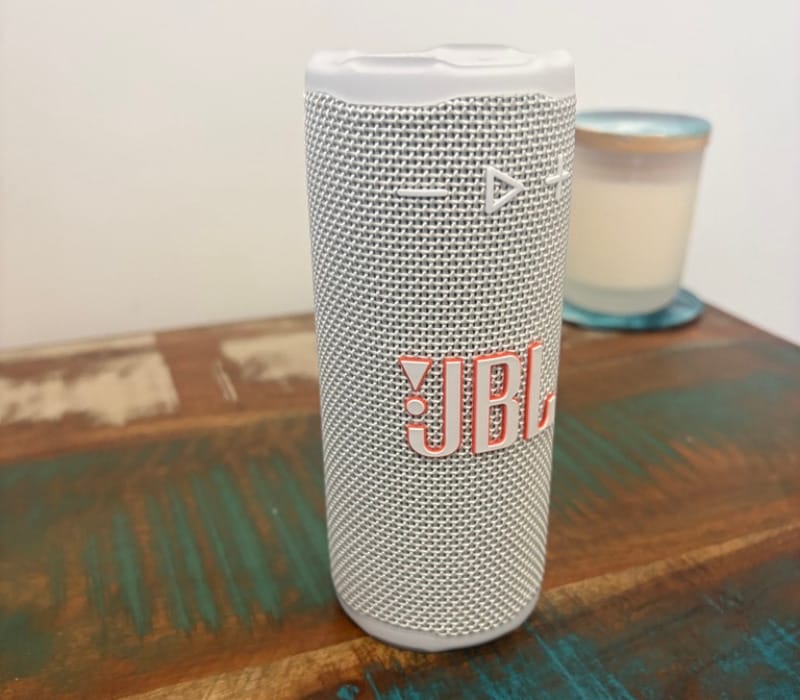
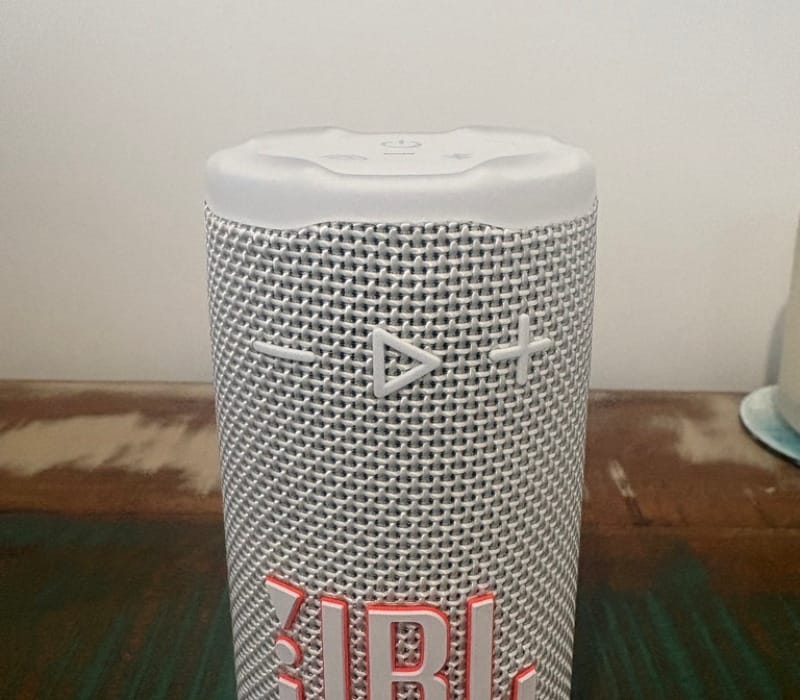
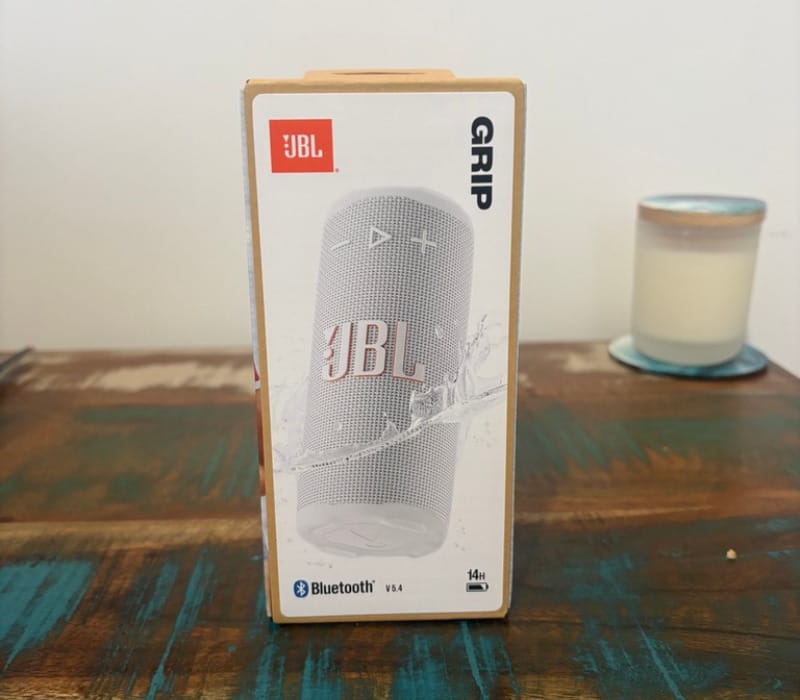
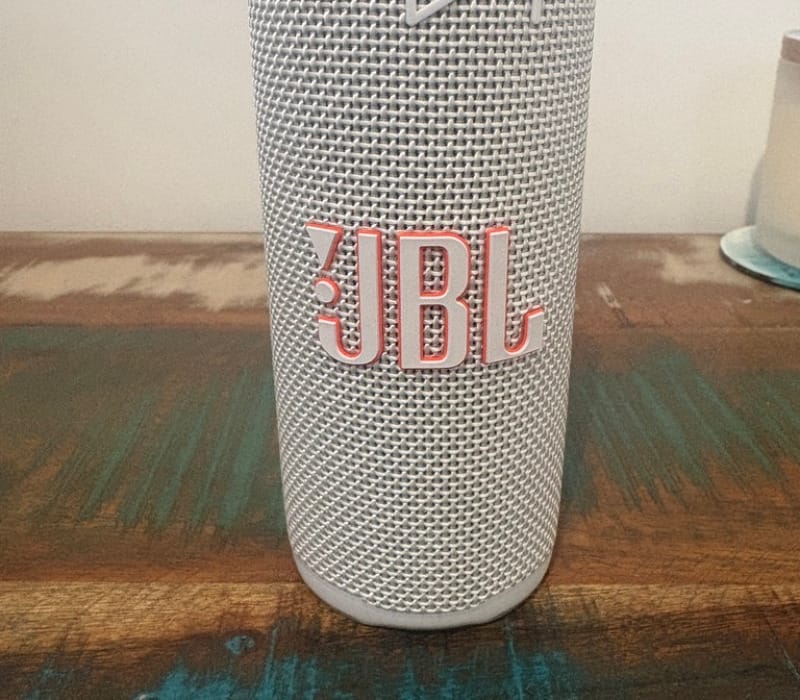
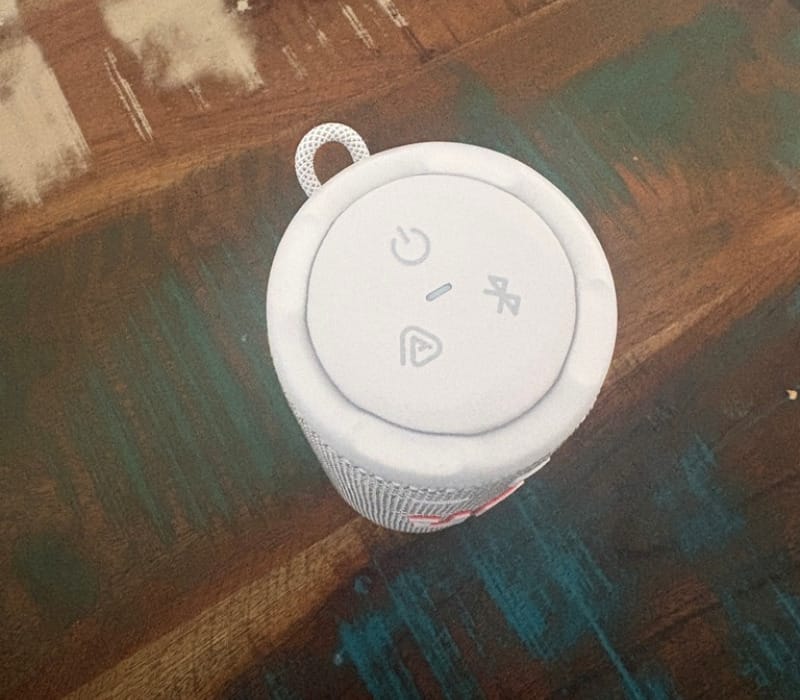
At 385 grams, the Grip sits comfortably between the 285-gram Clip 5 and the considerably heavier 585-gram Flip 7. That middle-ground weight makes it easy to justify tossing into a backpack or tote without really noticing it is there, while still feeling substantial enough in the hand that it does not seem flimsy.
The speaker’s body is wrapped in a durable fabric grille made from recycled material, a detail that fits with JBL’s broader push towards more sustainable manufacturing. The plastic housing beneath is also made using post-consumer recycled content, and the packaging itself uses FSC-certified paper printed with soy ink, small touches that add up for environmentally conscious buyers.
Durability is where the Grip really leans into JBL’s reputation. It carries an IP68 rating, meaning it is fully protected against dust ingress and can handle submersion in water, not just splashes. On top of that, JBL has given it a drop-proof rating, engineered to survive a one-metre fall onto concrete without missing a beat.
That combination of ratings makes the Grip a sensible option for outdoor use, whether that is a day at the beach, a hike, or simply leaving it on a balcony table during a barbecue where a spilled drink or sudden downpour would otherwise be a real concern.
Around the top of the speaker sit the primary controls, including power, Bluetooth pairing, and Auracast buttons, all raised slightly so they can be found by feel rather than sight. Volume and playback controls run along the front face, keeping the layout intuitive for anyone who has used a JBL portable speaker before.
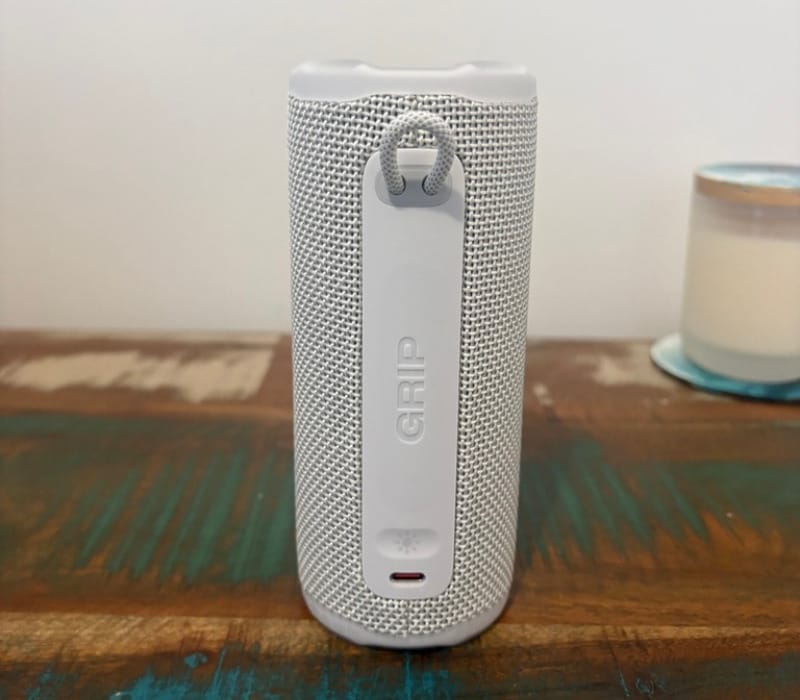
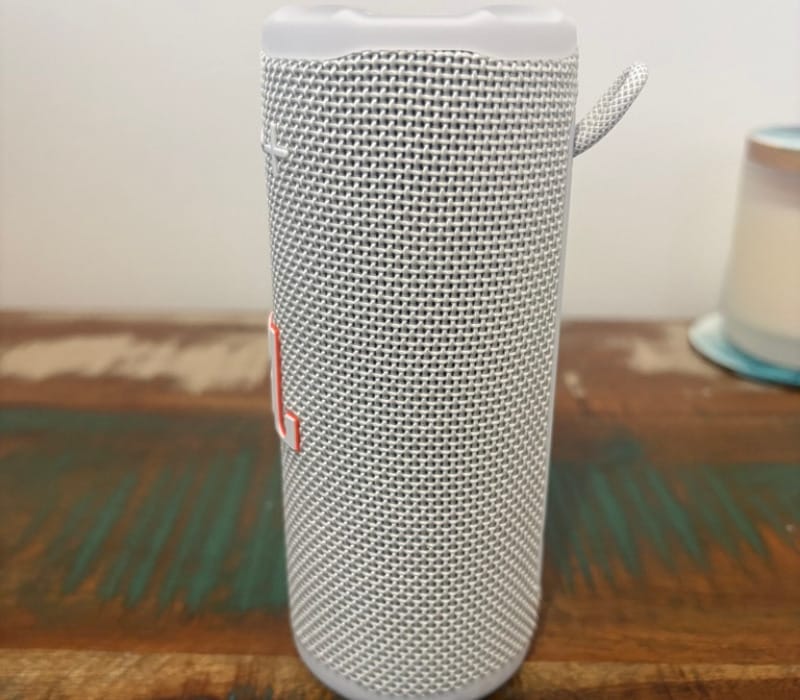
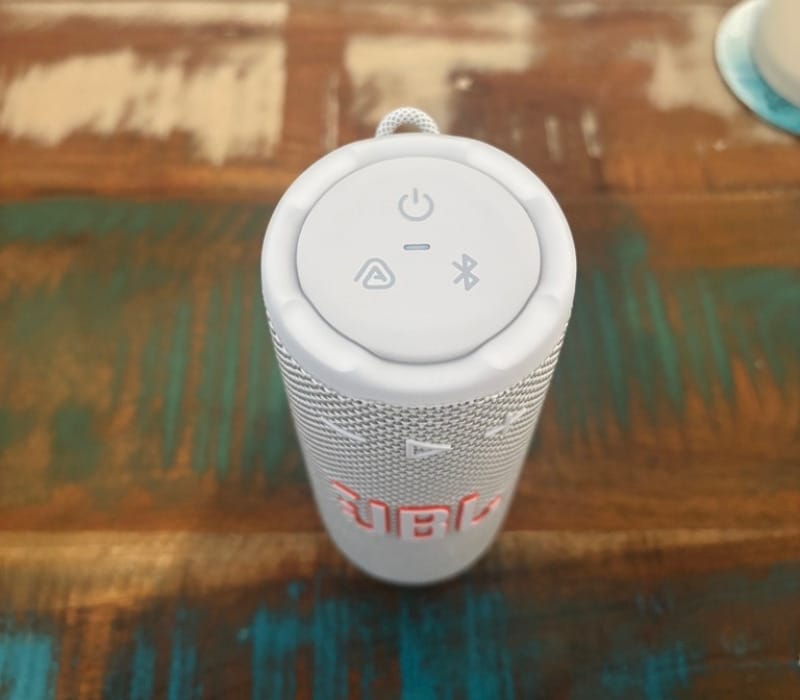
On the rear, a small loop provides an attachment point for a carabiner, which is sold separately, allowing the Grip to be clipped onto a bag strap or belt loop for hands-free carrying. It is a practical addition that reflects how JBL expects this speaker to actually be used day to day.
The standout physical feature, however, is the ambient light strip built into the back panel. It is bright enough to be noticeable even in daylight and can be adjusted for colour and brightness either through a dedicated button or via the JBL Portable app.
This lighting element is not just a gimmick tacked on for show. It gives the Grip a sense of character that other compact JBL speakers lack, and it is genuinely useful for setting a mood at night, whether that is a warm glow for a quiet dinner outdoors or a livelier colour for a get-together with friends.
The build quality throughout feels consistent with what JBL has delivered across its recent portable lineup. Seams are tight, the fabric is taut without bunching, and the buttons offer a satisfying amount of resistance so accidental presses are unlikely while the speaker is being carried around.
Charging is handled via USB-C, a sensible and increasingly universal choice that means most people will already have a compatible cable on hand. There is no support for a wired audio input, so the Grip is a Bluetooth-only affair, though this is in keeping with the rest of JBL’s compact portable range.
The cylindrical shape also has a practical benefit beyond aesthetics. It slides easily into the side pocket of a backpack or a bag that would otherwise struggle to accommodate the wider, flatter shape of speakers like the Flip 7 or Charge 6.
JBL has certified the Grip through independent testing bodies, including a TUV quality mark noted on the official product listing, reinforcing that the build and safety standards have been externally verified rather than simply claimed by the manufacturer.
The white colourway reviewed here has a fresh, versatile look that avoids feeling too clinical thanks to the textured fabric grille. It photographs well and tends to show off the ambient lighting effect a little more vividly than darker colour options might.
Footprint and shape aside, the Grip still manages to feel like a considered piece of industrial design rather than a stripped-down budget speaker. Every element, from the loop attachment to the light strip, appears to serve an actual purpose rather than existing purely for visual flair.
For anyone who has handled a JBL Clip or Flip speaker before, the Grip will feel immediately familiar in terms of material quality, while still offering enough of a fresh shape and lighting feature to justify its own spot in the range.
Key Features
At the heart of the JBL Grip’s audio performance is what JBL calls Bold JBL Pro Sound, paired with a feature the company refers to as AI Sound Boost. This analyses the music being played in real time and adjusts output on the fly, aiming to deliver a fuller sound with less distortion even when the volume is pushed higher.
Inside the compact housing sits a single 43 x 80mm full-range driver, delivering 16 watts of mono, directional sound. It is not designed to fill a large room on its own, but rather to project clearly towards whoever is closest, which suits its intended use as a personal or small-group speaker.
Complementing the driver are passive radiators that help reinforce low-end output without requiring a larger enclosure. This is a common approach in compact speakers, and it allows the Grip to produce more low-frequency presence than its size would otherwise suggest.
Battery life is rated at up to 12 hours on a single charge under normal use, which should comfortably cover a full day out. For those who need a little more, enabling Playtime Boost within the JBL Portable app extends that figure to a claimed 14 hours, trading a small amount of audio headroom for extra runtime.
The JBL Portable app is central to getting the most from the Grip. Once connected, it unlocks a seven-band equaliser, giving listeners fine control over the speaker’s tonal balance rather than being locked into a single fixed sound profile.
Beyond EQ adjustment, the app also handles the ambient lighting controls, letting users choose from various colour themes and lock in a preferred brightness level rather than cycling through options using the physical button alone.
Connectivity is handled over Bluetooth 5.4, supporting both SBC and AAC codecs. While it does not include higher-resolution codec support, this is standard for a speaker in this category and ensures broad compatibility across both Android and Apple devices.
One of the more useful features built into the Grip is Auracast support. This lets it link up with other current JBL Auracast-enabled speakers, including models like the Charge 6, Flip 7, Clip 5, Go 4, and Xtreme 5, effectively allowing multiple speakers to play the same audio simultaneously.
Two Grip units can also be paired together to create a genuine stereo setup, widening the soundstage considerably compared to relying on the single speaker alone. This is worth considering for anyone who already owns, or plans to buy, a second unit.
the Grip’s Auracast compatibility does not extend backwards to older JBL speakers running the previous PartyBoost system, such as the Charge 5 or Flip 6. Anyone hoping to mix older and newer JBL speakers together will need to check compatibility carefully first.
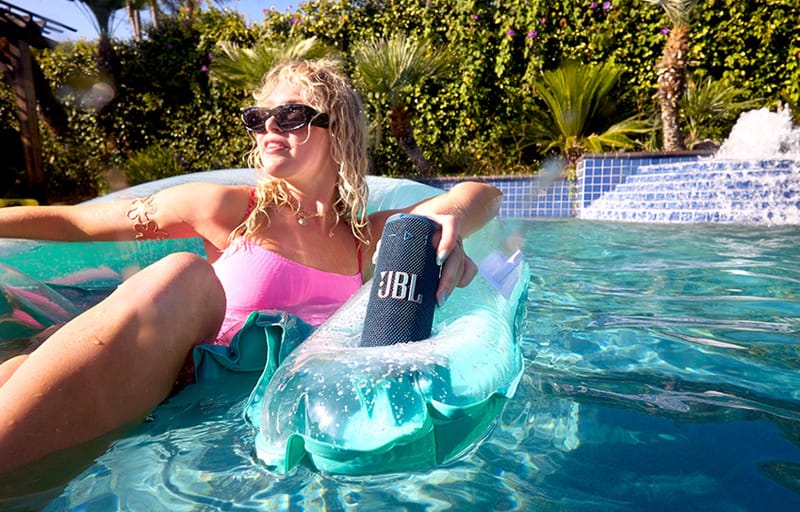
The waterproof and dustproof IP68 rating doubles as a feature in its own right rather than just a durability footnote, since it genuinely expands where the Grip can be used without hesitation, including poolside, at the beach, or in light rain.
Firmware updates are delivered through the JBL Portable app, meaning the Grip’s feature set and performance can continue to be refined after purchase. Keeping the app installed ensures access to the latest improvements as they roll out.
The recycled materials used in the Grip’s construction, from the plastic housing to the fabric grille, function as a feature for buyers who factor sustainability into their purchasing decisions, without requiring any compromise on durability or finish quality.
Taken together, these features position the Grip as more than a simple downsized speaker. The combination of app-based customisation, Auracast flexibility, and genuinely useful lighting controls gives it a feature set that feels considered rather than bare-bones.
Experience Using the Product and Performance
Picking up the JBL Grip for the first time, the upright shape takes a moment to adjust to if coming from a more traditional JBL speaker. It sits naturally in one hand, and the fabric texture gives it enough grip that it does not feel like it might slip out of a wet hand at the beach.
Powering it on for the first time is straightforward. A quick press of the top button brings it to life with a short audio confirmation, and pairing with a phone takes only a few seconds once the Bluetooth button has been pressed to enter pairing mode.
The ambient light strip makes its presence known immediately, even during the daytime setup process. It is genuinely eye-catching, and the white housing seems to make the light glow appear slightly more vivid than it might on a darker coloured unit.
Downloading the JBL Portable app early on is well worth the effort. Within a few taps, the seven-band equaliser becomes accessible, and dialling in a bit of extra bass or trimming some of the high end noticeably shapes how the Grip sounds depending on the music being played.
During casual listening sessions, whether that is background music while cooking or a podcast playing on a balcony, the Grip performs admirably. Vocals come through clearly, and the directional nature of the single driver means it projects well towards a specific area rather than spreading sound thinly in every direction.
Switching to more bass-heavy tracks reveals the benefit of the dual passive radiators. Low-end notes have a surprising amount of body for a speaker this size, avoiding the thin, tinny sound that plagues many ultra-compact Bluetooth speakers.
Pushing the volume up towards its ceiling does introduce some compression, which is to be expected given the compact single-driver design. However, the AI Sound Boost feature appears to be actively managing distortion at higher volumes, keeping the sound reasonably composed rather than harsh.
Taking the Grip outdoors is really where it starts to make sense as a product. Clipped to a bag strap using a carabiner attached to its rear loop, it becomes an easy companion for a bike ride or a walk, staying secure without adding noticeable weight.
A quick dunk under a garden hose, and later a splash test near a pool, confirm that the IP68 rating is not just a number on a spec sheet. Water beads off the fabric grille, and audio performance is unaffected once the speaker has dried out.
The drop-proof rating also gets a practical test when the Grip is set down a little too enthusiastically on a paved patio. It continues playing without any interruption or rattle, which is reassuring for anyone who tends to be a little careless with their gear outdoors.
Battery life during normal use tracks closely with JBL’s claimed figures. A full day of intermittent listening, rather than continuous playback at high volume, comfortably stretches past the 12-hour mark before the speaker needs a recharge.
Enabling Playtime Boost through the app does extend runtime further, and while there is a slight trade-off in outright loudness and clarity, it is a reasonable compromise for situations like camping trips where charging opportunities are limited.
Recharging via USB-C is quick and convenient, particularly since most people will already have a compatible cable for their phone or laptop. There is no wireless charging option, but this is a minor omission given the speaker’s price point and category.
Testing the Auracast pairing feature with a second JBL speaker running the same protocol produces a noticeably wider stereo image. Music spreads out more convincingly across a room, and the two speakers stay well synchronised without any noticeable audio lag.
Connecting the Grip alongside other Auracast-enabled JBL speakers in the same space, rather than pairing for true stereo, also works smoothly, letting multiple speakers around a backyard play the same track in unison for a larger gathering.
The physical button layout proves genuinely easy to use without looking, which matters when the speaker is clipped to a bag or sitting in a pocket. Volume adjustments, play and pause, and track skipping are all achievable through single or double presses without needing to fumble around.
Using the app’s equaliser to boost the mid and low frequencies slightly transforms tracks with a strong bassline, making the Grip feel more capable than its compact dimensions might initially suggest.
Vocal-forward music, such as acoustic or singer-songwriter tracks, comes through with a clarity that avoids the muddiness sometimes found in ultra-portable speakers that lean too heavily into bass emphasis.
Compared with JBL’s smaller Clip 5, the Grip’s larger single driver and passive radiator setup gives it noticeably more low-end presence and a fuller overall sound, without sacrificing the clarity in the higher frequencies.
Against the larger Flip 7, the Grip understandably cannot match the same depth of bass or outright volume, but it also weighs considerably less and takes up far less space, which is the trade-off buyers are making when choosing this model.
Using the Grip as a desktop speaker at home, positioned a metre or so away on a desk, proves surprisingly effective for casual background listening while working, thanks to its directional projection.
The ambient lighting feature continues to earn its keep during evening use, adding a genuinely pleasant atmosphere during outdoor dinners or casual gatherings, rather than feeling like an unnecessary addition purely for marketing purposes.
Firmware updates delivered through the JBL Portable app install quickly and without complication, and having the latest firmware version installed ensures the AI Sound Boost feature and Auracast connectivity work as intended.
Handling the Grip over an extended period reveals no noticeable wear on the fabric grille or the housing, even after repeated exposure to water and being tossed into a bag alongside other items.
The white colourway shows dirt and marks a little more readily than a darker finish might, though a quick wipe with a damp cloth is enough to keep it looking presentable.
Pairing and reconnecting to a previously used phone happens automatically and quickly once Bluetooth is enabled, without requiring the pairing process to be repeated each time, which is a small but appreciated convenience during daily use.
Range performance over Bluetooth proves solid for typical use cases, holding a stable connection across a backyard or from one side of a house to the other without noticeable dropouts.
Comparing the sound signature directly against similarly sized rivals in the ultra-portable category, the Grip holds its own thanks to the combination of its full-range driver, passive radiators, and the real-time processing offered by AI Sound Boost.
For anyone who regularly hosts small outdoor gatherings, the ability to pair multiple JBL Auracast speakers together adds genuine long-term value, particularly for those already invested in the broader JBL ecosystem.
By the end of extended testing, the JBL Grip proves itself as a speaker that delivers on its core promises: it is genuinely portable, tough enough for outdoor life, and capable of surprisingly enjoyable sound for something this size.
Conclusion
The JBL Grip carves out a sensible niche for itself within JBL’s crowded portable speaker range. It is not trying to be the loudest or bassiest option available, but rather the most convenient one to actually carry along and use without a second thought.
Between its IP68 durability rating, drop-proof construction, and genuinely useful ambient lighting feature, the Grip feels like a speaker designed around how people actually spend their time outdoors, rather than one built purely to hit a spec sheet.
The addition of a seven-band EQ, Auracast multi-speaker support, and AI Sound Boost processing through the JBL Portable app rounds out a feature set that feels considered rather than stripped back, giving buyers real flexibility to shape how the Grip sounds and behaves.
For anyone after a lightweight, rugged, and genuinely characterful companion speaker in white, the JBL Grip earns its place in the lineup, offering a rare combination of personality and practicality in a package small enough to disappear into any bag.