Meta has released Horizon Create, a mobile app that lets anyone type a description of a game and watch an AI system build a playable version of it. Alongside it sits Horizon Studio, a web-based tool aimed at creators who want finer control over art direction, difficulty and progression systems. Both tools mark Meta’s most direct pitch yet to turn casual users into game makers without a line of code.
Key takeaways
- ✓Meta has launched Horizon Create, a mobile app that builds playable games from written prompts.
- ✓Horizon Studio is a companion web tool offering deeper control over art, difficulty and progression.
- ✓Both tools run on the Meta Horizon Engine and publish games across Facebook and Instagram.
- ✓Horizon VP Saxs Persson says creators can reshape environments, characters and quests with follow-up prompts.
- ✓The tools lower the technical barrier to making games, targeting casual creators rather than trained developers.
The two tools run on the Meta Horizon Engine, the same underlying technology that powers Meta’s existing Horizon Worlds platform. Rather than producing a rough sketch or a proof of concept, Meta says the output is a genuinely playable 2D or 3D game, complete with characters, levels and mechanics that can be adjusted through further prompts.
Table of Contents
What Horizon Create and Horizon Studio actually build
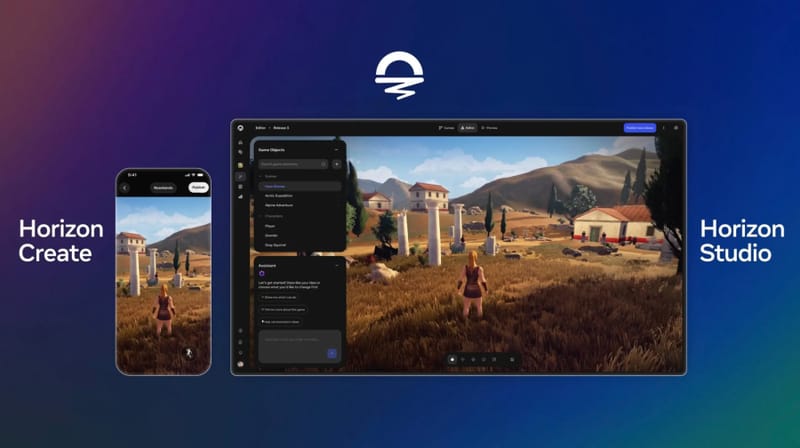
Horizon Create is designed for speed. It is a phone app built for people who want to sketch out an idea while commuting or between other tasks, describing a concept in plain language and letting the AI assemble a working prototype in the background. Meta positions it as the quick, on-the-go entry point for creators who might never have considered making a game before.
Horizon Studio takes the same underlying technology but wraps it in a desktop-style interface with more granular controls. Creators can dig into specifics such as how difficulty scales as a player progresses, what art style the world adopts, and how quests or reward systems unfold. It is aimed at people who have a clearer creative vision and want to shape the finer details rather than accept the first AI-generated draft.
How the prompt-to-game process works
Describing the workflow, Horizon VP Saxs Persson said the process starts the moment a creator opens the app. “You have an idea, you open the app, describe the game you want to build in your own words, and the system starts building it with you,” Persson said. He was clear that Meta does not consider the result a rough draft. “It’s not a sketch, it’s not a prototype, you build playable 2D and 3D games with real depth,” he added, noting that every subsequent change, from reimagining an environment to tweaking difficulty, is “one prompt away.”
That iterative approach is the core idea behind both tools. Instead of a single one-shot generation, Meta frames the process as an ongoing conversation between creator and AI, where a game evolves through repeated requests rather than manual editing in a traditional engine.
Publishing across Meta’s apps
Games built with either tool can be published directly across Meta’s existing platforms, including Facebook and Instagram, alongside Meta’s own Horizon Worlds ecosystem. That distribution reach is arguably as significant as the AI itself. A creator with no coding background can, in theory, publish a game to an audience of billions without ever touching a traditional game engine or app store submission process.
This also slots into Meta’s broader ambitions around its Horizon Worlds developer platform, which has spent recent years trying to attract creators to build experiences inside Meta’s social and virtual reality ecosystem. Generative tools that remove the technical barrier to entry are a logical next step for a platform that has struggled to fill its worlds with compelling, creator-made content.
What it means for creators and the wider industry
The launch places Meta alongside a growing list of companies experimenting with AI-assisted or AI-generated game development, a trend that has already stirred controversy elsewhere in the industry. Insomniac Games recently had to publicly address the generative AI controversy around Marvel’s Wolverine, denying that generative tools were used in ways that displaced human creative work. Meta’s approach differs in that it is explicitly marketed at amateur creators rather than professional studios, but the underlying question of how much creative and technical labour AI should absorb remains the same.
For hobbyists, Horizon Create and Horizon Studio could genuinely lower the barrier to making something playable, turning an afternoon idea into a shareable game without months of learning a traditional engine. For the broader games industry, it adds another data point in a fast-moving shift where large platform holders are racing to make game creation as accessible as posting a photo. NVIDIA has been pursuing a parallel but distinct path with its own developer-focused tools, including NVIDIA’s own push into AI-assisted game development tools, though that effort is squarely aimed at professional studios rather than casual creators.
Meta has not detailed pricing, release timing for all regions, or exactly how it plans to moderate AI-generated content published to its social apps. Those details will matter once Horizon Create and Horizon Studio move beyond early access, particularly given Meta’s ongoing efforts around its virtual reality hardware, including Meta’s recent redesign of its VR glasses, which points to a company trying to knit together its social, gaming and hardware ambitions into one ecosystem.
Frequently asked questions
What is Horizon Create?
Horizon Create is a mobile app from Meta that generates playable 2D and 3D games from written text prompts, letting people build a game by describing it in plain language rather than coding it manually.
How is Horizon Studio different from Horizon Create?
Horizon Studio is a web-based companion tool that offers more detailed editing controls, covering things like difficulty balancing, art direction and progression systems, aimed at creators who want to refine a game beyond the quick prototypes Horizon Create produces.
Where can games made with these tools be published?
Games built through Horizon Create or Horizon Studio can be published across Meta’s apps, including Facebook and Instagram, as well as within Meta’s Horizon Worlds platform.
Do people need coding experience to use Horizon Create?
No. Both tools are designed so that creators describe what they want in natural language, and the underlying Meta Horizon Engine handles the technical work of building and updating the game.