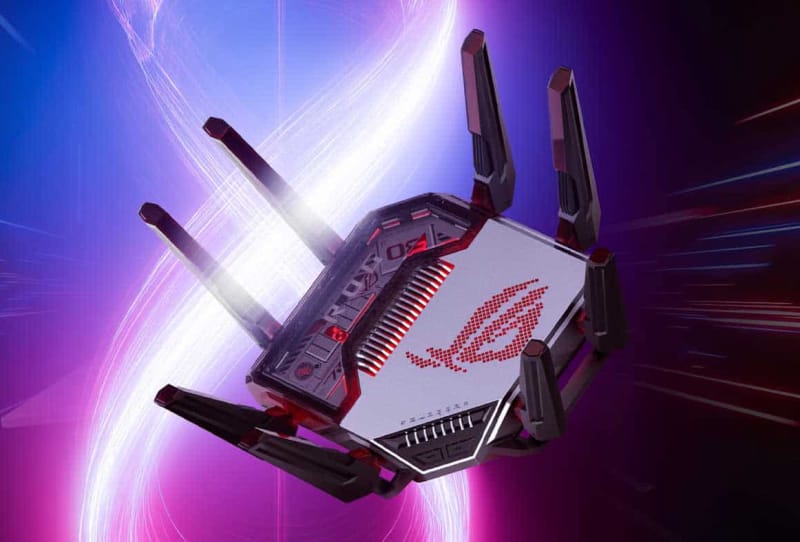
ASUS has released the ROG Rapture GT-BN98, the world’s first Wi-Fi 8 router, and it has landed in Australia ahead of most other markets. Where Wi-Fi 7 was mostly a race for bigger peak speeds, this new Wi-Fi 8 router is built around something gamers care about more: keeping every device on the network stable, even when a house full of consoles, laptops, smart cameras and speakers are all fighting for the same bandwidth.
Key takeaways
- ✓The ASUS ROG Rapture GT-BN98 is the world's first Wi-Fi 8 router, launching in Australia first.
- ✓Wi-Fi 8 (802.11bn) focuses on Ultra-High Reliability rather than chasing higher peak speeds.
- ✓Peak throughput sits near 46Gbps, similar to Wi-Fi 7, but mid- and long-range stability improves noticeably.
- ✓A new Adaptive Quality of Experience feature replaces older QoS tools to prioritise gaming traffic intelligently.
- ✓Wi-Fi 8 is backward compatible, so existing Wi-Fi 6 and Wi-Fi 7 devices still benefit from the upgrade.
That shift matters because modern homes are far noisier, networking-wise, than they were even a few years ago. A single household might now run a PS5 in the lounge, a gaming laptop upstairs, a handheld console on the move, plus a scattering of smart lights, doorbells and appliances all quietly chewing through Wi-Fi traffic in the background. ASUS designed the GT-BN98 specifically to handle that kind of chaos without anyone’s online match suffering for it.
Table of Contents
How a Wi-Fi 8 router differs from Wi-Fi 7 and Wi-Fi 6
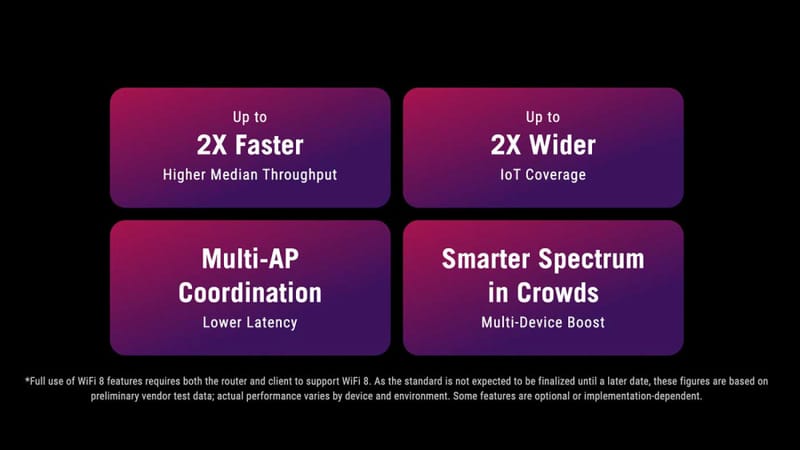
Wi-Fi 8, formally known as 802.11bn, is the successor to Wi-Fi 7 and Wi-Fi 6. Its headline idea is Ultra-High Reliability, a design philosophy that prioritises consistent, lag-free connections over simply posting bigger speed numbers on a spec sheet. Peak throughput sits around 46Gbps, broadly in line with Wi-Fi 7, so the leap isn’t really about raw bandwidth at all.
Instead, the real gains show up at mid and long range, the exact scenario that trips up a lot of home networks. A console or PC sitting a few rooms away from the router, with walls and floors in between, typically sees the steepest drop-off in speed and stability on older standards. Wi-Fi 8 is engineered to narrow that gap considerably, which is a genuine quality-of-life improvement for anyone whose gaming PC isn’t parked right next to the router.
Crucially, Wi-Fi 8 is backward compatible. Dropping a Wi-Fi 8 router into a home still running a mix of Wi-Fi 6 and Wi-Fi 7 devices, or an existing mesh system, still lifts performance across the whole network rather than only benefiting brand-new hardware.
| Standard | Main focus | Approx. peak speed | Multi-device handling |
|---|---|---|---|
| Wi-Fi 6 | Efficiency for many connected devices | Up to ~9.6Gbps | Good, but congestion grows with device count |
| Wi-Fi 7 | Maximum throughput and low latency | Up to ~46Gbps | Strong, though overlap between devices still occurs |
| Wi-Fi 8 | Ultra-High Reliability and stability | Up to ~46Gbps | Coordinated access points reduce overlap and interference |
Adaptive QoE: the feature that actually helps gaming
The feature most relevant to gamers on this Wi-Fi 8 router is Adaptive Quality of Experience, or Adaptive QoE. It’s an evolution of the Quality of Service tools that have existed on routers for years, letting a household prioritise one device’s traffic, say a console mid-match, over everything else on the network.
What makes Adaptive QoE different is how much smarter it is about context. Rather than applying a blanket priority rule, it understands what each connected device actually needs at any given moment and adjusts accordingly. That means a PS5 streaming a competitive match, a laptop downloading a patch, and a smart camera recording footage can all share the same network without one quietly starving the others of bandwidth.
This intelligence extends across multiple access points too. In homes running a mesh system, which is increasingly common, Wi-Fi 8 ensures separate access points aren’t simultaneously targeting the same device and creating interference. The result is a network that behaves more like a coordinated system than a collection of individual boxes doing their own thing.
What it means for Australian gamers and smart homes
For anyone gaming on a handheld while wandering around the house, the benefit is tangible. Wi-Fi 8 is designed to keep a connection smooth even as signal strength naturally drops with distance from the router, rather than letting it stutter the moment someone walks into another room. The same logic applies to a console permanently wired into a TV, where stable, low-latency throughput matters more than headline speed.
ASUS isn’t the only company chasing this next generation of wireless networking. TP-Link has also announced its own Wi-Fi 8 routers, suggesting the standard is about to become a genuine battleground among networking brands rather than a niche feature exclusive to one manufacturer. That’s good news for buyers, since competition tends to push prices down and features up over time.
The broader push toward more reliable home networking isn’t limited to routers, either. Mobile options like D-Link’s recent 5G Wi-Fi 6 hotspots show how much demand there is for dependable wireless connections outside the traditional home router setup, while emerging ideas like wireless eGPU setups that lean on fast, stable Wi-Fi hint at just how much is riding on networks getting more dependable, not just faster. A Wi-Fi 8 router sits squarely in that same trend: solving the reliability problem that raw speed alone never quite fixed.
For households juggling several gamers, a stack of smart devices, and a multi-storey floor plan, that reliability focus is arguably more useful day to day than another jump in peak speed. Whether Wi-Fi 8 becomes the new standard quickly will depend on how fast device makers and other router brands follow ASUS’s lead, but the direction of travel for home networking is now clear.
Frequently asked questions
What is Wi-Fi 8 used for?
Wi-Fi 8, also known as 802.11bn, is designed to keep connections stable and consistent in busy homes with many devices, rather than simply offering higher peak speeds than Wi-Fi 7.
Is a Wi-Fi 8 router backward compatible with older devices?
Yes. A Wi-Fi 8 router still works with existing Wi-Fi 6 and Wi-Fi 7 devices and mesh systems, and the whole network benefits from improved stability even if not every device is Wi-Fi 8 branded.
Do I need new hardware to benefit from Wi-Fi 8?
Not necessarily. Existing phones, laptops and consoles connected through a Wi-Fi 8 router can still see improved reliability, since much of the benefit comes from smarter traffic management at the router itself.
Is Wi-Fi 8 faster than Wi-Fi 7?
Peak speeds are similar, at around 46Gbps for both standards, but Wi-Fi 8 delivers noticeably better performance at mid and long range, along with reduced interference in homes with multiple access points.