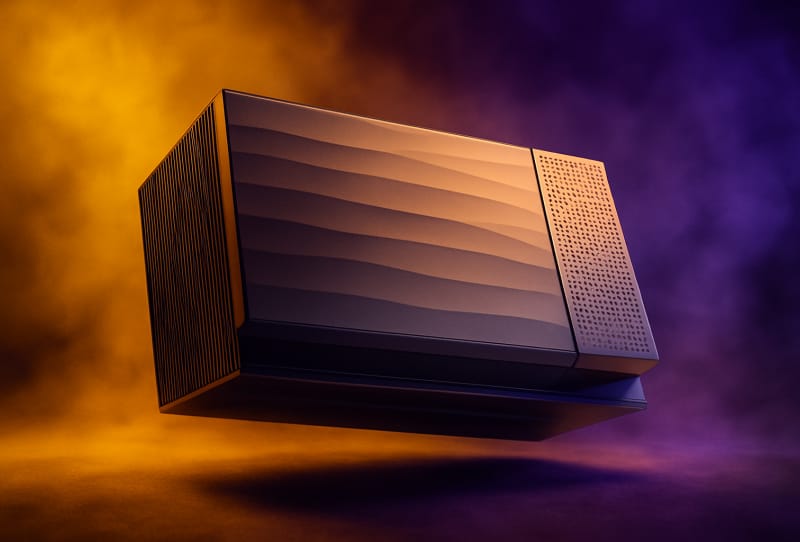
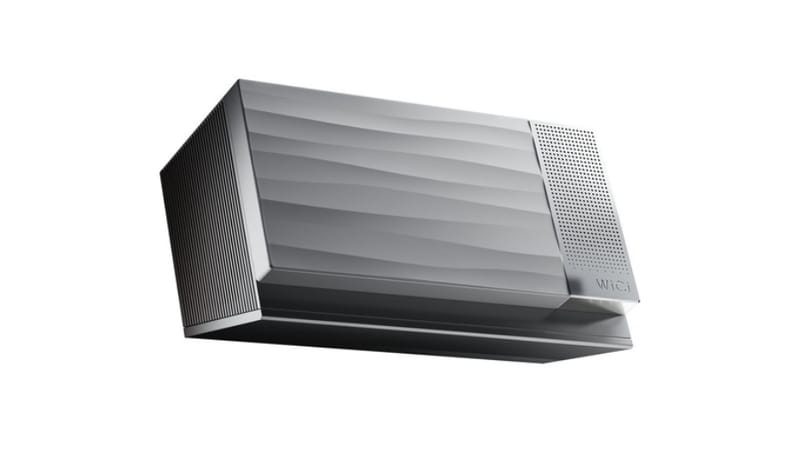
The WiCi One wireless eGPU lets a thin laptop tap into desktop-class graphics power without a single cable, streaming the connection entirely over Wi-Fi 7. Instead of plugging into a Thunderbolt or OCuLink port like nearly every other external graphics card on the market, this box sits across the room and does the job wirelessly, which is the whole point of the design.
Key takeaways
- ✓The WiCi One is an external GPU that connects to laptops wirelessly over Wi-Fi 7 instead of a cable.
- ✓The base model pairs an RTX 5060 Ti 16GB with an Intel Core 3 100U CPU and 1TB of NVMe storage.
- ✓WiCi claims the base unit runs Cyberpunk 2077 at 4K Ultra with DLSS 4 at around 80fps.
- ✓A higher-tier version with an RTX 5090 32GB and 4TB of NVMe 5 storage is planned for later release.
- ✓WiCi expects the first units to begin shipping in the fourth quarter of 2026.
Made by a company called WiCi, the unit houses a full graphics card, its own processor, storage and cooling system inside a single self-contained enclosure. Rather than relying on a physical link to the laptop it’s boosting, it broadcasts the graphics workload over a Wi-Fi 7 connection, a wireless standard fast enough to carry the kind of data throughput that gaming and rendering tasks demand. That’s a genuinely different approach to the eGPU problem, which has traditionally been held back by cable length, port compatibility and bandwidth bottlenecks.
Table of Contents
What’s actually inside the WiCi One wireless eGPU
The base configuration pairs an Nvidia RTX 5060 Ti with 16GB of memory alongside an Intel Core 3 100U processor and 1TB of NVMe storage. That’s a respectable mid-range gaming GPU bundled with a low-power CPU, which makes sense given the CPU’s job here is largely to manage the wireless streaming rather than do any heavy lifting itself.
WiCi has also confirmed a more powerful variant is coming further down the line, built around an RTX 5090 with 32GB of memory, an Intel Core Ultra 7 225H chip and a 4TB NVMe 5 drive. That’s a substantial step up in every category, positioning the higher-tier model as something closer to a full workstation replacement rather than a simple graphics boost box.
| Spec | Base model | Higher-tier model |
|---|---|---|
| GPU | RTX 5060 Ti 16GB | RTX 5090 32GB |
| CPU | Intel Core 3 100U | Intel Core Ultra 7 225H |
| Storage | 1TB NVMe | 4TB NVMe 5 |
| Connection | Wi-Fi 7 | Wi-Fi 7 |
Gaming and AI performance claims
WiCi says the base model can run Cyberpunk 2077 at 4K resolution on the Ultra preset with DLSS 4 enabled, hitting around 80 frames per second. It also claims Black Myth: Wukong can run at 4K on the Cinematic preset with DLSS 4 at roughly 60 frames per second. Those are strong numbers for a graphics card in the RTX 5060 Ti class, and if accurate over a wireless link, they suggest the Wi-Fi 7 connection isn’t introducing the kind of latency or bandwidth penalty that has doomed earlier attempts at wireless graphics streaming.
WiCi isn’t pitching the WiCi One purely as a gaming accessory, either. The company is marketing it as a tool for demanding AI workloads too, including running local AI assistants directly on-device rather than relying on cloud processing. That dual pitch, gaming rig by night and local AI inference box by day, reflects how GPU makers and their partners are increasingly framing graphics hardware as general-purpose compute rather than something built solely for rendering frames.
How this compares with traditional wired eGPUs
External GPUs have existed for years, but they’ve always been constrained by their connection method. Thunderbolt and OCuLink both offer solid bandwidth, but they tie the laptop to the enclosure with a physical cable, limit how far a user can sit from the box and can introduce compatibility headaches depending on the laptop’s ports and drivers. A wireless connection removes that leash entirely, letting the graphics box sit in a cabinet or another room while the laptop stays free to move.
The trade-off is that wireless connections have historically struggled to match the raw bandwidth and consistency of a direct cable, which is why nobody has really cracked reliable wireless eGPU performance at scale before now. Wi-Fi 7’s higher throughput and lower latency compared with earlier wireless standards appear to be the enabling factor here, though real-world testing outside WiCi’s own benchmarks will be the true measure of whether the performance holds up during sustained, demanding gameplay rather than short bursts.
What it means for laptop owners
For anyone who bought a slim, portable laptop and later wished it could handle heavier games or creative workloads, a wireless eGPU is an appealing middle ground between upgrading to a bulky gaming laptop and building a separate desktop. It keeps the laptop light for travel while offering a way to plug into serious graphics performance at a desk or in a living room setup.
WiCi says it expects to begin shipping the base model during the fourth quarter of 2026, with pricing and availability details for the RTX 5090 variant to be announced closer to its own launch. Preorders for the base configuration are open now, though buyers considering an eGPU should weigh laptop compatibility and home network setup carefully, since a Wi-Fi 7 router and a stable wireless environment will likely be essential to getting the advertised performance in practice.
Frequently asked questions
Does the WiCi One wireless eGPU need a Wi-Fi 7 router to work?
WiCi has built the device around Wi-Fi 7 specifically for its higher bandwidth and lower latency, so getting the performance the company claims will likely depend on a Wi-Fi 7 router and a strong wireless connection rather than an older network.
What laptops are compatible with the WiCi One?
WiCi hasn’t published a detailed compatibility list publicly, and since the connection is wireless rather than port-based, compatibility will likely depend more on driver support and network hardware than on a laptop having a specific port.
How does a wireless eGPU differ from a Thunderbolt eGPU?
A Thunderbolt or OCuLink eGPU connects via a physical cable, offering consistent bandwidth but tying the laptop to the enclosure. The WiCi One instead streams the graphics workload over Wi-Fi 7, freeing the laptop from any cable at the cost of relying on wireless network conditions.
When will the WiCi One start shipping?
WiCi expects to begin shipping the base RTX 5060 Ti model during the fourth quarter of 2026, with further details on the more powerful RTX 5090 variant to follow closer to its own release.