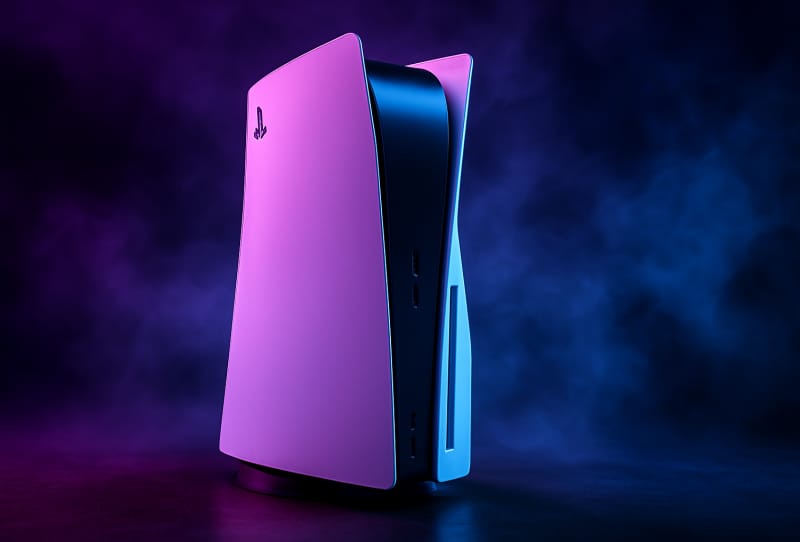
Sony has filed a new patent that points toward PlayStation 6 frame generation technology, a clear sign the company is building its own answer to the AI frame-boosting tools already common on PC. The filing does not confirm a release date or final feature set, but it gives the clearest look yet at how Sony intends to tackle the trend that has already reshaped PC gaming through Nvidia and AMD.
Key takeaways
- ✓Sony has filed a patent describing its own frame generation system, widely tipped for PlayStation 6.
- ✓The filing builds on earlier reports that Sony was exploring frame generation for its next console.
- ✓Frame generation uses AI to insert extra frames between rendered ones, boosting perceived frame rate.
- ✓Nvidia's DLSS Frame Generation and AMD's FSR already use this approach on PC graphics cards.
- ✓A patent filing does not confirm the feature will ship; PlayStation 6 remains officially unannounced.
Frame generation has become one of the defining graphics technologies of this console generation. Rather than rendering every single frame from scratch, the technique uses artificial intelligence to generate extra frames and insert them between the ones the hardware actually renders. The result is a smoother, higher frame-rate experience without demanding the same raw horsepower a fully native frame count would require.
Table of Contents
What the new Sony patent describes
Reports on the filing note that this is not the first hint of Sony’s interest in the area. The company had already signalled it was investigating frame generation for its next console, and this latest patent reportedly fleshes out how such a system might actually function on PlayStation hardware.
Details remain limited, as is typical with early-stage patent filings, and Sony has not made any public statement confirming the technology will appear in a shipping product. Patents are filed for all sorts of reasons, including defensive ones, so the existence of a filing is not a guarantee that PlayStation 6 will launch with built-in frame generation. It does, however, suggest internal research and development is well underway.
Why frame generation matters for console gaming
Console makers have leaned increasingly on AI-driven image reconstruction to hit higher frame rates and resolutions without simply throwing more silicon at the problem. Sony already has a foothold here: PSSR upscaling already rolled out to the base PS5, having debuted on PS5 Pro before being extended more broadly. Frame generation would be a logical next step, tackling frame rate rather than resolution.
For players, the appeal is straightforward. Higher and more stable frame rates make fast-paced games feel more responsive, and they can help titles hit performance targets on TVs and monitors with high refresh rates. The trade-off, as PC gamers have learned through DLSS and FSR, is that generated frames are not “real” in the traditional rendering sense, which can introduce input latency or visual artifacts if the implementation is not well tuned.
How Sony’s approach compares to Nvidia and AMD
On PC, frame generation is already a mature, if still evolving, category. Nvidia’s DLSS Frame Generation uses dedicated AI hardware on its graphics cards to interpolate frames, while AMD’s FSR achieves a similar result with a more hardware-agnostic approach. Sony’s patent suggests the company wants a console-native equivalent, tailored to its own silicon rather than borrowed from a PC graphics vendor.
| Company | Technology | Platform | Status |
|---|---|---|---|
| Nvidia | DLSS Frame Generation | PC graphics cards | Shipping |
| AMD | FSR Frame Generation | PC and consoles | Shipping |
| Sony | Unnamed (patent-stage) | Likely PlayStation 6 | Patent filed, unconfirmed |
Building its own system rather than licensing one gives Sony tighter control over how the technology works with its own graphics architecture and exclusive titles, similar to how it developed PSSR in-house rather than adopting an existing PC solution wholesale.

What this means for PlayStation 6 expectations
PlayStation 6 remains officially unannounced, so any patent-based detail should be read as an indication of research direction rather than a locked-in specification. Sony has filed a steady stream of patents covering future PlayStation features in recent months, including a separate Sony patent describing a self-repairing AI system and another patent covering viewer-controlled stream cursors. Taken together, the filings paint a picture of a company experimenting broadly with AI across hardware, software, and streaming features well ahead of its next console launch.
Hardware leaks have followed a similar pattern lately, with leaked filings for an OLED PlayStation Portal surfacing through regulatory databases rather than official announcements. None of this confirms exact timing for PlayStation 6, but it does suggest Sony is actively laying groundwork, both in hardware and in the AI techniques that will likely define how games look and run on it.
For now, the sensible takeaway is that Sony clearly wants its own frame generation story for its next console generation, rather than relying on partners or off-the-shelf solutions. Whether that technology ends up matching the quality of Nvidia’s or AMD’s efforts will only become clear once PlayStation 6 is formally revealed and independent testing becomes possible.
Frequently asked questions
What is frame generation in games?
Frame generation is an AI technique that creates additional frames and inserts them between the ones a console or GPU actually renders, increasing the displayed frame rate without requiring the hardware to render every frame natively.
Does this patent confirm PlayStation 6 will have frame generation?
No. A patent filing shows Sony is researching the technology, but companies file patents for many reasons and not every filing becomes a shipping feature. PlayStation 6 itself has not been officially announced.
Is this similar to Nvidia DLSS or AMD FSR?
Conceptually, yes. All three approaches use AI to interpolate extra frames to boost smoothness. Sony’s patent suggests a console-native version built around its own hardware rather than a licensed PC solution.
Does PS5 already use similar technology?
PS5 and PS5 Pro use PSSR, Sony’s AI upscaling system, which improves image resolution rather than frame rate. Frame generation would be a separate, complementary technology focused on smoothness.