Keychron has released the groundwork for its Keychron MKF firmware, an open-source platform built specifically for Hall effect and TMR magnetic gaming keyboards. Short for Magnetic Keyboard Firmware, the project aims to give enthusiasts, modders and even rival keyboard makers a shared, transparent codebase for building advanced analogue input features, rather than leaving everyone stuck with closed, brand-locked software.
Key takeaways
- ✓Keychron has launched MKF, an open-source firmware project for Hall effect and TMR magnetic keyboards.
- ✓Planned features include 8 kHz polling, adjustable actuation, Rapid Trigger, SOCD and custom response curves.
- ✓The firmware will also support PDO and controller emulation, though no public code exists yet.
- ✓Only wired connectivity is planned for the initial release of Keychron MKF firmware.
- ✓MKF follows Keychron's earlier open-source Zephyr firmware project announced for gaming mice.
No public code has been published yet. What does exist is a landing page at mkf.gg that lays out what Keychron wants the project to become, including the specific features it plans to support from day one and the broader philosophy behind opening the firmware up to the community. It follows closely on the heels of Zephyr, an open-source firmware project Keychron previously announced for gaming mice, suggesting the company is pushing the same open approach across its entire peripheral range.
Table of Contents
What the Keychron MKF firmware project covers
Keychron describes MKF as “an open firmware foundation for magnetic gaming keyboards, with room for the project and its community to grow.” That framing matters because magnetic switch keyboards, whether they use Hall effect or TMR (tunnelling magnetoresistance) sensors, rely on software to unlock their real advantage over mechanical switches: the ability to read how far a key has travelled and react accordingly, rather than just registering a simple on or off press.
The initial feature outline for Keychron MKF firmware covers the features competitive players now expect as standard, among them 8 kHz polling for lower input latency, adjustable actuation points, Rapid Trigger for near-instant key reset, and SOCD (simultaneous opposing cable direction) handling for conflicting directional inputs. Those alone would put it on par with most premium magnetic keyboards already on the market.
Beyond the basics: custom curves and controller emulation
Where the project gets more ambitious is in the extras layered on top of those fundamentals. Keychron plans to support custom response curves, letting users tune how a key’s output scales across its travel distance rather than accepting a fixed default. It will also include PDO, a function that sends additional keypresses the deeper a key is held down, which is a niche but genuinely useful trick for certain games and macros.
Controller emulation is also on the list, which would let a magnetic keyboard mimic analogue stick or trigger input, a feature that has started appearing on high-end gaming keyboards aimed at genres like racing and flight simulation. The table below summarises what has been outlined so far.
| Planned feature | What it does |
|---|---|
| 8 kHz polling | Reports key state up to 8,000 times per second for lower latency |
| Adjustable actuation | Lets users set how far a key must travel before it registers |
| Rapid Trigger | Resets a key almost instantly once it starts moving back up |
| SOCD handling | Resolves conflicting directional inputs pressed at the same time |
| Custom response curves | Allows tuning of output across a key’s full travel range |
| PDO | Sends extra keypresses the deeper a key is held |
| Controller emulation | Lets a keyboard behave like an analogue game controller |
Only wired connectivity appears to be planned for the first release of the firmware, which is a sensible starting point given the polling rates and latency the project is chasing. Keychron has indicated the scope will widen beyond competitive gaming once the core foundation is stable, opening the door to productivity and accessibility use cases down the track.
Why an open-source approach makes sense for magnetic keyboards
Mechanical keyboards already have a well-established open-source ecosystem in QMK and VIA, and that openness is a big reason the enthusiast hobby grew as fast as it did. Magnetic switch keyboards, by contrast, have mostly shipped with proprietary configuration software tied to a single brand, which limits what hobbyists can tinker with and makes cross-brand compatibility difficult.
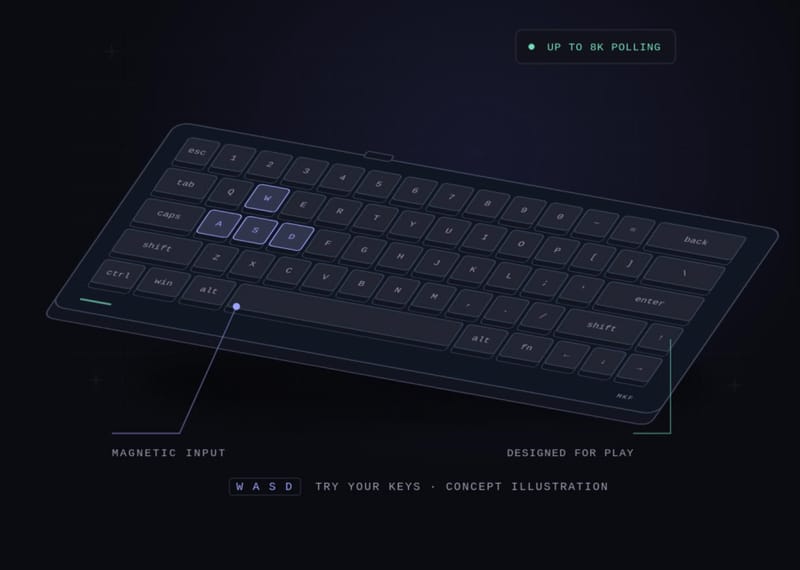
By opening the Keychron MKF firmware codebase to outside contributors, Keychron is effectively betting that a shared standard will grow the whole category faster than keeping its tools locked down. It is also a logical move for a company that already sells magnetic switch keyboards such as its K4 HE and K10 HE models, since community-built features and bug fixes benefit its own product line as much as anyone else’s.
What it means for buyers and rival keyboard makers
For shoppers, the immediate impact is limited since there is no public code to install yet and no confirmed timeline for a stable release. The bigger implication is longer term. If MKF firmware gains traction, it could become a shared base that other Hall effect and TMR keyboard makers build on, similar to how plenty of mechanical boards now ship with QMK-compatible firmware out of the box.
That would be good news for anyone eyeing rival Hall effect boards like the ATK RS6 V2, or budget rapid trigger keyboards such as the Mchose Ace68 V2, since a common firmware standard tends to push every brand to add features faster just to stay competitive. It is worth remembering the project is very early, however, and Keychron’s own recent hardware, including its ergonomic Orca Echo keyboard and K4 HE and K10 HE magnetic switch keyboards, still runs its existing configuration software rather than MKF.
Frequently asked questions
What is Keychron MKF firmware?
MKF, short for Magnetic Keyboard Firmware, is an open-source firmware project from Keychron built for Hall effect and TMR magnetic gaming keyboards, covering features like adjustable actuation, Rapid Trigger and SOCD handling.
Is the MKF firmware available to download now?
Not yet. Keychron has published a landing page outlining its planned features at mkf.gg, but no public code has been released at this stage, so there is no firmware to install today.
Will MKF firmware support wireless keyboards?
The initial release appears to be wired only. Keychron has not ruled out wireless support later, but the first version of the project is focused on wired magnetic keyboards and their latency-sensitive features.
How does MKF relate to Keychron’s Zephyr mouse firmware?
Zephyr is a separate open-source firmware project Keychron announced earlier for gaming mice. MKF applies the same open philosophy to magnetic keyboards, suggesting Keychron is building open firmware across its wider peripheral lineup.