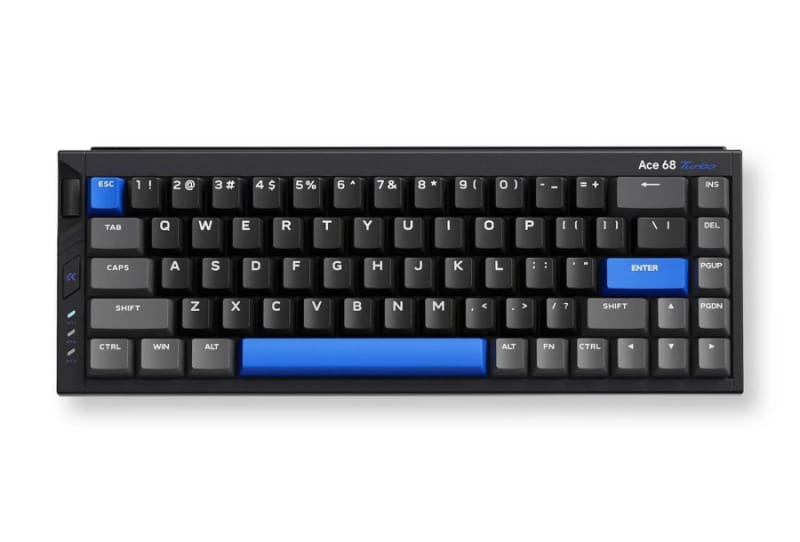
Mchose has refreshed its budget hall effect keyboard with a dedicated rapid trigger button, giving the Ace68 V2 a feature that used to be locked behind software menus. The new model keeps the compact 68-key layout and angled front edge that made the original Ace68 popular as a cheaper stand-in for Wooting’s 60HE, but adds a few physical touches that separate it from the first version.
Key takeaways
- ✓The Mchose Ace68 V2 adds a dedicated hardware rapid trigger button on the rear edge
- ✓It keeps the same 68-key, 60HE-inspired layout and angled front edge as the original Ace68
- ✓Star Ring switches use a 33 gf actuation force, while Royal Steed switches sit at 35 gf
- ✓Both switches are linear and magnetic, mounted on an aluminium plate in a tray-mount layout
- ✓The keyboard ships in white, black, or pink, each with matching frosted translucent keycaps
For anyone unfamiliar with the category, hall effect keyboards use magnetic switches that can detect how far a key has travelled, rather than simply registering an on or off press. That lets the keyboard offer rapid trigger, a feature that resets a keystroke the instant a key starts moving back up, which is handy in competitive games where split-second re-presses matter. The Mchose Ace68 V2 brings that functionality to a lower price bracket than most of its hall effect rivals, which is exactly why the original Ace68 built a following in the first place.
Table of Contents
What’s new on the Mchose Ace68 V2
The headline change is a physical rapid trigger switch built into the back edge of the case. Previously, adjusting rapid trigger sensitivity on the Ace68 meant digging through companion software every time a player wanted to switch between, say, a shooter that benefits from aggressive rapid trigger and general typing or office work where it can cause accidental inputs. A hardware toggle removes that friction entirely.
Mchose has also added a thin metal strip running along the edge of the case, which is mostly a cosmetic update but gives the keyboard a slightly less plasticky look on the desk. The rest of the design carries over from the original, including the wrist strap and the steep front edge angle borrowed from the Wooting 60HE’s silhouette, both of which help with hand positioning during fast gaming sessions.
Mchose has not confirmed the exact material used for the bottom case, though its weight points to a plastic shell rather than metal. One casualty of the redesign is the pair of flip-out feet found on the original Ace68, which are missing from the V2 despite the otherwise similar chassis.
Switches, colours, and build details
The Ace68 V2 is available in white, black, or pink, and every colourway comes fitted with matching frosted translucent PC keycaps. Switch choice depends on the finish: the white and pink models can be configured with either Star Ring or Royal Steed magnetic switches, while the black version is limited to Royal Steeds only.
Both switch types are linear, but they are not identical. The Star Ring switch uses a box stem and actuates at 33 grams of force, while the Royal Steed has a cylindrical stem and a slightly heavier 35 gram actuation point. Mchose has mounted both options on an aluminium switch plate using a tray-mount configuration, which typically gives a firmer, more consistent feel than gasket-mounted boards aimed purely at a softer typing sound.
| Feature | Mchose Ace68 V2 |
|---|---|
| Layout | 68-key, 60HE-inspired |
| Switch options | Star Ring (33 gf) or Royal Steed (35 gf), both linear magnetic |
| Switch plate | Aluminium, tray-mount |
| New feature | Dedicated hardware rapid trigger button |
| Colours | White, black, pink |
| Keycaps | Frosted translucent PC, colour-matched |
How the Ace68 V2 stacks up against rivals
The hall effect keyboard market has become crowded over the past year or two, with everything from Wooting’s own 80HE+ to budget-focused boards like Epomaker’s HE60 chasing the same audience. Mchose has carved out a niche by undercutting the premium brands significantly while still offering genuine magnetic switches rather than cheaper optical alternatives.
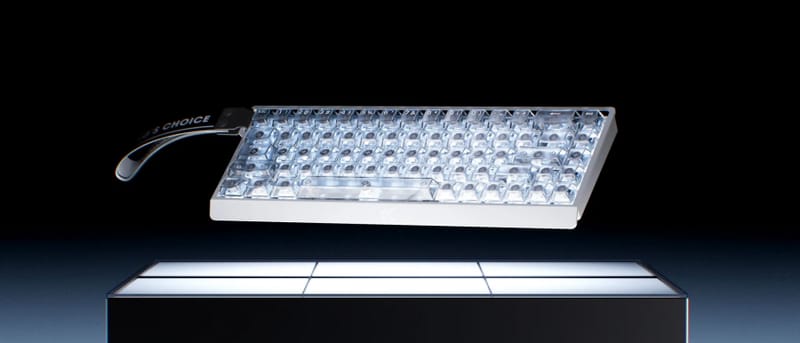
Compared with higher-end options such as Razer’s Huntsman V3 HE, the Ace68 V2 is clearly aimed at a different buyer. It lacks the polish, software ecosystem, and per-key analogue tuning that pricier boards offer, but the addition of a physical rapid trigger switch closes one of the biggest usability gaps that separated budget hall effect keyboards from their premium counterparts.
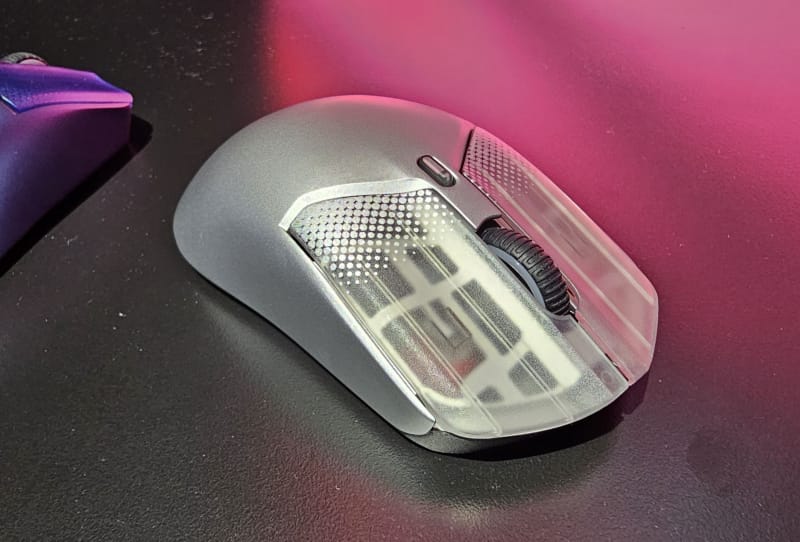
The broader trend toward magnetic switches extends beyond keyboards too, with products like Keychron’s G6 HE magnetic mouse bringing the same adjustable actuation concept to other peripherals. That spread suggests hall effect technology is moving from a niche enthusiast feature into something buyers expect across an entire desk setup.
What it means for buyers
For gamers who already liked the original Ace68, the V2 is a straightforward upgrade rather than a reinvention. The hardware rapid trigger button is the kind of quality-of-life change that matters more in daily use than it might sound on paper, particularly for players who switch between games with different sensitivity needs throughout a session.
It also reinforces how competitive the entry-level hall effect segment has become. Three years ago, magnetic switches were mostly the domain of enthusiast brands charging a premium. Now, a company like Mchose can fit the same core switch technology, an aluminium plate, and physical rapid trigger control into a keyboard aimed squarely at buyers who previously would have been priced out of the category entirely. That shift is good news for anyone shopping for their first hall effect board without wanting to pay flagship rates.
Frequently asked questions
What is a hardware rapid trigger button?
It is a physical switch on the keyboard itself that lets a player toggle rapid trigger behaviour instantly, without opening companion software to change settings between games or tasks.
What switches does the Mchose Ace68 V2 use?
It uses either Star Ring or Royal Steed magnetic linear switches, with actuation forces of 33 grams and 35 grams respectively, depending on the colourway chosen.
Is the Mchose Ace68 V2 similar to the Wooting 60HE?
Its layout, 68-key footprint, wrist strap, and angled front edge are directly inspired by the Wooting 60HE, though Mchose uses its own switches and electronics rather than Wooting’s hardware.
What changed from the original Ace68?
The V2 adds a dedicated hardware rapid trigger button and a metal trim strip along the case edge, while dropping the flip-out feet found on the first Ace68.