The Intel Core Ultra 7 260K has turned up for sale with no official launch, fitted exclusively inside two Newegg-built ABS gaming desktops rather than sold as a standalone chip. Intel has confirmed its existence but has not formally announced it, and buyers can only get one by purchasing one of those two complete PCs.
Key takeaways
- ✓The Intel Core Ultra 7 260K has appeared unannounced inside two Newegg-built ABS gaming desktops.
- ✓Intel confirms it is a limited-availability SKU with no boxed retail version for sale separately.
- ✓It shares the 8P+12E core layout and 30 MB cache of the Core Ultra 7 265K but tops out at 5.4 GHz.
- ✓DDR5-6400 support places it in the original Arrow Lake family, not the newer Arrow Lake Refresh lineup.
- ✓Full specifications are expected to appear on Intel's own website within days.
That is an unusual way for a modern desktop processor to reach the market. Chipmakers typically unveil new SKUs with spec sheets, pricing tiers, and review samples well before retail listings go live. Here, the Core Ultra 7 260K appeared first in product listings for Newegg’s in-house ABS brand, with Intel only acknowledging it after the fact.
Table of Contents
What the Core Ultra 7 260K actually is
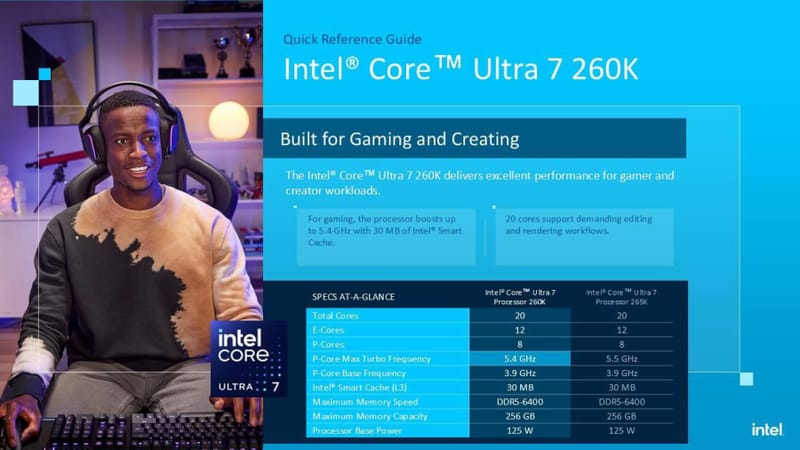
Newegg’s own buying guide for the chip lays out a familiar silicon profile. The Core Ultra 7 260K uses the same 8 performance-core, 12 efficiency-core layout as its existing siblings, paired with 30 MB of L3 cache and a 125 W base power rating. It supports DDR5-6400 memory with capacity up to 256 GB, which is plenty for a high-end gaming or content creation build.
The one meaningful difference from the Core Ultra 7 265K is clock speed. Where the 265K’s performance cores can boost to 5.5 GHz, the 260K caps out at 5.4 GHz. Everything else, from cache size to memory support to thermal design power, lines up closely with its better-known sibling.
Where it sits in Intel’s Arrow Lake family
That DDR5-6400 ceiling matters more than it might first appear. Intel’s newer Arrow Lake Refresh chips, including the Core Ultra 5 250K Plus and Core Ultra 7 270K Plus, support faster DDR5-7200 memory and come with access to Intel’s Binary Optimization Tool, a utility aimed at squeezing extra performance out of supported titles. Because the Core Ultra 7 260K is locked to DDR5-6400, it sits in the original Arrow Lake generation instead, missing out on both of those upgrades.
| Spec | Core Ultra 7 260K | Core Ultra 7 265K |
|---|---|---|
| Core layout | 8P + 12E | 8P + 12E |
| L3 cache | 30 MB | 30 MB |
| Max P-core boost | 5.4 GHz | 5.5 GHz |
| Base power | 125 W | 125 W |
| Memory support | DDR5-6400, up to 256 GB | DDR5-6400, up to 256 GB |
| Retail availability | None, prebuilt only | Boxed retail |
Why it’s limited to two prebuilt systems
Newegg has confirmed the Core Ultra 7 260K is exclusive to its ABS-branded desktops and will not be sold on its own. The Kaze II Aqua pairs the chip with an RTX 5060 graphics card, while the Flux II Aqua steps up to an RTX 5070, both built around 32 GB of DDR5 memory and a 1 TB NVMe SSD. Neither system is available with any other CPU in that exact configuration.
Industry reporting on the situation, including coverage that Intel responded to directly, describes the chip as a limited-availability SKU with no boxed version intended for general retail. That framing suggests the Core Ultra 7 260K exists primarily as a way for Intel to supply system builders with a specific price-to-performance tier, rather than as a chip aimed at enthusiasts building their own rigs. Intel has indicated that formal specifications should appear on its own site within a few days of the listings surfacing.
This kind of OEM-only silicon isn’t unprecedented. Chipmakers regularly bin processors into slightly different tiers for system integrators, letting a manufacturer like Newegg offer a distinct configuration without disturbing the retail lineup that enthusiasts shop from directly. What’s unusual here is how publicly the part surfaced before Intel said anything at all.
What it means for PC buyers
For most shoppers, the Core Ultra 7 260K changes very little in practice. Its real-world performance should sit extremely close to the Core Ultra 7 265K, given the near-identical core count, cache, and power envelope, with only a 100 MHz difference in peak boost clock separating them. Anyone comparing the two prebuilt ABS desktops against similarly specced systems built around the 265K is unlikely to notice a meaningful gap in gaming or everyday workloads.
The bigger story is what this reveals about how Intel and its retail partners manage chip supply and segmentation. As Intel continues rolling out its Arrow Lake Refresh lineup alongside the original Arrow Lake chips, having a limited, system-integrator-only part suggests Intel is finding ways to use available silicon without disrupting its public product stack. It also lines up with a broader pattern of quiet, prebuilt-exclusive processors appearing from major chipmakers whenever supply and demand don’t perfectly match retail catalogues, a dynamic that has shaped recent launches such as Intel’s budget Wildcat Lake laptop chips selling out faster than expected.
Whether more of these semi-hidden SKUs appear will likely depend on how Intel’s desktop roadmap develops over the next few quarters, particularly as attention shifts toward next-generation platforms and as AMD’s latest revenue guidance against Intel puts pressure on both companies to compete harder on value. Buyers eyeing the Kaze II Aqua or Flux II Aqua desktops should treat the Core Ultra 7 260K as functionally equivalent to a 265K with a very slightly lower clock ceiling, rather than a chip with anything meaningfully different to offer.
Frequently asked questions
Can the Intel Core Ultra 7 260K be bought separately?
No. Newegg has confirmed the chip is exclusive to its ABS Kaze II Aqua and Flux II Aqua prebuilt desktops and will not be sold as a standalone boxed processor.
How does the Core Ultra 7 260K compare to the Core Ultra 7 265K?
The two chips share the same 8P+12E core layout, 30 MB of L3 cache, and 125 W base power. The only confirmed difference is clock speed, with the 260K’s performance cores topping out at 5.4 GHz versus 5.5 GHz on the 265K.
Does the Core Ultra 7 260K support the faster memory and tools found on Arrow Lake Refresh chips?
No. Its DDR5-6400 memory ceiling places it in the original Arrow Lake family, so it misses out on the DDR5-7200 support and Binary Optimization Tool available on Arrow Lake Refresh parts like the Core Ultra 7 270K Plus.
Will Intel release official specifications for this chip?
Intel has indicated that full specifications for the Core Ultra 7 260K should appear on its own website within a few days of the processor’s appearance in retail listings.