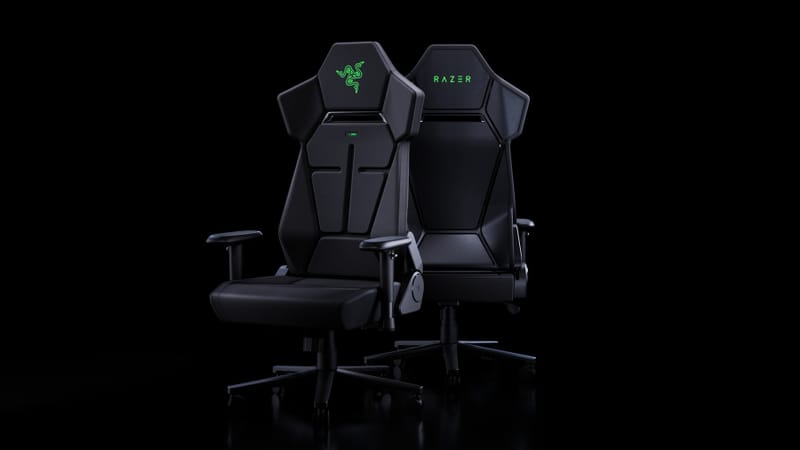
The Razer Soma Pro is a gaming chair that turns the seat itself into a haptic speaker, feeding vibration, spatial audio and RGB lighting directly into whoever is sitting in it. It headlines an updated Soma lineup from Razer, alongside the simpler Soma Sensa HD Haptics, both aimed at gamers who want to feel the action rather than just see and hear it.
Key takeaways
- ✓The Razer Soma Pro gaming chair uses six built-in haptic motors instead of a strap-on cushion
- ✓Razer Sensa HD Haptics syncs vibration intensity and direction to in-game events in over 100 supported PC titles
- ✓The Soma Pro adds THX Spatial Audio speakers and Chroma RGB lighting, while the Soma Sensa HD Haptics drops those extras
- ✓Both chairs run wirelessly over Razer HyperSpeed or Bluetooth LE but still need a USB-C power source
- ✓Non-supported games, movies and music still get haptic feedback through Razer's Audio-to-Haptics conversion
Razer has been building toward this for a while. The Soma Chroma, a wireless RGB chair, launched earlier this year as the first entry in the line. The new Soma Pro and Soma Sensa HD Haptics round out the range by folding in the haptic technology Razer first showed off through Project Esther back in 2024, now rebranded as Razer Sensa HD Haptics.
Addie Tan, Razer’s global head of its lifestyle division, framed the launch as closing a long-standing gap in PC setups. According to a company statement, gamers have upgraded their monitors, headsets and mice for years while the chair stayed static, and the Soma Pro is designed to make the seat part of the experience rather than furniture that sits underneath it.
Table of Contents
How the Razer Soma Pro haptics actually work
Both new chairs house six haptic motor actuators built directly into the seat, a step up from Razer’s earlier Freyja, which was effectively a wired cushion placed over an existing chair. Razer calls the new approach “multizone feedback,” meaning the chair can distinguish between an explosion to the left and one happening right in front of the player, adjusting intensity, direction and distance rather than firing a single generic rumble for every event.
Razer lists more than 100 PC games with native Sensa HD Haptics support, including Battlefield 6, Borderlands 4, Marvel Rivals and S.T.A.L.K.E.R. 2: Heart of Chornobyl. For everything outside that list, Audio-to-Haptics in Razer Synapse converts whatever sound is playing into vibration, which extends the effect to unsupported games, movies and music alike. On the Soma Pro, players can adjust overall intensity or tune each of the six motor zones individually.
Despite being marketed as wireless, neither chair is fully cordless. Each draws power over a single USB-C connection, either from a wall outlet or a compatible power bank, to maintain what Razer describes as a cable-free look at the chair itself. Neither a power bank nor a power adapter ships in the box, so anyone chasing that tidy wireless aesthetic will need to source their own.
Spatial audio and RGB lighting set the Soma Pro apart
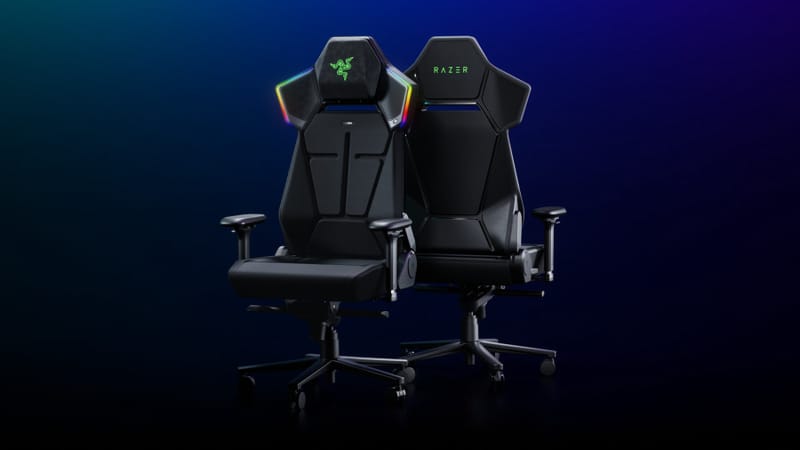
The Soma Pro is the only chair in the range with built-in speakers, delivering THX Spatial Audio from behind the headrest. It can run on its own or pair with a front speaker setup, effectively acting as the rear channel. Razer has used a similar concept before with its clip-on Clio headrest speakers, but here the hardware is fully integrated into the chair.
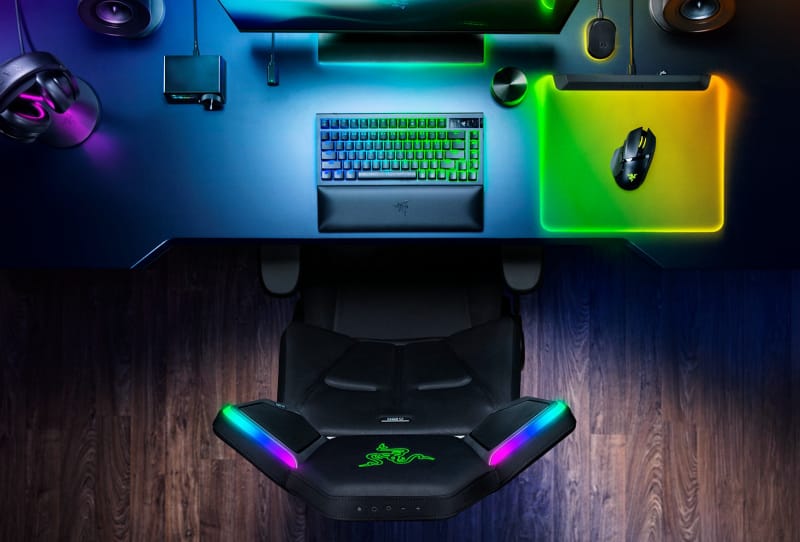
Chroma RGB lighting is also exclusive to the Pro model, offering 16.8 million colours that react to on-screen action across more than 300 supported games and sync with the rest of a Razer setup through Synapse. It is worth noting the lighting faces outward rather than toward the seated player, so it reads more as a feature for streamers and spectators than for the person actually playing. Anyone who has watched RGB lighting setups recently cause headaches on Windows 11 will know these ecosystems can be finicky, so smooth Synapse integration matters here.
Controls for both chairs sit on a built-in panel that switches between Razer HyperSpeed Wireless at 2.4GHz for PC and Bluetooth LE for mobile devices, with a companion Razer Furniture app letting the Pro’s haptics, audio and lighting be adjusted straight from a phone, bypassing Synapse entirely if preferred.
Comfort, fit and what the Soma Sensa HD Haptics drops
Away from the electronics, both chairs share the same seating hardware: a built-in lumbar arch for neutral posture, dual-density cold-cured foam with a softer top layer over a firmer core, and a backrest that reclines up to 132 degrees. Both use steel frames rated for users up to 331 pounds (roughly 150 kilograms). Razer sizes the Soma Pro for people between 5 feet 5 inches and 6 feet 6 inches, while the Sensa model fits a slightly wider range starting from 5 feet 3 inches.
The Soma Pro also gets the most adjustable fit in the range, with 4D armrests, a magnetic head cushion, a frog tilt mechanism and a powder-coated aluminium alloy wheelbase. The Soma Sensa HD Haptics keeps the same six-actuator haptic system but drops the speakers and RGB lighting entirely, aiming at buyers who already own a headset or desktop speakers and just want the vibration feedback without the extras.
Anyone weighing up a haptic chair against a standard ergonomic seat should also think about posture and long-term comfort, not just features. For a broader look at that trade-off, picking a gaming chair that actually supports posture is worth reading before committing to any high-end seat, haptic or otherwise.
| Feature | Soma Pro | Soma Sensa HD Haptics |
|---|---|---|
| Haptic motors | 6 zones, adjustable per zone | 6 zones, adjustable per zone |
| Built-in speakers | Yes, THX Spatial Audio | No |
| Chroma RGB lighting | Yes, 16.8 million colours | No |
| Connectivity | HyperSpeed Wireless / Bluetooth LE | HyperSpeed Wireless / Bluetooth LE |
| Height range | 5’5″ to 6’6″ | 5’3″ to 6’6″ |
| Warranty | 3 years mechanical, 2 years electronic | 3 years mechanical, 2 years electronic |
Why the Soma Pro matters for gaming setups
The shift from a strap-on cushion like the Freyja to a fully integrated chair addresses one of the more obvious complaints about haptic accessories: comfort and cable clutter. A built-in system that still functions without native game support, thanks to Audio-to-Haptics, means the feature doesn’t become obsolete the moment a new release skips official integration.
The bigger question is whether haptic feedback through a chair adds enough immersion to matter over cheaper alternatives like Razer’s Kraken V4 Pro headset, which already includes its own haptic drivers in a far more portable form. For streamers and content creators, the Soma Pro’s visible RGB lighting and rear-channel audio offer something a headset simply can’t: a setup that looks and sounds impressive to an audience watching the feed, not just the person playing.
Frequently asked questions
What is Razer Sensa HD Haptics?
Razer Sensa HD Haptics is the haptic feedback system built into the Soma Pro and Soma Sensa HD Haptics chairs. It uses six motor actuators to deliver vibration that matches the intensity, direction and distance of in-game events, rather than a single generic rumble.
Does the Razer Soma Pro work with games that don’t officially support it?
Yes. Razer’s Audio-to-Haptics feature in Synapse converts any audio signal into vibration, so the chair still produces haptic feedback for unsupported games, as well as for movies and music.
Is the Razer Soma Pro fully wireless?
Not entirely. It connects to a PC or phone wirelessly via HyperSpeed Wireless or Bluetooth LE, but it still needs a USB-C power connection from a wall outlet or a power bank, neither of which is included.
What’s the difference between the Soma Pro and the Soma Sensa HD Haptics?
Both chairs share the same six-motor haptic system, seating comfort features and wireless controls. The Soma Pro adds built-in THX Spatial Audio speakers and Chroma RGB lighting, which the Soma Sensa HD Haptics does not include.