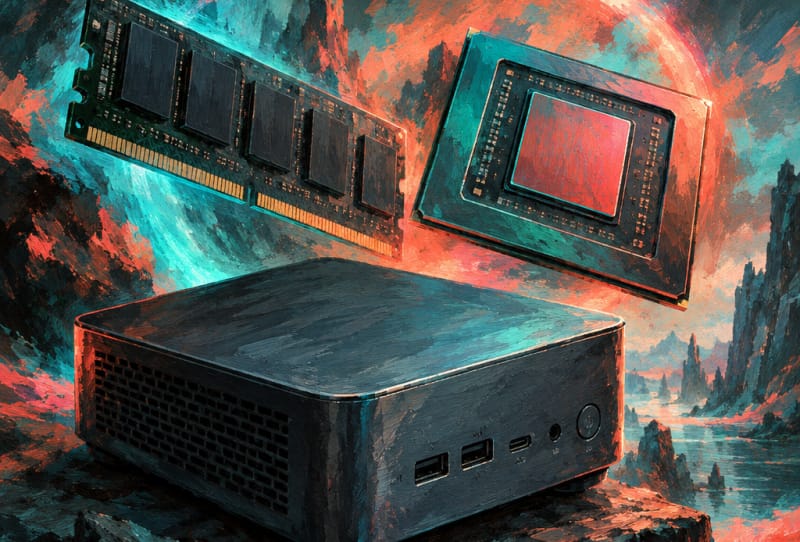
AMD Siren Halo is the codename now circulating for a rumoured chip that reportedly pairs GDDR7 memory with RDNA 5 graphics, aimed at a new generation of powerful gaming mini PCs. The claim comes from Russian hardware outlet GameGPU, and AMD has not confirmed any of it, so this sits firmly in rumour territory for now rather than a product reveal.
Key takeaways
- ✓AMD Siren Halo is a reported codename for a chip combining GDDR7 memory with RDNA 5 graphics
- ✓The claim comes from Russian outlet GameGPU and has not been confirmed by AMD
- ✓Siren Halo appears positioned as a successor to the existing Strix Halo mini PC platform
- ✓GDDR7 would offer far more bandwidth than the LPDDR5X memory used in current Ryzen AI Max chips
- ✓No specifications, pricing, or release timing have been officially announced
Still, the pairing described is worth taking seriously. AMD already has a working template for this kind of chip in Strix Halo, the silicon behind its Ryzen AI Max series, and the idea of pushing that formula further with faster memory and a newer graphics architecture fits neatly with where the company has been heading all year.
Table of Contents
What the AMD Siren Halo report claims
According to GameGPU, Siren Halo would combine next-generation RDNA 5 graphics with GDDR7 memory, a jump that would separate it sharply from the LPDDR5X unified memory AMD currently uses in Strix Halo based Ryzen AI Max chips. The report is thin on hard specifications such as compute unit counts, clock speeds, or memory capacity, which is typical of an early-stage leak rather than an official roadmap disclosure.
Because the only source so far is a single outlet without a named AMD contact or document trail, the detail should be treated as unverified. No release window, product naming, or partner devices have been attached to it. Readers should treat Siren Halo as a working codename and a direction of travel, not a confirmed chip with a launch date.
From Strix Halo to a rumoured successor
Strix Halo, sold under the Ryzen AI Max branding, already demonstrated that AMD could squeeze a genuinely large integrated GPU, built on RDNA 3.5, into a mobile-class chip and still feed it enough memory bandwidth to run modern games at respectable settings. It has turned up in mini PCs and premium handhelds, offering configurations with large pools of shared LPDDR5X memory that double as system RAM and graphics memory.
A move to GDDR7 would be a notable departure from that approach, since GDDR7 is typically soldered dedicated graphics memory rather than unified system memory, and it is the same memory standard underpinning Nvidia’s current desktop graphics cards. Using it in an APU aimed at mini PCs suggests AMD may be willing to trade some of the flexibility of unified memory for a significant bandwidth boost, provided the power and cost trade-offs make sense for a compact desktop-style product rather than a thin laptop.
| Aspect | Strix Halo (current) | Siren Halo (rumoured) |
|---|---|---|
| Graphics architecture | RDNA 3.5 | RDNA 5 (unconfirmed) |
| Memory type | LPDDR5X, unified | GDDR7 (unconfirmed) |
| Target devices | Mini PCs, premium handhelds, laptops | Gaming mini PCs (reported) |
| Official confirmation | Shipping product | None from AMD |
Why GDDR7 and RDNA 5 would matter for mini PCs
Memory bandwidth is usually the limiting factor for integrated graphics once the compute hardware gets large enough to matter. Strix Halo’s unified LPDDR5X pool already improved on earlier AMD APUs, but GDDR7 operates at substantially higher bandwidth than LPDDR5X, which could let a sizeable integrated GPU run closer to what a modest discrete graphics card delivers today. Pairing that memory with RDNA 5, the architecture expected to follow RDNA 4 in AMD’s Radeon lineup, would theoretically compound the gains further.
None of that guarantees a smooth result. GDDR7 draws more power and generates more heat than mobile memory standards, which matters for a mini PC’s compact cooling system even if it is less constrained than a laptop chassis. AMD would also need to justify the added cost and complexity against simply scaling up existing Strix Halo designs, something it has already been doing aggressively through its Ryzen AI Halo push at IFA 2026.
What it means for buyers and the mini PC market
Mini PCs have become one of the more interesting battlegrounds in PC hardware, with devices now ranging from efficient home server boxes to machines carrying serious graphics muscle. Some vendors have gone further still, building mini PCs already pushing desktop-class graphics power using full discrete GPUs squeezed into small chassis, while others lean on AMD’s integrated approach for a quieter, more compact alternative.
If AMD Siren Halo eventually materialises, it would give system builders another option between those two extremes, an APU powerful enough to handle serious gaming without the bulk of a discrete graphics card. That would sit alongside existing AMD-powered systems, including laptops built around AMD’s powerful mobile chips and smaller form factor machines such as gaming-focused mini PCs built for dual-boot flexibility, broadening the range of hardware chasing the same compact-but-capable niche.
For now, the sensible approach is patience. AMD has not acknowledged Siren Halo, specifications are absent, and a single report is not enough to treat any of this as settled. Anyone shopping for a gaming mini PC today should judge current hardware on its own merits rather than waiting on a chip that may be a year or more away, if it appears at all.
Frequently asked questions
What is AMD Siren Halo?
AMD Siren Halo is a rumoured codename reported by GameGPU for a chip said to combine GDDR7 memory with RDNA 5 graphics, intended for powerful gaming mini PCs. AMD has not confirmed its existence.
Is Siren Halo related to Strix Halo?
It appears to be positioned as a successor direction to Strix Halo, the platform behind AMD’s current Ryzen AI Max chips used in mini PCs and premium handhelds, though no official link has been confirmed.
When will AMD Siren Halo be released?
There is no confirmed release date. The chip has not been officially announced, so any timing remains speculative until AMD comments.
Why would GDDR7 memory matter for a gaming mini PC chip?
GDDR7 offers considerably more bandwidth than the LPDDR5X memory used in current Strix Halo chips, which could help a large integrated GPU perform closer to a discrete graphics card, assuming AMD can manage the extra power and heat involved.