
GPD has confirmed the full specification sheet for the GPD Win Mini Ultra, its next handheld gaming PC, revealing an Intel Arc G3 Extreme chip, up to 64GB of RAM and a notably bigger battery than the model it replaces. Pricing has not been announced, but the device’s actual hardware is no longer a mystery.
Key takeaways
- ✓The GPD Win Mini Ultra runs Intel's Arc G3 Extreme chip with 14 cores in a 2P+8E+4LPE layout
- ✓Arc B390 graphics pack 12 Xe3 cores clocked up to 2.3 GHz
- ✓RAM tops out at 64GB of LPDDR5X-8533, up from an earlier leaked 32GB figure
- ✓Battery capacity grows to 56.01Wh with a bundled 100W charger
- ✓At 845g the handheld is roughly 290g heavier than the standard GPD Win Mini
The confirmation arrives via GPD’s official product page, which lays out a configuration that differs meaningfully from what leaked on the company’s Weibo account last month. That earlier teaser, covered in GPD’s earlier Weibo teaser of the Win Mini Ultra, pointed to a 9.8-inch screen and a 32GB memory ceiling. The finalised specs tell a different story, and in most respects, a better one.
Table of Contents
What’s inside the GPD Win Mini Ultra
At the centre of the device sits Intel’s Arc G3 Extreme, a chip built around 14 CPU cores arranged in a 2P+8E+4LPE configuration. It can boost up to 4.7GHz, giving the handheld a genuine performance core alongside efficiency cores for lighter tasks. Paired with it is Arc B390 graphics silicon, featuring 12 Xe3 cores that clock as high as 2.3GHz, a jump that should matter for anyone pushing modern titles at the device’s native resolution.
Memory has also been revised upward since the leak. The GPD Win Mini Ultra now supports up to 64GB of LPDDR5X running at 8533 MT/s, double the figure that circulated last month. That extra headroom matters for a handheld running demanding games or juggling background apps, and it puts the device closer to small form-factor desktops than most portable gaming PCs typically manage. Thermal design power is rated between 15W and 45W, which gives GPD room to tune performance against battery life depending on how the device is configured out of the box.
The display has shrunk slightly from the leaked figure, landing at 8 inches rather than 9.8. It’s an LTPS IPS panel running at 1920×1200 with a variable refresh rate spanning 48Hz to 120Hz, which should help smooth out frame pacing in less demanding games while keeping power draw in check during slower-paced scenes.
Specifications at a glance
| Component | GPD Win Mini Ultra |
|---|---|
| Processor | Intel Arc G3 Extreme, 14 cores (2P+8E+4LPE), up to 4.7GHz |
| Graphics | Arc B390, 12 Xe3 cores, up to 2.3GHz |
| Display | 8-inch LTPS IPS, 1920×1200, 48-120Hz variable refresh |
| Memory | Up to 64GB LPDDR5X-8533 |
| TDP | 15-45W |
| Storage | M.2 2280, PCIe 5.0 x4 capable (ships with PCIe 4.0 SSD) |
| Battery | 56.01Wh, bundled 100W charger |
| Weight | 845g |
More ports, a bigger battery, and extra weight
Connectivity sees a clear upgrade over the Ryzen-powered GPD Win Mini. The Ultra ships with two USB4 v2 ports, each rated at 80 Gbps and carrying DisplayPort 2.1 output, alongside a microSD Express slot for fast expandable storage. The internal M.2 2280 slot accepts full-size PCIe 5.0 x4 drives, though GPD is shipping units with PCIe 4.0 SSDs as standard, leaving an upgrade path open for owners who want to swap in faster storage later.
Battery capacity climbs to 56.01Wh, up from 44.24Wh on the standard Mini, and GPD includes a 100W charger in the box to help top up that larger cell quickly. That jump in capacity, combined with the more power-hungry Intel silicon, explains much of why the Win Mini Ultra weighs in at 845g, roughly 290g heavier than the 2025 Mini. For a device meant to be held during long sessions, that’s a tangible difference anyone upgrading from the smaller model will notice immediately.
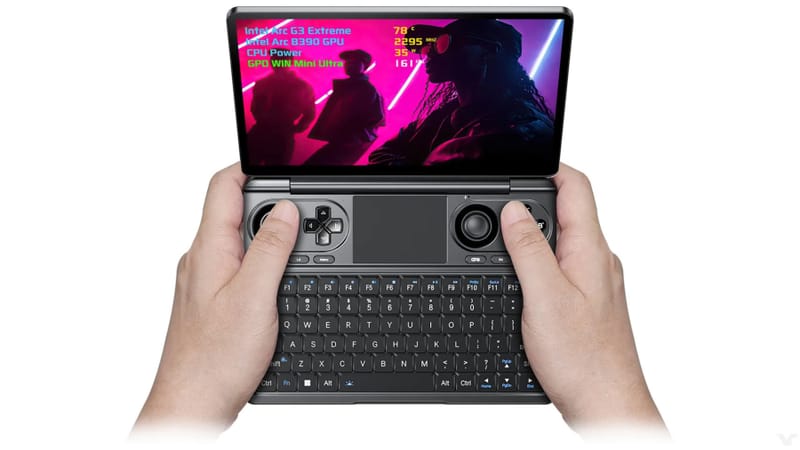
The move to Intel also marks a shift in strategy for GPD, whose recent handhelds have leaned heavily on AMD’s Ryzen mobile chips. Choosing the Arc G3 Extreme suggests GPD sees enough performance and efficiency upside in Intel’s latest silicon to justify the switch, at least for this particular model, and it gives buyers considering handheld PCs a genuine alternative chipset to weigh against the usual AMD-based competition.
What it means for buyers
None of this answers the question most buyers actually have, which is cost. GPD has published the full spec sheet but has stayed quiet on pricing and availability, so anyone keen on the Win Mini Ultra is left weighing confirmed hardware against an unconfirmed release window. Given the jump in memory, storage flexibility and connectivity, it’s reasonable to expect this model will sit above the standard Win Mini on price, but nothing official has surfaced yet.
For now, the GPD Win Mini Ultra looks like a meaningful step up for anyone who found the existing Win Mini short on memory or I/O. Faster USB4 ports, PCIe 5.0 storage headroom and a considerably larger battery address some of the more common complaints levelled at compact handhelds, even if the added weight is a trade-off some buyers will need to accept.
Frequently asked questions
What chip powers the GPD Win Mini Ultra?
It uses Intel’s Arc G3 Extreme, a 14-core processor paired with Arc B390 graphics featuring 12 Xe3 cores clocked up to 2.3GHz.
How much RAM does the GPD Win Mini Ultra support?
The confirmed spec sheet lists up to 64GB of LPDDR5X memory running at 8533 MT/s, double the amount suggested by an earlier leak.
How does the GPD Win Mini Ultra compare to the standard Win Mini?
The Ultra adds faster USB4 v2 ports, a microSD Express slot, PCIe 5.0 storage support and a larger 56.01Wh battery, though it weighs about 290g more at 845g.
When is the GPD Win Mini Ultra being released, and how much will it cost?
GPD has not announced pricing or an official release date, despite publishing the device’s full specifications.