A newly published Activision voice chat patent describes a system that would train non-player characters to react like real gamers, learning from how players actually sound over voice comms when they land a kill, get killed, or otherwise hit a big moment in a match. The filing, spotted by patent-tracking site Patentlyze, raises an obvious question: what happens when an AI model is trained on the unfiltered things people yell in the heat of a game.
Key takeaways
- ✓Activision's patent application was published on November 12, titled 'Methods and Systems for Applying Machine Learning to Generate Gameplay Audio'
- ✓The system would record player voice chat reactions to events like kills or deaths and use them to train NPC behaviour
- ✓Discord and TeamSpeak are named as possible sources of voice data, matched to events via timestamps
- ✓Past AI chatbots trained on player voice and text have repeatedly been shut down after producing offensive responses
- ✓A published patent does not guarantee the technology will ever appear in a shipped game
The application, titled “Methods and Systems for Applying Machine Learning to Generate Gameplay Audio,” was published on November 12. It sits with the Activision name attached and lays out a fairly detailed pipeline for turning player voice data into NPC behaviour, rather than describing a vague concept.
Table of Contents
What the Activision voice chat patent actually describes
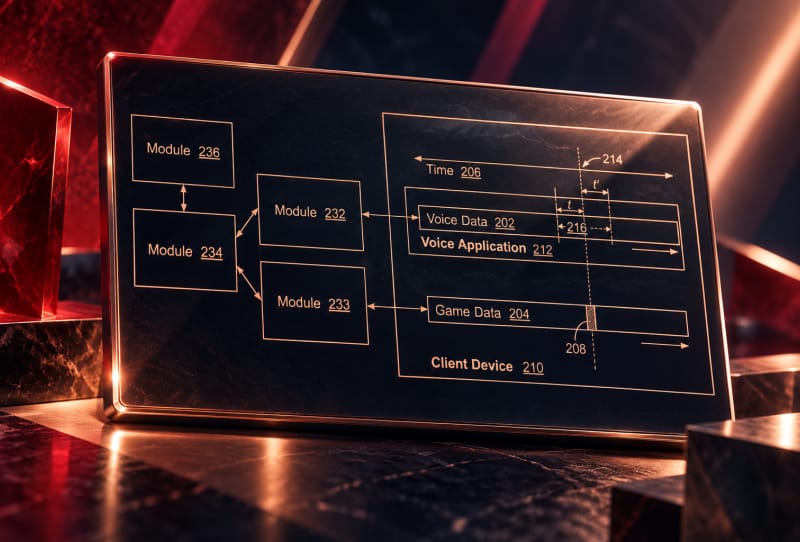
According to the filing, the system records how players react over voice chat to specific in-game triggers, things like landing a kill, dying, or clutching a round. That audio gets matched to the event that caused it using timestamps, so the software knows which grunt, shout, or laugh belongs to which moment.
Once that pairing exists, the recordings are fed into a neural network. The trained model then generates “human-like” vocal reactions for NPCs, whether those characters are fighting alongside the player as teammates or standing against them as enemies. The intent, as described, is to make computer-controlled characters sound less scripted and more like an actual person reacting in real time.
Notably, the patent names Discord and TeamSpeak as possible sources of the voice data it would draw on. Both are third-party apps widely used alongside games rather than tools built by Activision itself, which raises its own questions about how voice recordings would be captured and consented to in practice.
Key details from the filing
| Detail | What the patent says |
|---|---|
| Title | Methods and Systems for Applying Machine Learning to Generate Gameplay Audio |
| Published | November 12, 2026 |
| Core idea | Train a neural network on player voice reactions tied to in-game events |
| Named voice sources | Discord, TeamSpeak |
| Target output | NPC voice reactions for teammates and enemies |
Not Activision’s first unusual filing
Gaming companies have form when it comes to patenting ideas that sound stranger on paper than they might in practice. Sony previously filed for a wearable collar designed to blow air on players, likely intended for VR titles. Microsoft, for its part, pitched a system for inserting ads during loading screens and immediately after boss fights.
Patents like these don’t guarantee a shipped feature. Companies file broadly to protect intellectual property long before anything reaches a retail build, and plenty of filings never progress past the paperwork stage. Still, the pattern shows publishers are actively exploring how machine learning and player data can be folded into the moment-to-moment feel of a game, not just its marketing or matchmaking.
The obvious problem with training AI on voice chat
Training a model on human reactions captured during emotionally charged, competitive gaming sessions carries real risk. Voice chat in matches like those built around Activision, alongside Riot and Ubisoft, which is already facing regulatory scrutiny in the EU over in-game currency practices, tends to be loud, profane, and occasionally outright abusive.
History backs up that concern. Similar experiments with AI trained on player input have had to be pulled quickly after things went wrong. An AI-powered Darth Vader character added to Fortnite, for example, was tricked by players into saying slurs almost immediately after launch, forcing a swift response from the developers involved.
Feeding a model the raw emotional spikes of competitive voice chus, without heavy filtering, risks repeating that exact failure at a larger scale. Whether Activision’s eventual implementation, if it ever ships one, includes safeguards against this isn’t detailed in the patent itself.
What this means for players
For now, nothing changes in any live Activision title. A patent filing is a legal protection, not a confirmed feature, and the gap between the two can be years or may never close at all. Players won’t suddenly hear NPCs mimicking their squad’s voice chat in the next Call of Duty update.
That said, the filing fits a broader industry trend of publishers looking to make NPCs feel less robotic through machine learning, following similar interest from other game-makers who have experimented with AI-generated dialogue and reactive companions. It also sits alongside existing voice features already live in games, such as the built-in team voice chat added to League of Legends and the chat speaker tags on PS5, both of which show how central voice communication has become to modern multiplayer design.
Whether Activision ever builds this system, and how it might handle the messier side of player voice chat, remains to be seen. For a company already under regulatory pressure on other fronts, getting the ethics of this one right will matter as much as getting the technology working.
Frequently asked questions
Is this Activision voice chat patent a confirmed game feature?
No. It is a published patent application, which protects an idea legally but does not confirm the technology will appear in any released game.
What games could this technology affect?
The filing doesn’t name specific titles. Given Activision’s portfolio, any eventual use would most likely appear in a Call of Duty game or a similar multiplayer-focused release.
Would players need to opt in to have their voice chat recorded?
The patent filing doesn’t detail consent mechanisms. That detail would need to be addressed separately if the system were ever built into a shipping product.
Has this kind of AI training gone wrong before?
Yes. Other attempts to train game AI on player input, including an AI-voiced Darth Vader character, have been shut down after players manipulated the system into producing offensive output.