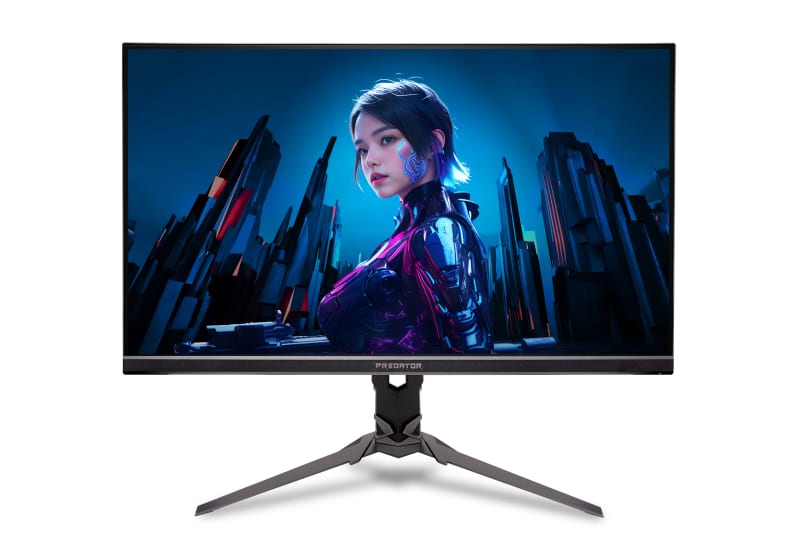
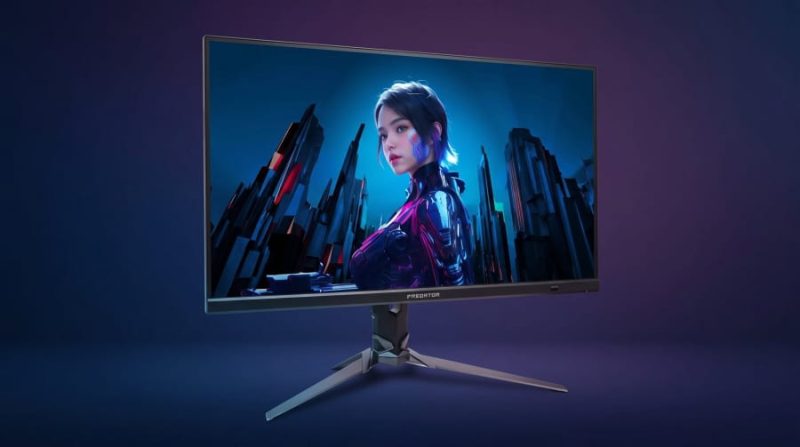
The Predator XB253Q U1 is Acer’s first monitor to break the 1,000Hz barrier, and unlike some rivals chasing that same number, it does so without asking gamers to sacrifice resolution. Unveiled at IFA 2026 in Berlin, the 24.5-inch display hits its full 1,000Hz refresh rate at native full HD, rather than forcing a step down to 720p the way several earlier four-digit-refresh monitors have required.
That distinction matters more than it might first appear. A handful of manufacturers have already advertised 1,000Hz-class panels this year, but most only reach that ceiling at a much lower resolution, which limits how sharp the image looks even as motion becomes buttery smooth. Acer says the XB253Q U1 avoids that trade-off entirely, aiming it squarely at esports players who want speed and clarity in the same package.
Table of Contents
What the Predator XB253Q U1 actually offers
Beyond the headline refresh rate, the XB253Q U1 leans on Acer’s proprietary Visual Response Boost Pro technology, which the company says cuts down on motion blur and ghosting so fast-moving objects stay crisp during frantic gameplay. It also carries VESA DisplayHDR 400 certification, Circular Polarized technology designed to reduce glare during long sessions, and support for both AMD FreeSync Premium and Nvidia G-Sync to keep screen tearing out of the picture.
Acer has priced the monitor at $1,099, positioning it firmly as a specialist esports tool rather than an everyday desktop display. The combination of native FHD resolution and a genuine four-digit refresh rate is still rare enough that it justifies the premium for players chasing every possible edge in competitive titles.
| Feature | Predator XB253Q U1 |
|---|---|
| Screen size | 24.5 inches |
| Native resolution | 1,920 x 1,080 (FHD) |
| Max refresh rate | 1,000Hz at native resolution |
| HDR certification | VESA DisplayHDR 400 |
| Adaptive sync | AMD FreeSync Premium, Nvidia G-Sync |
| Extra features | Visual Response Boost Pro, Circular Polarized anti-glare |
Why 1,000Hz is suddenly a real target
Acer isn’t the only company chasing this milestone. Earlier this year it launched the Predator XB273U F6, another 1,000Hz panel, though that model only reaches the full rate at a 1,280 by 720 resolution. Samsung has gone even further on paper with the 27-inch Odyssey G6, announced at Gamescom as the world’s first 1,100Hz monitor, but it too caps out at 720p when running at that speed. LG’s own 1,000Hz gaming monitor, the UltraGear 25G590B-B, is notable for already being on sale and, like the new Acer, achieves 1,000Hz at full HD rather than a cropped resolution.
The appeal of these extreme refresh rates comes down to responsiveness. Higher refresh rates lower input lag and reduce the smearing effect of fast on-screen motion, because the display simply redraws the image more often every second. For competitive esports players, shaving even a millisecond off reaction time can matter, though even casual gamers tend to notice smoother, sharper motion once they’ve used a high refresh panel, even if the improvement is not always obvious at first glance.
Acer’s wider IFA 2026 monitor lineup
The XB253Q U1 was just one of several new screens Acer showed off in Berlin. The 31.5-inch Predator X32 V3, priced at $899, uses a QD-OLED Penta Tandem panel at 3,840 by 2,160 resolution with VESA DisplayHDR TrueBlack 400 certification, aimed at buyers who want cinematic contrast alongside gaming performance.

Acer also revealed the curved 34-inch Nitro XZ340CKR P, which pairs a 5,120 by 2,160 WUHD resolution at 180Hz with Dynamic Frequency and Resolution support, letting it drop to 2,560 by 1,080 for up to 360Hz when speed matters more than pixel count. Rounding out the range are the Nitro XV270U Z3, which offers tri-mode DFR switching across QHD, FHD, and HD, and the Nitro XV275X P, a $1,199 model built around 5K resolution with 2,304-zone mini LED backlighting for more precise local dimming.
When these monitors will actually arrive
Acer says the curved Nitro XZ340CKR P will land later this year, while the rest of the newly announced lineup, including the Predator XB253Q U1, is expected to reach shelves in early 2027. That timing puts it in direct competition with LG’s already-available 1,000Hz option and whatever Samsung ultimately ships of its Odyssey G6.
For shoppers weighing up a high refresh rate monitor purchase, the arrival of native full HD 1,000Hz panels from multiple major brands suggests this is quickly becoming a genuine product category rather than a one-off gimmick. Anyone comparing options would do well to look at how a good gaming monitor can sharpen competitive play before deciding whether the jump from a familiar 240Hz or 360Hz panel is worth the outlay, since real-world benefits can vary depending on the games played and the rest of the gaming rig involved.
It’s also worth watching how rivals respond. AOC’s dual-mode 5K and 360Hz monitor and ViewSonic’s 240Hz QHD OLED monitor show that manufacturers are exploring different paths to the same goal of faster, sharper competitive displays, and 2027 is shaping up to be a genuinely interesting year for anyone shopping at the high end of the gaming monitor market.