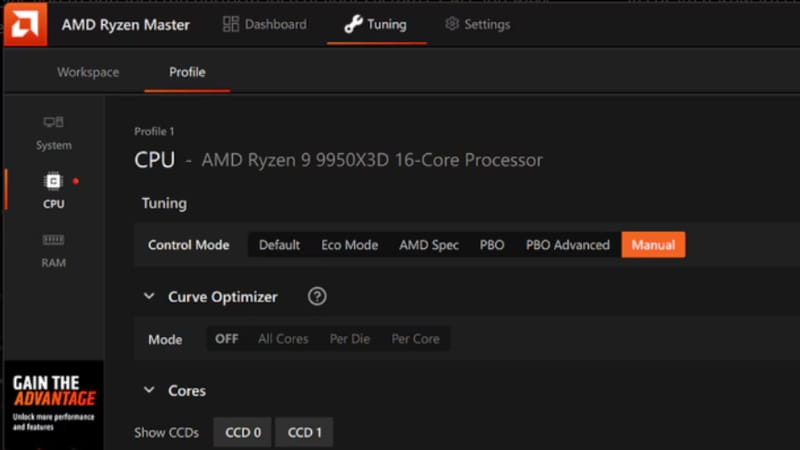
Ryzen overclocking on Linux is now officially supported for the first time, with AMD porting the core driver behind its Windows-only Ryzen Master software to open source systems. The new AMD Overclocking Driver (AOD) is limited in scope for now, but it marks the first time Linux users have had an official, AMD-sanctioned way to adjust tuning parameters without relying on community workarounds.
Key takeaways
- ✓AMD has officially ported its Overclocking Driver (AOD) from Ryzen Master to Linux for the first time.
- ✓The initial Linux driver supports SMT toggling, read-only memory clock data, and PPT, TDC and EDC limit adjustments.
- ✓Changes to PPT limits apply only after a reboot, while HSMP-based runtime limits reset on restart.
- ✓AMD built the driver to be modular, letting developers build their own tools rather than porting Ryzen Master wholesale.
- ✓Live tuning similar to Windows Ryzen Master is not yet available, but AMD says the driver will keep expanding.
The driver was detailed by AMD engineer Shyam Sundar S K in notes sent to the AMD Linux platform driver mailing list. Rather than shipping a full copy of Ryzen Master software, AMD has chosen to build out the underlying driver piece by piece, giving developers the building blocks to create their own tools around it.
Table of Contents
What the first AMD AOD Linux driver actually supports
This initial release of Ryzen overclocking on Linux is deliberately narrow. According to AMD’s own notes, the current feature set covers three areas: a switch to enable or disable Simultaneous Multi-Threading (SMT), a read-only view of memory clock speed, and the ability to adjust PPT, TDC and EDC limits within AMD’s supported ranges and step sizes.
Those last three settings, Package Power Tracking, Thermal Design Current and Electrical Design Current, are the main levers enthusiasts use to push more sustained performance out of a Ryzen chip. Being able to adjust them from Linux, even in this early form, gives tinkerers a legitimate starting point rather than relying on unofficial scripts.
There is an important caveat buried in the technical detail. AMD’s documentation notes that the firmware only applies new PPT, TDC and EDC values after the next reboot, and it does not report back the currently active limits. That makes those attributes write-only for now, so users will not be able to simply read back their current settings the way Windows-based Ryzen Master users can.
Why Ryzen overclocking on Linux behaves differently to Windows
The reboot requirement stems from how AMD’s firmware handles different types of changes. Adjustments made through AOD alter the PBO PPT limit, which is stored by the system and only takes effect on the next boot. By contrast, changes made through AMD’s existing HSMP interface adjust the runtime limit inside the System Management Unit immediately, but those changes are lost as soon as the machine restarts.
That split explains why AMD has not simply dropped a full Ryzen Master port onto Linux. Live, real-time tuning similar to what Windows users get is not part of this release, and the two change paths behave in fundamentally different ways under the hood. Building a true equivalent means reconciling both mechanisms cleanly, which takes time to get right.
AMD’s approach instead favours modularity. New kernel directories, including one specifically for AMD WMI drivers, are being introduced so that features can be added incrementally. Developers will be able to choose earlier versions of the driver for simpler controls or wait for more advanced builds as AMD expands what AOD can do, effectively laying groundwork for a genuine Ryzen Master alternative built specifically for Linux.
Part of a wider AMD Linux push
This is not an isolated move. AMD has been steadily closing feature gaps between Windows and Linux across its product stack, and Ryzen overclocking on Linux fits that pattern. It follows other recent fixes addressing long-standing Linux limitations, and lines up with AMD’s broader platform ambitions discussed at AMD’s Ryzen AI Halo push at IFA 2026, where the company laid out plans spanning chips, software and ecosystem support.
The timing also matters for gaming on Linux specifically. AMD has separately confirmed plans around FSR 4.1 reportedly heading to Xbox Series X consoles, and the Linux gaming scene has been bolstered further by tools like a new GUI launcher for Xbox Game Pass on Linux. Taken together, these efforts suggest AMD sees Linux, including SteamOS-based handhelds and desktop distributions, as a growing priority rather than an afterthought.
What it means for Linux users and overclockers
For enthusiasts who already run Linux as a daily driver, official Ryzen overclocking on Linux removes a long-standing gap. Previously, adjusting power limits on a Ryzen chip under Linux generally meant relying on community tools or manual kernel parameters with no official backing from AMD. Having a sanctioned driver, even a limited one, gives those tools a stable and supported foundation to build on.
It will not satisfy everyone immediately. Users hoping for live voltage curve editing, per-core frequency tuning or a polished graphical interface akin to the full Windows Ryzen Master suite will need to wait. AMD has not committed to a timeline for when AOD will reach feature parity, only that the modular structure is designed to let it grow over time.
Still, the direction is clear. Each step AMD takes toward matching its Windows feature set on Linux chips away at one of the more persistent arguments against switching platforms for performance tuning. For Linux gamers and builders who have waited years for first-party overclocking support, this is a meaningful, if incomplete, step forward.
Frequently asked questions
What is the AMD Overclocking Driver (AOD)?
AOD is the underlying driver that powers AMD’s Ryzen Master overclocking software on Windows. AMD has now ported a limited version of it to Linux, giving developers and users official access to some tuning controls for the first time.
Can Linux users fully replace Ryzen Master right now?
Not yet. The current Linux driver only supports SMT toggling, read-only memory clock reporting, and PPT, TDC and EDC limit adjustments. Live tuning features found in the full Windows version of Ryzen Master are not yet available on Linux.
Why do some settings only apply after a reboot?
Changes made through AOD adjust the stored PBO PPT limit, which the firmware only applies at the next boot. Separately, AMD’s HSMP interface can change runtime limits immediately, but those changes are lost on restart, since the two mechanisms work differently under the hood.
Will AMD add more overclocking features to Linux later?
AMD has structured the new driver to be modular, adding dedicated directories for its WMI drivers so functionality can expand over time. The company has not given a firm timeline, but the architecture is designed to support a more complete Ryzen Master alternative for Linux in future updates.