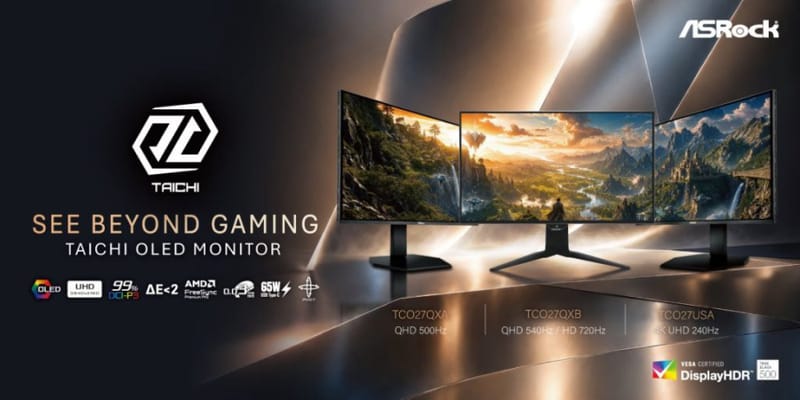
ASRock Taichi OLED monitors have arrived, marking the motherboard and graphics card maker’s first serious push into the gaming display market under its flagship Taichi name. Three 27-inch panels headline the launch, each chasing a different combination of resolution and refresh rate, but all sharing the same premium build philosophy that has made Taichi a familiar sight on PC hardware shelves for years.
Rather than a single hero product, ASRock has spread its bets across UHD, QHD and a dual-mode WOLED option, giving buyers a genuine choice depending on whether they prioritise sharpness or raw speed. That approach mirrors what rivals like Asus and Alienware have done with their own OLED ranges, and it signals ASRock wants to be taken seriously as a display brand rather than treated as a newcomer dabbling in monitors.
Table of Contents
What’s Inside the New Taichi OLED Range
All three monitors share a common feature set that ASRock is clearly positioning as a baseline for the Taichi name. Every panel comes factory calibrated to a DeltaE of less than 2, a tight colour accuracy figure that should appeal to creators as much as gamers. Each model also includes AMD FreeSync Premium Pro support, a built-in KVM switch for controlling two connected systems from one keyboard and mouse, and a USB-C port capable of delivering 65W of power for charging a laptop or docked device.
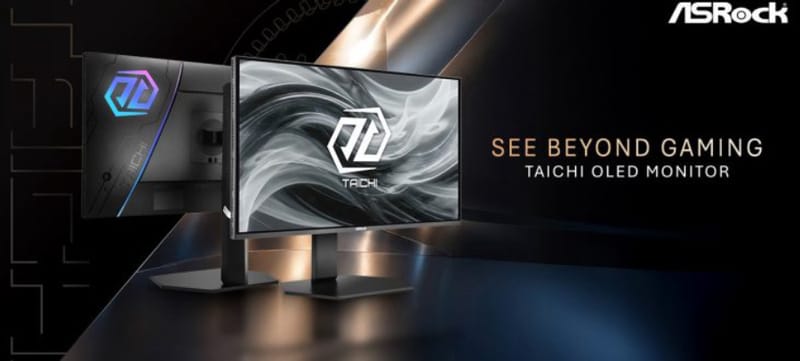
Connectivity is generous too. HDMI 2.1 and DisplayPort 2.1 inputs give each monitor enough bandwidth to run their high refresh rates at native resolution without compression tricks. ASRock has also carried over the Taichi brand’s signature rear lighting, a design touch borrowed directly from its motherboards, so the monitors look the part sitting on a desk built around Taichi components.
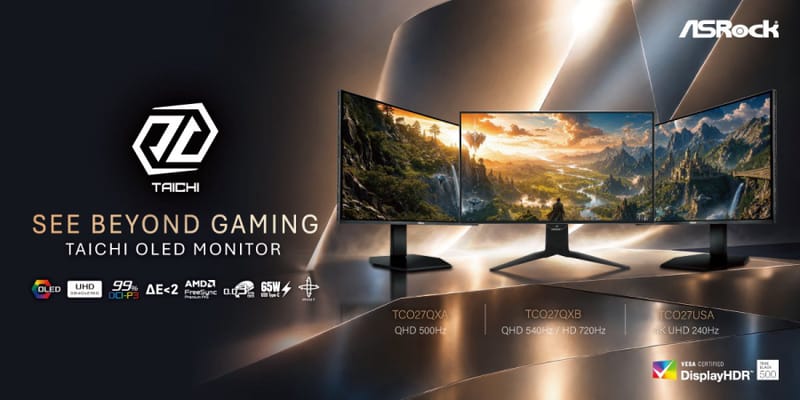
The differences show up in the panels themselves. The entry point, the TCO27USA, uses a 27-inch 4K UHD Penta Tandem OLED panel running at 240Hz, with VESA DisplayHDR True Black 400 certification and a distinctive dual-lighting setup that sets it apart visually from the other two models.
Specifications Compared
| Model | Panel Type | Resolution | Refresh Rate | HDR Certification |
|---|---|---|---|---|
| TCO27USA | Penta Tandem OLED | 4K UHD | 240Hz | DisplayHDR True Black 400 |
| TCO27QXA | QD-OLED | QHD | 500Hz | DisplayHDR True Black 500 |
| TCO27QXB | Tandem WOLED (Dual Mode) | QHD / 720p | 540Hz / 720Hz | Not specified |
The TCO27QXA swaps the UHD panel for a QD-OLED sheet instead, jumping to a 500Hz refresh rate and stepping up to VESA DisplayHDR True Black 500 certification. That combination targets competitive players who want the punchy contrast QD-OLED is known for without sacrificing motion clarity in fast-paced titles.
The most unusual model is the TCO27QXB, which pairs a 27-inch Tandem WOLED panel with a Dual Mode switch. Users can run it at QHD with a 540Hz refresh rate for everyday use, or drop the resolution to 720p to push the panel to a claimed 720Hz, a figure aimed squarely at esports players chasing every possible frame.
How ASRock’s Taichi Monitors Stack Up Against Rivals
ASRock is entering a crowded space. Asus has already pushed OLED esports monitors to extreme refresh rates with products like the ASUS ROG PG259QWS Ace esports OLED monitor, while its QD-OLED lineup includes the ASUS ROG Strix OLED XG27ACDMSR, a 320Hz panel that sits closer to the TCO27QXA’s territory. Alienware, meanwhile, has been busy expanding its own high-end range, most recently with Alienware’s own OLED gaming monitor lineup that spans 5K resolution down to 560Hz esports panels.
What sets the Taichi range apart is less any single spec and more the bundle of extras ASRock has included as standard. A built-in KVM switch and 65W USB-C charging are still relatively rare on gaming-focused OLED monitors, and having them on every model in the lineup, rather than reserved for a flagship, suggests ASRock is trying to make the whole range feel premium rather than tiered.
Factory calibration under DeltaE 2 is another point worth noting, since many gaming monitors ship with looser out-of-box accuracy that requires manual adjustment or a colorimeter to fix. Pairing that accuracy with AMD FreeSync Premium Pro also means the monitors should handle variable frame rates cleanly across a wide range, reducing tearing without needing Nvidia’s G-Sync module.
What The Launch Means For Buyers
ASRock has not confirmed local pricing or an Australian release window for any of the three Taichi OLED monitors, so shoppers will need to wait for regional retail details before these become a realistic option. The specifications alone, however, put them in direct competition with established players rather than positioning them as a budget alternative.
For gamers building a system around ASRock motherboards or graphics cards, the aesthetic tie-in through the Taichi rear lighting is an obvious drawcard. But the more practical appeal lies in the shared feature set: a KVM switch and USB-C charging genuinely simplify a desk with multiple devices, something worth weighing against rival panels that often reserve those conveniences for their most expensive models. Anyone setting up multiple monitors on a gaming PC will likely appreciate having KVM switching built in rather than added on.
The wider takeaway is that OLED gaming monitors keep climbing in refresh rate without giving up the resolution or colour accuracy that used to be traded away for speed. ASRock joining that race with a fully-featured range from the outset, rather than a single test product, suggests the company sees monitors as a long-term category rather than a one-off experiment.