
The Bambu Lab H2C enters the 3D printing space with a clear focus on users who expect consistency, accuracy, and efficiency from every print. Rather than aiming to be a general-purpose machine, it positions itself as a refined tool built for demanding workflows where reliability matters just as much as output quality. From the first interaction, it feels designed to remove common friction points that slow down the creative and production process.
What immediately sets the H2C apart is its approach to multi-material and multi-colour printing. Instead of relying on traditional purging methods that generate excess waste and extend print times, this printer takes a more considered path that prioritises efficiency and predictability. That shift alone changes how complex prints are approached, especially for users who regularly work with colour separation or mixed material properties.
Beyond its technical ambitions, the H2C also focuses heavily on usability and day-to-day practicality. Features such as automated calibration, remote print management, and a controlled internal environment help streamline the entire printing experience. The result is a machine that feels equally at home in a professional studio, educational setting, or advanced home workshop without demanding constant oversight.
Design and Functionality
The Bambu Lab H2C presents itself as a serious, purpose-built machine with a strong emphasis on durability and precision. Its frame uses a combination of metal and reinforced panels that give the printer a solid, confidence-inspiring presence. Every surface feels deliberate, with little sense of compromise in materials or construction.
The external design leans toward a clean, professional aesthetic rather than something flashy or experimental. Dark finishes and large glass panels provide clear visibility into the build chamber while maintaining a controlled internal environment. This balance between form and function makes the printer suitable for both visible studio spaces and dedicated workrooms.
Opening the enclosure reveals a thoughtfully organised internal layout. Key components are positioned to maximise airflow and accessibility while keeping cabling and moving parts well managed. This internal organisation contributes not only to performance but also to long-term reliability and ease of maintenance.

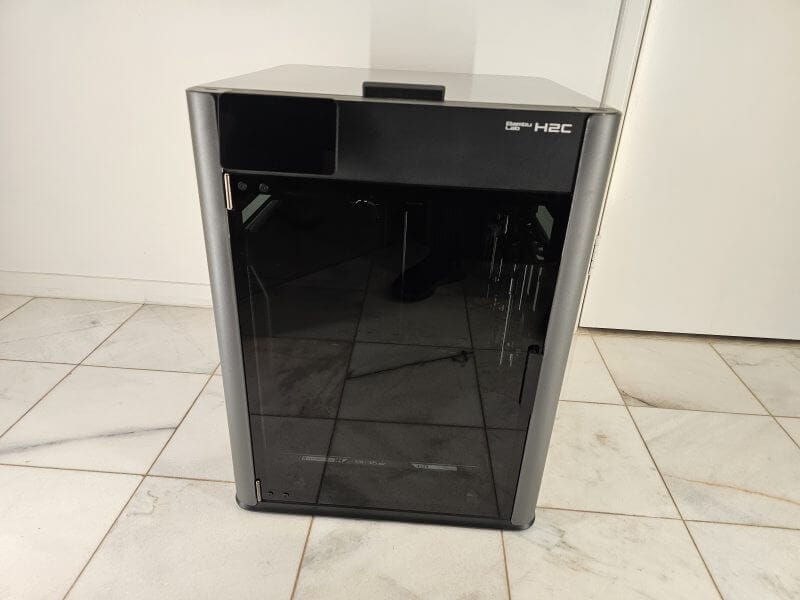
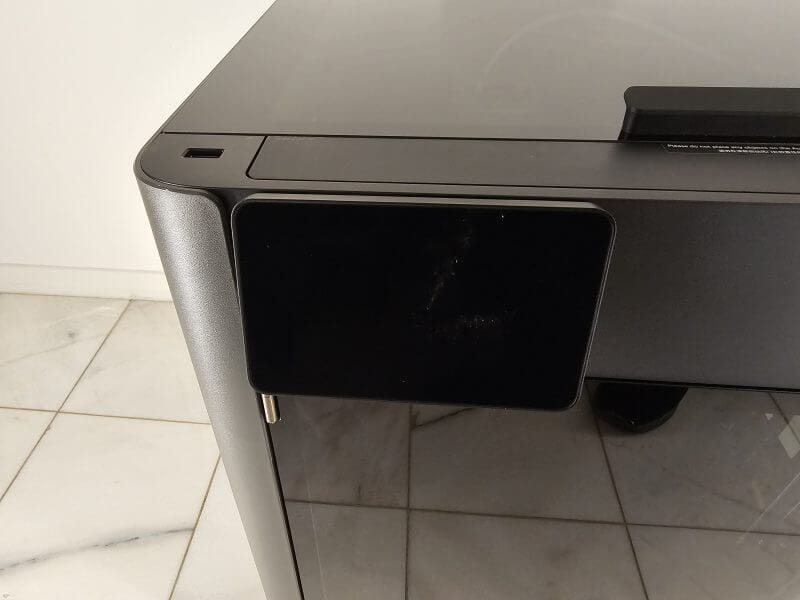


One of the most distinctive elements of the H2C’s design is its multi-hotend storage and swapping system. Instead of relying on a single nozzle to handle every material change, the printer allocates dedicated hotends that can be exchanged automatically. This approach reduces mechanical stress and simplifies complex print sequences.
The hotend exchange mechanism is integrated cleanly into the side of the build chamber. It does not intrude on the usable print volume or create unnecessary complexity for the user. From a functional standpoint, it feels like a core part of the machine rather than an optional add-on.
At the front of the printer, a large touchscreen provides direct access to controls, system status, and print progress. The display is sharp, responsive, and angled in a way that makes interaction comfortable whether standing or seated. Menus are clearly laid out, reducing the learning curve even for advanced features.
The build plate system is another area where practicality has clearly been prioritised. A flexible steel plate with a textured surface allows prints to adhere reliably during operation while remaining easy to remove once complete. This reduces the need for tools and lowers the risk of damaging finished parts.
Automatic bed levelling is handled quietly in the background before prints begin. Sensors map the surface with precision, ensuring consistent first layers across the entire build area. This automation removes one of the most common sources of frustration in day-to-day printing.
The enclosed chamber plays an important role in both material compatibility and print consistency. Active temperature control helps stabilise conditions during longer jobs, particularly when working with engineering-grade filaments. This controlled environment also contributes to cleaner layer bonding and reduced warping.
Cooling is managed through a network of intelligently controlled fans. Each cooling component adjusts dynamically based on operating conditions rather than running at full speed constantly. This results in more stable temperatures and lower overall noise during operation.
Internal lighting has been integrated to improve visibility without being intrusive. It allows users to easily check print progress through the glass panels or via the built-in cameras. When lighting is not needed, it can be disabled to suit different working environments.
Despite its advanced capabilities, the H2C remains approachable from a usability perspective. Routine tasks such as loading filament, swapping plates, or initiating prints are straightforward and well guided by the interface. This makes the printer accessible without sacrificing depth for advanced users.
The overall footprint of the machine is substantial, reflecting its enclosed design and internal systems. It benefits from being placed on a stable surface that can handle its weight and movement. Once properly positioned, the printer feels planted and secure during operation.
The design and functionality of the H2C reflect a strong focus on reliability, efficiency, and thoughtful engineering. Every major design decision appears to support consistent output and reduced user intervention. This cohesion between form and function is one of the printer’s strongest attributes.
Key Features
One of the defining features of the Bambu Lab H2C is its automated hotend swapping system. Instead of forcing a single nozzle to handle multiple filaments, the printer assigns dedicated hotends that are exchanged as needed during a print. This dramatically reduces downtime between material changes and keeps colour transitions clean.
The hotend system relies on a rapid heating method that allows each nozzle to reach operating temperature quickly. Because the hotends are lightweight and self-contained, the swapping process feels efficient rather than disruptive. This enables complex prints to progress smoothly without long pauses.
Multi-material printing is further enhanced by the printer’s ability to manage several filaments within a single job. Different plastics can be assigned to specific parts of a model, opening up opportunities for functional design rather than purely visual results. This is particularly useful for components that require flexible joints, rigid frames, or dissolvable supports.
An actively heated chamber is built into the H2C to support a wider range of materials. By maintaining a stable internal temperature, the printer reduces warping and layer separation during long or demanding prints. This consistency is especially beneficial when working with engineering-focused filaments.
The extrusion system is driven by a high-precision motor designed to deliver steady and controlled filament flow. Closed-loop monitoring helps detect issues such as resistance or filament slippage before they escalate. This adds an extra layer of reliability during extended print sessions.
Multiple onboard cameras contribute to both monitoring and automation. These cameras provide live video feeds that allow users to check progress remotely. They also support intelligent detection of print issues, helping prevent wasted material when problems occur.
Before a print begins, the printer verifies the condition of the build plate. This includes checking for obstructions or leftover parts from previous jobs. Catching these issues early helps avoid failed first layers and unnecessary restarts.
Air quality management is handled through a multi-stage filtration system. Fine particles and odours generated during printing are captured before they can escape into the surrounding space. This makes the printer more suitable for enclosed rooms or shared work environments.
Internal lighting has been designed to complement both physical viewing and camera monitoring. The illumination ensures clear visibility of the print area without causing glare or hotspots. Users can enable or disable lighting based on their preferences.
The build plate itself is engineered for both adhesion and convenience. Its textured surface grips prints firmly during operation while allowing finished parts to be removed with minimal effort. This reduces post-processing time and protects delicate components.
Print progress is visually represented through subtle lighting cues on the machine. These indicators provide quick feedback on job status without requiring interaction with the screen. It is a small touch that improves usability in busy environments.
The touchscreen interface acts as the central hub for controlling the printer. It provides access to system settings, print queues, and maintenance tools in a clear and logical layout. Even advanced features are presented in a way that feels intuitive.
Remote access is supported through dedicated desktop and mobile applications. Users can start prints, monitor progress, and adjust settings while away from the machine. This flexibility is particularly useful for longer jobs that run unattended.
Automatic calibration routines handle tasks such as bed levelling and system checks. These processes run quickly and consistently, reducing the need for manual intervention. This allows users to focus more on design and output rather than setup.
The printer supports a wide selection of filament types out of the box. From common materials to more demanding composites, the H2C adapts its behaviour to suit the chosen filament. This versatility broadens the range of projects it can handle.
Noise management has clearly been considered in the overall design. Enclosure panels and controlled fan speeds help keep operational sound levels in check. This makes the printer more comfortable to run for extended periods.
These features position the H2C as a well-rounded and forward-thinking 3D printer. Each capability contributes to smoother workflows and more predictable results. Rather than relying on a single standout feature, the printer succeeds through thoughtful integration across the entire system.
Experience Using the Product and Performance


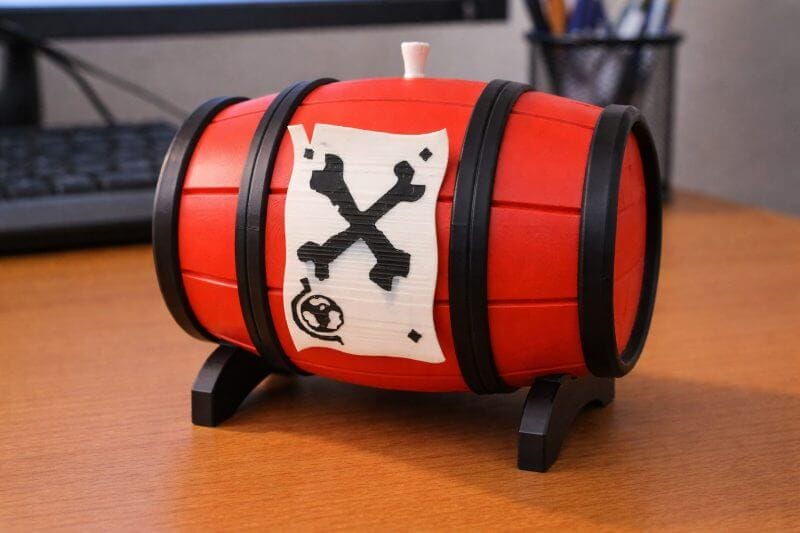
Using the Bambu Lab H2C on a day-to-day basis quickly builds a sense of confidence in the machine. From the moment a print is queued, the system feels predictable and well controlled. That reassurance becomes increasingly important as print times stretch into many hours.
Sending a job to the printer is straightforward and flexible. Prints can be started directly from the touchscreen, a desktop application, or a mobile device. This flexibility makes it easy to integrate the printer into different workflows without feeling tied to a single interface.
Initial preparation before a print begins is largely automated. The printer checks the build surface, calibrates itself, and confirms system readiness with minimal user input. These steps reduce the likelihood of avoidable failures early in the process.
First layer performance is consistently strong. The combination of automated levelling and a textured build plate helps ensure even adhesion across the entire surface. This reliability removes much of the trial and error often associated with starting a print.
As the printer moves into longer jobs, motion remains smooth and controlled. Rapid toolhead movement does not feel erratic or aggressive, even at higher speeds. This stability helps preserve surface quality while maintaining efficient print times.
Layer consistency is one of the H2C’s strongest traits. Walls appear uniform, and transitions between layers remain clean across both simple and complex geometries. This consistency carries through even when prints involve frequent material or colour changes.
Multi-colour printing is where the printer truly distinguishes itself. Colour transitions are handled with minimal interruption to the printing process. The absence of excessive purging keeps the workflow efficient and visually tidy.
Multi-material prints also benefit from this approach. Switching between rigid, flexible, or support materials feels deliberate rather than risky. This encourages more ambitious designs that combine different material properties within a single object.
During extended prints, the heated chamber proves its value. Internal temperatures remain stable, which helps prevent warping and layer separation. This stability is particularly noticeable when working with more demanding filaments.
Noise levels remain well controlled throughout operation. Fans adjust dynamically rather than running at full speed constantly. This results in a quieter experience that is easier to tolerate over long periods.
Monitoring prints is both simple and informative. Live video feeds provide a clear view of progress without needing to be physically present. This makes it easy to check on a job while working elsewhere.
The camera system adds an extra layer of reassurance. If something appears out of place, the printer can pause the job and notify the user. This proactive approach helps reduce wasted material and lost time.
Print quality remains consistent even when pushing higher speeds. Fine details are retained, and dimensional accuracy stays within tight tolerances. This balance between speed and precision is difficult to achieve but well executed here.
Support structures are generated and printed cleanly. When removed, they leave minimal surface scarring. This reduces post-processing effort and preserves the integrity of finished parts.
The printer handles repeated jobs without noticeable drift in performance. Calibration remains stable across multiple prints, reducing the need for frequent adjustments. This reliability is valuable in busy environments where uptime matters.
Material handling is smooth and dependable. Filament feeds cleanly through the system with minimal resistance. Detection systems help identify issues early, preventing more serious interruptions.
Loading and unloading filament is guided and intuitive. Clear prompts reduce the chance of mistakes during changes. This makes the process approachable even for less experienced users.
Print recovery features provide peace of mind. In the event of an interruption, the printer can resume where it left off. This helps protect long prints from unexpected setbacks.
The H2C performs equally well with functional parts and aesthetic models. Structural components show strong layer bonding and durability. Visual prints benefit from clean surfaces and accurate colour placement.
Complex geometries print with impressive consistency. Overhangs and fine features are handled confidently when settings are properly configured. This expands the range of viable design options.
Print scheduling through the software ecosystem feels seamless. Queuing multiple jobs and managing them remotely saves time. This is particularly useful for users juggling several projects at once.
Thermal management remains stable even during long sessions. Internal temperatures do not fluctuate unpredictably. This contributes to consistent material behaviour from start to finish.
Maintenance tasks are minimal and well guided. When attention is required, the interface provides clear instructions. This reduces downtime and uncertainty.
The printer encourages experimentation rather than caution. Reliable results make it easier to try new materials or more complex designs. This sense of freedom enhances the overall experience.
Over time, the H2C fades into the background in the best possible way. It becomes a dependable tool rather than a device that demands constant attention. This allows users to focus on design and output instead of troubleshooting.
Performance remains predictable across a wide range of project types. Small prototypes and larger assemblies are handled with equal confidence. This versatility makes the printer suitable for varied use cases.
The software integration supports this consistency. Slicing, monitoring, and control all work together smoothly. The experience feels cohesive rather than fragmented.
Even after extended use, the printer maintains its initial level of performance. There is little sense of degradation or inconsistency. This speaks to the robustness of both hardware and software design.
The experience of using the H2C is defined by trust. It delivers reliable results across long print cycles and complex jobs. That dependability makes it a strong foundation for serious, ongoing work.
Conclusion
The Bambu Lab H2C establishes itself as a highly capable 3D printer that prioritises efficiency, reliability, and intelligent design. Its approach to multi-material and multi-colour printing removes many of the frustrations that have traditionally limited more ambitious projects. This makes complex prints feel far more accessible and practical.
What stands out most is how well the printer balances advanced capability with everyday usability. Automation, monitoring tools, and a stable printing environment work together to reduce manual intervention without oversimplifying the experience. This balance allows both experienced users and growing teams to work confidently.
From a performance perspective, the H2C delivers consistent results across a wide range of materials and print styles. Speed, accuracy, and surface quality are maintained even during long or technically demanding jobs. That consistency builds trust and encourages more creative and functional experimentation.
For those seeking a dependable, forward-looking 3D printing platform, the H2C presents a compelling option. Its thoughtful engineering and refined workflow support serious output without unnecessary complexity. As a complete system, it feels designed to grow alongside the user’s ambitions rather than limit them.
