Anyone who has stood next to a front-of-house engineer or watched a camera operator on a busy set will recognise the habit of wearing headphones with one ear covered and the other exposed to the room. Almost no headphone is designed with that posture in mind, which is exactly the gap Beyerdynamic is targeting with the DT 275 PRO, a compact on-ear monitoring headphone built for people who need to hear both their signal and their surroundings at once.
Review summary
Beyerdynamic DT 275 PRO
The Beyerdynamic DT 275 PRO is a compact, wired on-ear monitoring headphone built for DJs, camera crews and audio professionals who need accurate sound and strong isolation, even when wearing just one earcup. It performs well as a practical, no-frills tool, backed by thoughtful design touches like swivelling cups, a dual-entry cable and user-replaceable parts. Overall, it delivers reliable, neutral monitoring performance in a lightweight package suited to demanding, on-the-move production work.
Highlights
- ✓Strong 22 dBA passive noise isolation for an on-ear design
- ✓Lightweight 195g build for all-day comfort
- ✓Dual-entry, lockable cable with coiled and straight options included
- ✓Replaceable ear pads, headband padding and cable for longevity
- ✓Neutral, accurate sound suited to professional monitoring
Rather than chasing bass-heavy consumer tuning or wireless convenience, Beyerdynamic has gone back to basics with a wired, closed-back design that prioritises accuracy and passive noise isolation. It is aimed squarely at DJs, camera crews, podcasters, video editors and live sound engineers who need to make fast, reliable judgements about what they are hearing, often in loud or unpredictable environments.
This review looks at how the DT 275 PRO is built, what makes it tick, and how it holds up for the kind of demanding, on-the-move production work it has clearly been designed around. Weighing just 195 grams and finished in matte black, it is a headphone that puts practicality ahead of flash, and that philosophy runs through nearly every design decision Beyerdynamic has made here.
Table of Contents
Design and Functionality
The DT 275 PRO takes an on-ear rather than over-ear approach, which immediately sets it apart from many of Beyerdynamic’s other monitoring headphones. On-ear designs sit against the ear rather than fully enclosing it, which usually makes passive isolation harder to achieve, but it also keeps the headphone smaller, lighter and easier to stash in a bag between takes.
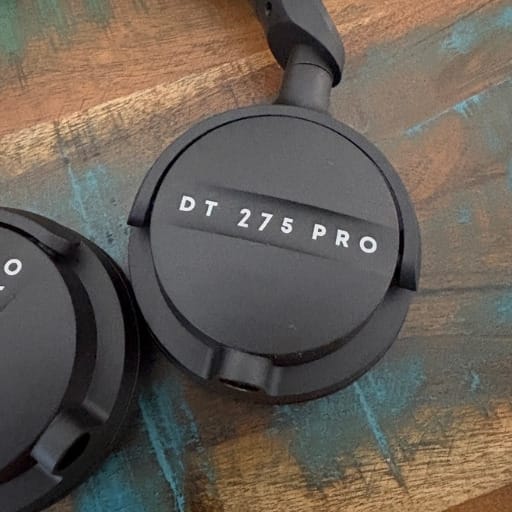
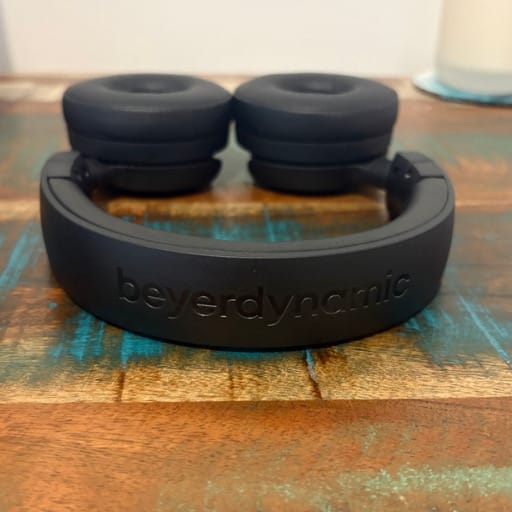
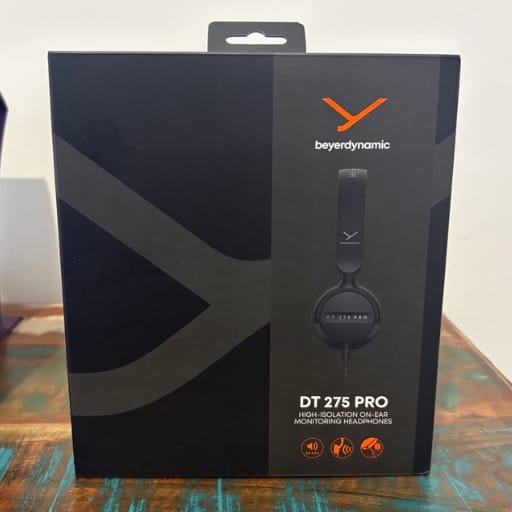



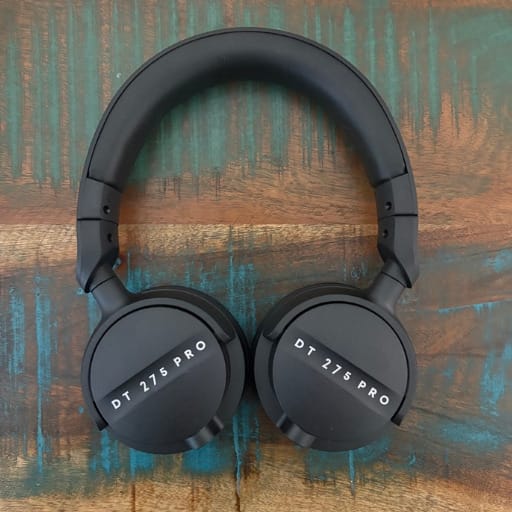
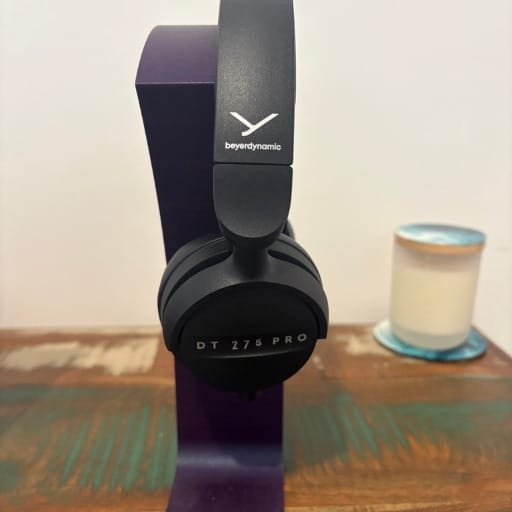
At 195 grams without the cable, the DT 275 PRO sits comfortably under the 200 gram mark that tends to separate headphones that feel light on the head from those that start to feel like a clamp after a few hours. For anyone spending a full shift wearing headphones while standing, walking or crouched behind a camera, that weight saving is more noticeable than it might sound on paper.
The earcups are finished in matte black and use a closed-back, dynamic driver design paired with faux leather ear pads. The padding extends to the headband as well, giving the top of the head a soft contact point rather than a thin strip of plastic digging in during long sessions.
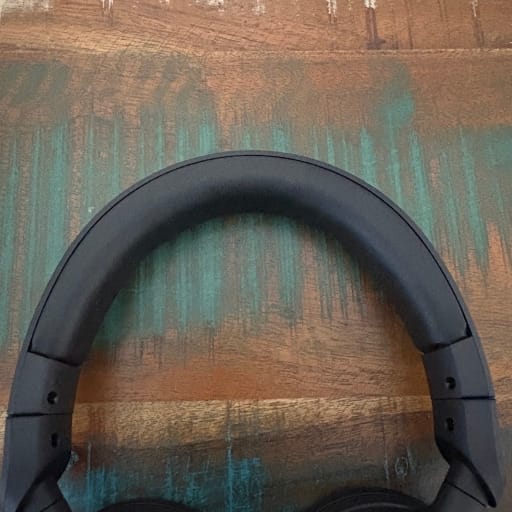
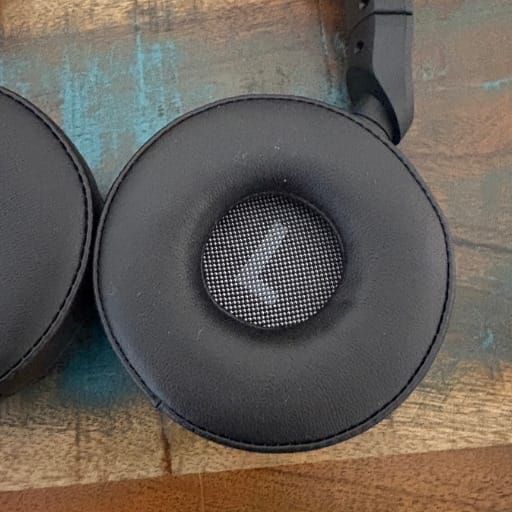
One of the standout functional details is the swivelling earcup design. Each cup can rotate inward, which serves two purposes. First, it allows the headphone to fold down into a smaller footprint for storage in a production bag or DJ case. Second, it lets one cup sit flat and comfortably against the side of the head when pushed off the ear, which is exactly the half-on, half-off posture so many monitoring professionals actually use.
Cable management is another area where Beyerdynamic has clearly thought about real-world use rather than just spec sheet appeal. The DT 275 PRO uses a dual-entry cable system, meaning the cable can be connected to either the left or right earcup depending on preference or workflow. This is a small detail that makes a genuine difference when working around a mixing desk, camera rig or DJ booth, since it means the cable can be routed away from other equipment rather than forced into an awkward position.
The cable itself locks into place at the earcup rather than simply pushing in, which reduces the chance of an accidental disconnect during quick movements or busy handoffs between crew members. That locking mechanism also ties into the headphone’s approach to durability, since a secure connection point is less likely to wear out or work loose over months of daily use.
Beyerdynamic supplies a 1.5 metre cable that comes in both coiled and straight form, giving users the flexibility to choose the style that suits their setup. A coiled cable is often preferred in DJ booths and live environments where some stretch and slack is useful, while a straight cable can suit editing desks or camera rigs where a tidier run is more practical.
Connectivity is handled through a gold-plated 3.5 mm mini stereo jack, with a 6.35 mm (quarter inch) adapter included in the box for larger equipment such as mixing consoles or audio interfaces. This dual connector approach means the DT 275 PRO can move between a phone or laptop and professional studio gear without needing a separate adapter cable.
The build quality feels appropriately robust for a headphone aimed at daily professional use. Beyerdynamic has leaned on durable materials throughout, which makes sense given that monitoring headphones in production environments tend to get thrown in bags, dropped on desks and generally treated with less care than a pair bought purely for casual listening.
What really stands out from a functionality standpoint is how modular the DT 275 PRO has been made. The ear pads, headband padding and cable are all listed as replaceable and reorderable parts, which is a meaningful point of difference from headphones where a single failed component means the whole unit is effectively finished.
This replaceability also has a practical hygiene benefit for shared production environments, where multiple crew members might use the same headphones across a shift or a shoot. Being able to swap pads between users, or simply refresh worn components after months of daily wear, extends the working life of the headphone considerably.
The overall aesthetic is understated, which suits the professional context Beyerdynamic is designing for. There is no flashy branding or RGB lighting here, just a clean matte black finish that looks equally at home in a recording booth, on a video set or clipped to a belt between DJ sets.
In the box, buyers get the DT 275 PRO headphones themselves, the 1.5 metre cable in coiled and straight form, the 6.35 mm adapter, a drawstring carry bag and a quick start guide. The drawstring bag is a simple but welcome inclusion, giving the headphones a dedicated home in a bag rather than rattling around loose with other gear.
Taken together, the design brief here is clear. Beyerdynamic has built a headphone specifically for people who need to move quickly, monitor accurately, and keep working without their gear becoming a point of failure during a long or demanding day.
It is a refreshingly focused approach, and one that avoids the temptation to load the DT 275 PRO with unnecessary features that would only add weight, cost or complexity without addressing the actual problems professionals face on set or in the booth.
Key Features
The headline feature of the DT 275 PRO is its passive noise isolation, rated by Beyerdynamic at 22 dBA. For an on-ear headphone, this is a genuinely strong figure, since on-ear designs typically struggle to match the isolation levels of over-ear models due to the smaller seal around the ear.
That isolation figure matters because it is what makes the headphone’s core use case actually workable. When only one earcup is on the head, that single cup needs to hold back enough ambient noise on its own for the wearer to still make accurate judgements about the audio signal, whether that’s checking dialogue clarity, cueing a track or confirming a mix decision.
Frequency response is rated from 5 Hz up to 24,000 Hz, a wide range that extends well beyond typical human hearing at both ends. This kind of extended response is common in monitoring headphones because it gives engineers confidence that nothing in the audible spectrum is being rolled off or coloured by the driver itself.
Nominal impedance sits at 45 ohms, which is a genuinely useful figure for anyone working with portable or field equipment. At this impedance, the DT 275 PRO can be driven to comfortable listening levels straight from a camera’s headphone output, a field recorder, a laptop or a mixer, without needing a dedicated headphone amplifier.
Sound pressure level is rated at 105 dB SPL at 1 kHz and 1 mW, rising to 119 dB SPL at 1 Vrms, with a maximum sound pressure level of 125 dB SPL. These figures indicate plenty of headroom for loud environments such as live venues or busy sets, without the headphone needing to be pushed into distortion territory to be heard clearly.
Total harmonic distortion is listed at just 0.04 percent at 500 Hz and 0.03 percent at 1 kHz, both very low figures that point to a clean, accurate reproduction of the source signal. For monitoring work, low distortion is arguably more important than raw output level, since the goal is to hear exactly what is in the recording rather than a coloured or embellished version of it.
Maximum short-term power handling is rated at 100 mW, which is well within what most portable and professional audio sources will realistically deliver, giving the driver a comfortable margin before it is ever pushed to its limits.
The dual-entry cable system deserves another mention as a standalone feature rather than just a design quirk, because it genuinely changes how the headphone can be used across different scenarios. Being able to lock the cable into either earcup means the DT 275 PRO can adapt to left-side or right-side monitoring setups depending on the wearer’s role or preference.
Beyerdynamic has also confirmed that the cable from its DJ 300 PRO X headphones is compatible with the DT 275 PRO, which is a handy detail for anyone who already owns or works alongside that model. It means a spare cable may already be sitting in a DJ’s kit bag without needing to source a specific replacement part.
The swivelling earcups function as both a comfort feature and a portability feature. Being able to fold the cups flat makes the DT 275 PRO noticeably easier to pack into a camera bag, backpack or DJ case compared with a headphone that only folds one way or not at all.
Weight is a feature in its own right here. At 195 grams without cable, the DT 275 PRO is light enough to wear through a full production day without the fatigue that heavier over-ear monitoring headphones can bring, particularly when only one cup is being worn at a time.
The inclusion of both a coiled and straight cable in the box gives users a genuine choice depending on their working environment, rather than forcing a single cable style that may or may not suit every job. This is a small but thoughtful addition that saves buyers from having to purchase a second cable separately.
Replaceable ear pads, headband padding and cable round out the feature set, positioning the DT 275 PRO as a headphone that can be maintained and refreshed over time rather than replaced outright once a wear part fails.
Finally, the gold-plated 3.5 mm connector with included 6.35 mm adapter ensures the DT 275 PRO can move seamlessly between consumer devices and professional studio or broadcast equipment, which is exactly the kind of flexibility a working professional needs from a single pair of headphones.
Experience Using the Product and Performance
Putting the DT 275 PRO on for the first time, the immediate impression is how light and unobtrusive it feels compared with larger over-ear monitoring headphones. There is no sense of being clamped, and the padded headband distributes weight evenly across the top of the head rather than concentrating pressure in one spot.
The faux leather ear pads feel soft against the skin from the outset, without the stiffness that some synthetic materials have when new. Over extended wear, they continue to feel comfortable rather than becoming warm or irritating, which is an important consideration for anyone wearing headphones through a multi-hour shoot or session.
Fitting the headphone in the traditional way, with both cups over the ears, gives a surprisingly composed and neutral sound for a compact on-ear design. There is no obvious bass boost or treble emphasis working to flatter music, which is exactly the point for a monitoring headphone built to reveal problems rather than mask them.
Vocals and dialogue come through with clarity, which is critical for anyone using the DT 275 PRO to check spoken word content, podcast recordings or on-set audio. Sibilance and mouth noise, the kind of small details that can ruin a otherwise good take, are easy to pick out rather than being smoothed over.
Switching to the half-on, half-off wearing style that the DT 275 PRO has clearly been designed around, the swivelling earcup does exactly what it needs to. It sits flat and comfortably against the side of the head without digging in or feeling like it is going to slip off during movement.
With one cup off the ear, the remaining cup’s isolation becomes the whole story, and this is where the claimed 22 dBA of passive attenuation genuinely earns its place. In a moderately noisy environment, that single earcup does a credible job of keeping ambient sound down enough to still make confident calls about what is coming through the signal.
In louder settings, such as a busy live venue or a set with a lot of background chatter and equipment noise, the isolation naturally has its limits, since this is a passive design rather than one relying on active noise cancellation. Even so, the difference between having that cup sealed against the ear versus an open-backed alternative is noticeable.
For DJ-style cueing, the ability to lock the cable into either earcup pays off quickly. Being able to route the cable away from turntables, mixers or other equipment on either side of the booth removes a small but constant annoyance that fixed-cable headphones tend to introduce.
Swapping the cable from one side to the other is a simple, tactile process. The locking connector clicks into place with a reassuring firmness, and there is no sense that repeated swapping is going to loosen the connection or wear out the mechanism prematurely.
The included coiled cable proves particularly well suited to booth and stage use, where a bit of natural stretch and give is useful for moving around without the cable pulling tight or catching on equipment. The straight cable, meanwhile, feels better suited to a desk-based editing or mixing environment where a tidier, less bouncy cable run is preferable.
Switching between the 3.5 mm connection and the 6.35 mm adapter for use with a mixing console highlights just how seamless Beyerdynamic has made this transition. There is no fumbling with loose adapters or worrying about a poor connection, since the supplied adapter screws on securely and stays put.
Driving the DT 275 PRO from a range of sources, including a laptop, a camera’s headphone output and a small field mixer, confirms that the 45 ohm impedance really does make a practical difference. Volume levels are comfortably achievable across all of these sources without needing to max out the output or reach for a separate headphone amplifier.
The low total harmonic distortion figures translate into a genuinely clean listening experience, even at higher volumes. Pushing the headphone louder to check for problems in a noisy environment does not introduce the kind of harshness or breakup that can make it hard to tell whether an issue is in the recording or in the headphone itself.
For video editing and podcast production work, wearing the DT 275 PRO over long sessions is a comfortable experience thanks to that low overall weight and the well-padded headband. There is little of the ear fatigue that heavier headphones can introduce after a few hours at a desk.
The neutral tuning does mean the DT 275 PRO is not the headphone to reach for if the goal is enjoying music casually. Bass is present but not emphasised, and there is no attempt to add warmth or excitement to the sound. For editing and monitoring work, though, this restraint is exactly what makes problems in a mix or recording easier to spot.
Testing the swivel mechanism repeatedly over the course of daily use shows no signs of looseness developing, and the cups continue to rotate smoothly and hold their position whether folded flat for storage or angled for half-on wear.
Packing the DT 275 PRO into a camera bag alongside other gear demonstrates the practical benefit of the folding design. The included drawstring bag keeps the headphone protected from scratches and tangling cables, while the folded profile takes up noticeably less space than a full-size over-ear monitoring headphone would.
For content creators working solo, such as reviewing footage or checking a voiceover on location, the DT 275 PRO’s compact size and light weight make it easy to keep on hand throughout a shoot without it becoming a burden to carry or wear.
Comparing the experience to over-ear alternatives in a similar price bracket, the trade-off becomes clear. Over-ear designs generally offer stronger passive isolation and a more enveloping soundstage, but the DT 275 PRO’s compact size, light weight and flexible cable routing make it far more practical for anyone who needs to move quickly or work with only one ear covered.
In a quiet studio environment, the isolation advantage of the DT 275 PRO is less relevant, since there is little ambient noise to block out in the first place. In this context, the headphone still performs well as a neutral monitoring tool, but its specific strengths are less pronounced than in a noisier working environment.
Long day-to-day use also highlights how well thought out the replaceable parts system is in practice. Knowing that worn ear pads or a damaged cable can be swapped out rather than requiring a full replacement headphone adds a sense of long-term confidence that is easy to overlook until it becomes relevant.
Handling the headphone during handoffs between crew members, a common occurrence on busy sets, shows the benefit of the sturdy build quality. The DT 275 PRO does not feel delicate or precious, which matters when it is being passed around, clipped to belts or set down quickly between takes.
Testing the dual cable entry system from both a left-handed and right-handed working perspective confirms that Beyerdynamic has genuinely built this for flexibility rather than as a marketing checkbox. Whichever side suits a particular workflow or equipment layout, the cable locks in just as securely.
Extended wear during a simulated full shift, moving between checking audio at a desk, monitoring on set and reviewing footage on the move, shows no significant hot spots developing on the head or ears. The lightweight construction genuinely pays off across a demanding day.
Audio detail retrieval remains consistent whether the DT 275 PRO is being used for music, dialogue or a mixed production track. Subtle background hiss, clipping or uneven levels are all easy to identify, which is exactly the kind of performance a monitoring headphone at this level needs to deliver.
For DJs specifically, the combination of secure cable locking, comfortable half-on wear and strong single-ear isolation makes the DT 275 PRO a genuinely purpose-built tool rather than a general headphone being pressed into DJ duty. The compatibility with the DJ 300 PRO X cable adds a further layer of practicality for anyone already invested in that ecosystem.
Video and content creators who need to quickly check audio between takes will find the DT 275 PRO fast and easy to use, with no fiddly adjustments required to get a reliable listen. The quick start guide included in the box is straightforward, though most users will find the headphone intuitive enough not to need it.
Across all of this testing, the DT 275 PRO consistently delivers on its core promise. It isolates well for its size, stays comfortable across long sessions, adapts to different cable and wearing configurations, and presents a clean, neutral sound that makes it easy to trust what is being heard.
The headphone does not try to be everything to everyone, and that focus is ultimately its greatest strength. It is built for a specific kind of professional workflow, and within that context it performs impressively well.
Conclusion
The Beyerdynamic DT 275 PRO succeeds because it solves a genuine problem rather than chasing a broad audience. Its combination of strong passive isolation, flexible cable routing and a lightweight on-ear design makes it a compelling choice for anyone who spends their working day checking audio in unpredictable environments.
DJs, camera operators, podcasters and live sound engineers stand to gain the most from what this headphone offers, particularly the ability to monitor confidently with just one ear covered. That specific use case is rarely addressed this well by other headphones on the market.
The neutral tuning, low distortion figures and sensible impedance all point to a headphone built with monitoring accuracy as the priority, rather than one chasing an exciting or flattering sound signature. Combined with replaceable pads, padding and cable, it is also a headphone designed to last through years of daily professional use rather than being discarded at the first sign of wear.
For professionals who need a compact, reliable monitoring solution that fits easily into a busy production workflow, the DT 275 PRO is well worth serious consideration.