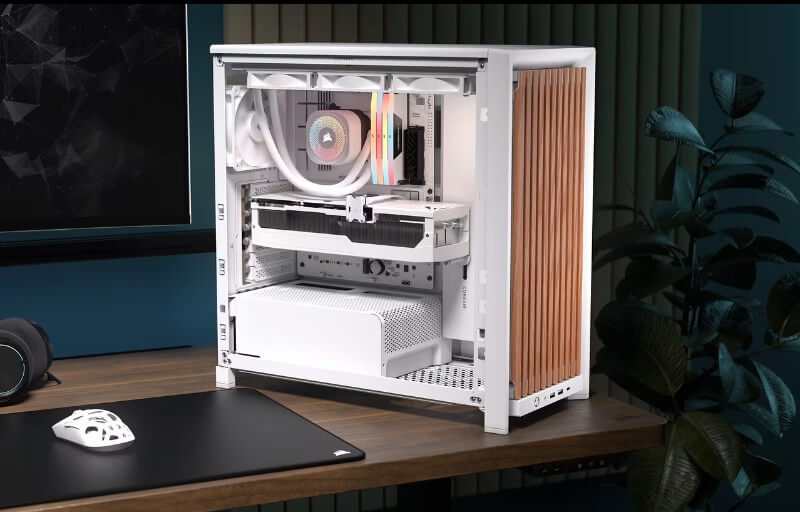
The Corsair FRAME 4000D WOOD RS brings a more refined personality to the familiar mid-tower format, combining practical building flexibility with a distinctive White/Oak finish. The contrast between the clean white chassis and the real wood front panel gives it a warmer, more furniture-inspired appearance than many conventional PC cases, making it particularly well suited to modern desks, studios and gaming spaces where presentation matters just as much as hardware support.
Beyond its visual appeal, the case is designed around Corsair’s modular FRAME system, giving builders far more freedom to adapt the chassis around different components and cooling layouts. Support for ATX, Micro-ATX, Mini-ITX and E-ATX motherboards provides a strong foundation for a wide range of systems, while generous graphics card clearance, multiple radiator mounting positions and broad fan compatibility make it capable of handling both straightforward builds and more ambitious configurations.
Corsair has also focused on making the building process feel approachable, with features such as the InfiniRail fan mounting system, integrated GPU support, strong cable-management space and convenient access to removable panels. Combined with four included RS120 PWM fans and a layout that encourages flexible airflow planning, the FRAME 4000D WOOD RS feels like a case that can suit a new build today while still leaving plenty of room for future upgrades.
Table of Contents
Design and Functionality
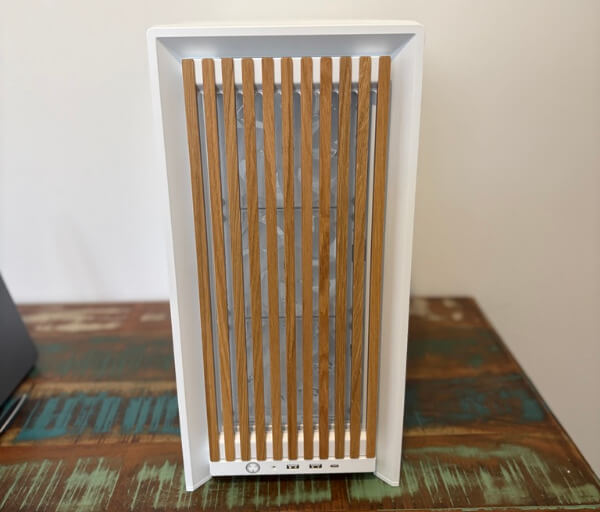
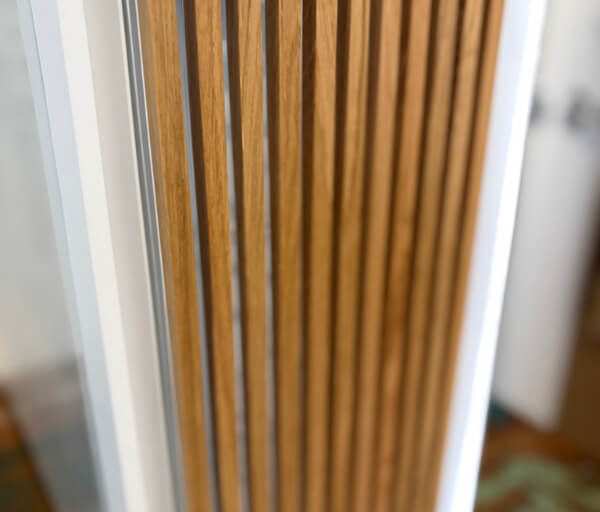
The Corsair FRAME 4000D WOOD RS immediately stands out through its White/Oak finish, which gives the chassis a clean and contemporary appearance without making it feel overly clinical. The real wood front panel adds warmth and texture, creating a strong contrast against the white exterior while still maintaining the understated look expected from a modern mid-tower case.
At 486 mm high, 490 mm long and 239 mm wide, the chassis provides a spacious internal layout while remaining manageable for a desk or floor-based setup. Its proportions leave enough room for substantial hardware without pushing the case into the much larger full-tower category, which makes it a practical choice for a broad range of systems.
The materials used throughout the case contribute to its premium presentation. Steel forms the main structure, while tempered glass, solid wood and carefully integrated plastic components create a balanced combination of durability and visual appeal.

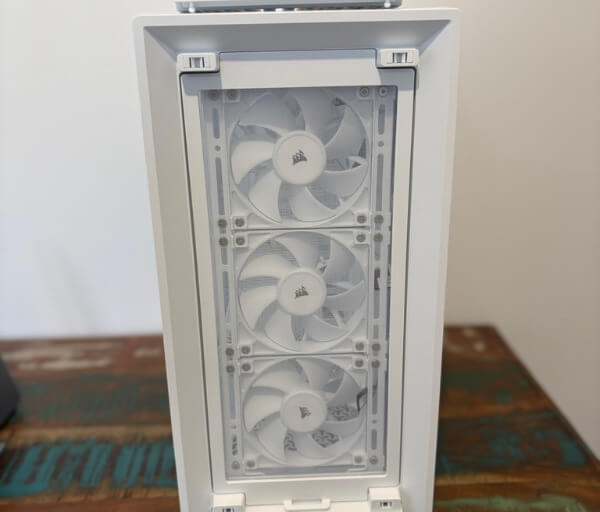
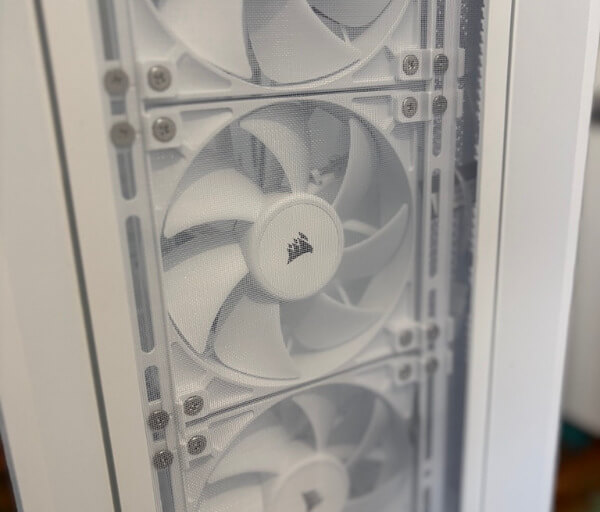


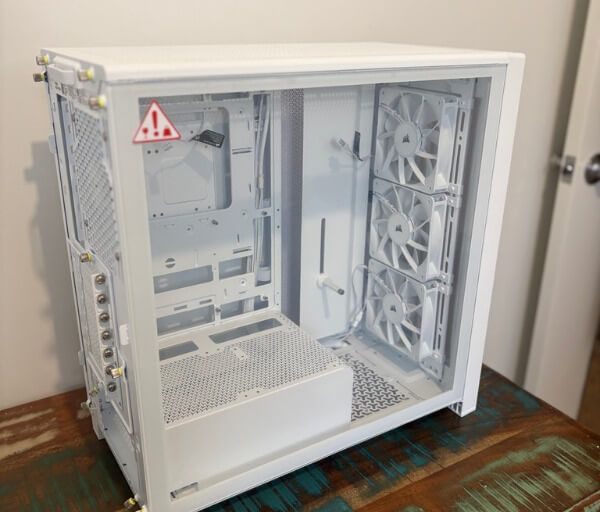


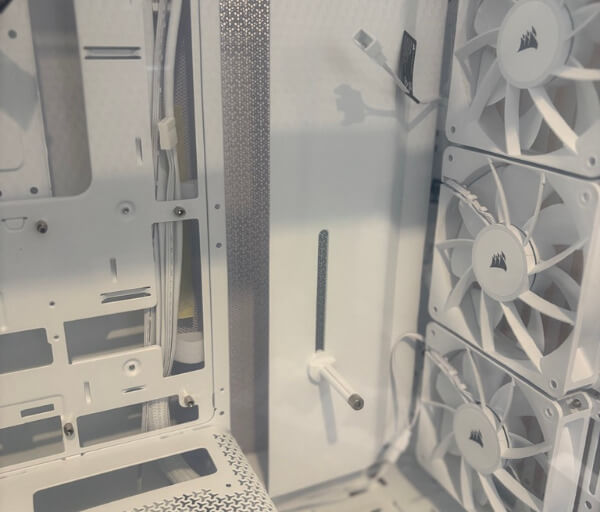
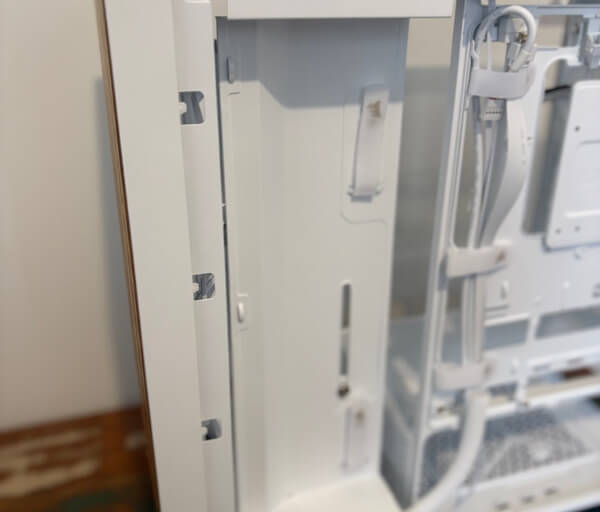

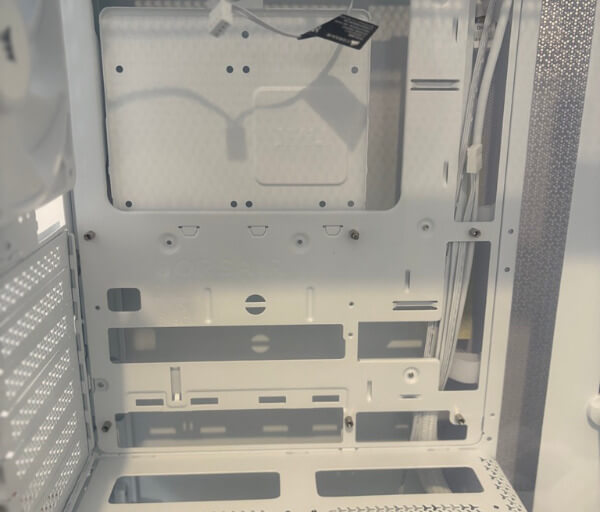
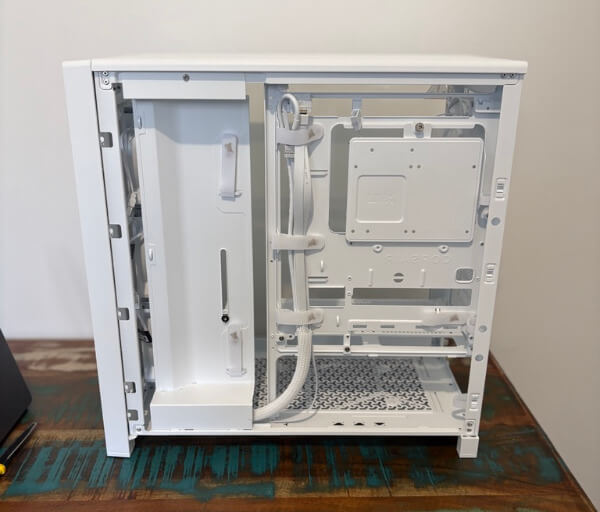
The tempered glass side panel provides a wide view of the internal hardware, making the case especially suitable for builds where component presentation is important. In the White/Oak version, this clear side panel also works particularly well with lighter components, RGB lighting or more minimalist hardware configurations.
One of the strongest aspects of the FRAME 4000D WOOD RS is its modular construction. Rather than treating the chassis as a fixed layout, Corsair has designed many areas to be interchangeable or adjustable, giving builders greater freedom to refine the case around their chosen hardware.
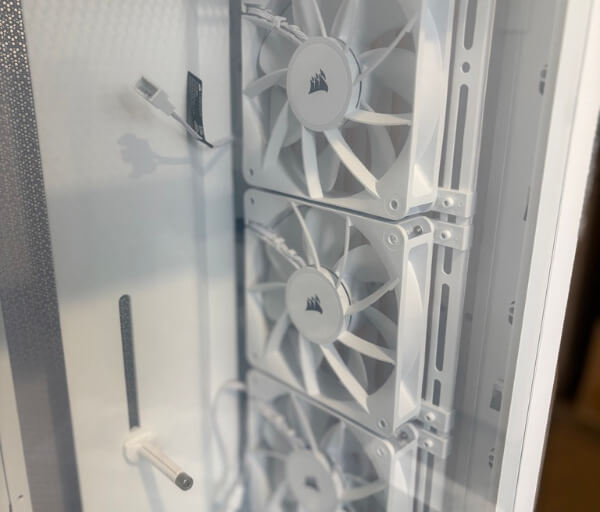
This flexibility is particularly noticeable around the cooling mounts. Corsair’s InfiniRail system uses adjustable steel mounting points that can be repositioned to suit different fan arrangements, allowing airflow to be planned more precisely than with traditional fixed mounting holes.
The front section can accommodate a wide range of cooling hardware while still retaining the visual character of the oak panel. Behind the front fascia is a removable dust filter, helping keep incoming air cleaner while providing straightforward access when routine maintenance is required.
Cooling flexibility continues across the roof, where the adjustable mounting system supports several fan configurations. Builders can install up to three 120 mm fans or two 140 mm fans in this area, while the generous space also supports large radiator installations for systems using liquid cooling.
Corsair has also provided extensive radiator compatibility throughout the chassis. Radiators up to 360 mm can be accommodated in multiple locations, giving builders the freedom to choose between front, roof and side mounting arrangements depending on the components and cooling strategy being used.
Internally, the case offers generous clearance for modern graphics cards. With support for GPUs up to 430 mm long, there is ample space for large contemporary cards, while the integrated anti-sag support arm helps stabilise heavier models and keeps them sitting neatly inside the chassis.
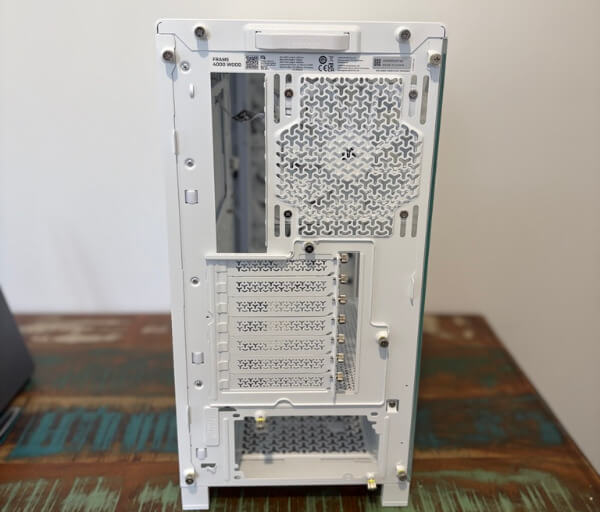
The graphics card mounting area is equally versatile. Seven horizontal expansion slots are available for a conventional installation, while the rear slot assembly can also support vertical GPU configurations when paired with the appropriate riser cable and mounting arrangement.
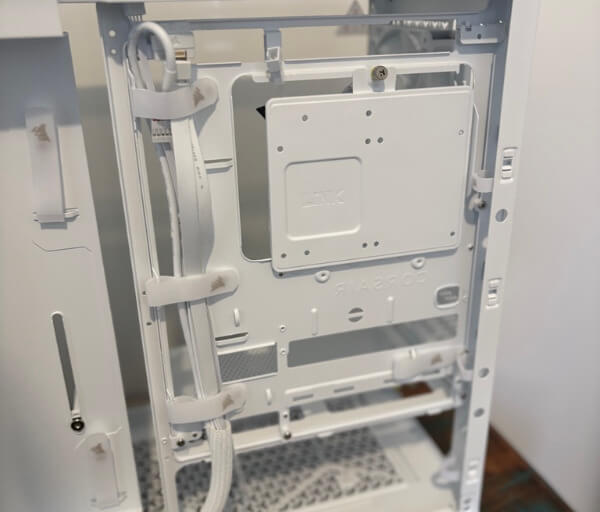
Cable management has been given considerable attention as well. There is substantial room behind the motherboard tray, along with dedicated spaces that allow excess cabling to be routed away from the visible chamber, helping builders maintain a cleaner presentation through the tempered glass panel.
Storage support has been integrated without consuming unnecessary internal space. The case can accommodate up to two 2.5-inch drives and one 3.5-inch drive, providing enough flexibility for builders who still rely on local SATA storage alongside modern M.2 drives.
The front I/O layout completes the design with a useful selection of modern connections, including two USB 3.2 Gen 1 Type-A ports, a USB 3.2 Gen 2×2 Type-C port and a combined audio connection. Combined with the illuminated power button and easy-access placement, these controls reinforce the practical nature of a chassis that has been designed to look refined while remaining straightforward to use every day.
Key Features
The modular FRAME system is one of the defining features of the Corsair FRAME 4000D WOOD RS. It gives builders the ability to change and adapt key parts of the chassis over time, which makes the case particularly appealing for anyone who regularly upgrades components or likes to refine the look of a system after the initial build is complete.
Corsair’s InfiniRail fan mounting system adds another layer of flexibility by allowing fan positions to be adjusted rather than locking them into a small number of fixed locations. This makes it easier to tailor airflow around specific components, especially when using larger graphics cards, radiators or more complex cooling arrangements.
Cooling support is extensive for a mid-tower chassis. The case can accommodate radiators in 120 mm, 140 mm, 240 mm, 280 mm and 360 mm sizes, with three separate 360 mm mounting locations available across the front, roof and side of the case.
That flexibility makes the FRAME 4000D WOOD RS well suited to both air-cooled and liquid-cooled systems. Builders can choose a simple fan arrangement for an efficient everyday PC or develop a more elaborate cooling configuration with multiple radiators and additional intake and exhaust fans.
Four RS120 PWM fans are included as standard, giving the case a useful cooling foundation straight away. PWM control allows fan speeds to respond dynamically to system temperatures, helping the build remain quieter during lighter workloads while still providing increased airflow when component temperatures begin to rise.
Fan capacity extends well beyond the included setup, with support for up to 13 120 mm fans or seven 140 mm fans depending on the chosen configuration. This gives enthusiasts plenty of scope to tune airflow for high-performance hardware without being restricted by limited mounting options.
Large graphics cards are also well catered for, with generous internal clearance allowing GPUs up to 430 mm in length. Even substantial modern cards can therefore be installed without making the internal layout feel unnecessarily cramped.
Corsair complements that clearance with an integrated GPU anti-sag stabilisation arm. The support can be adjusted to suit different card heights and helps reduce downward pressure on the graphics card and motherboard slot, which is especially useful with heavier high-end models.
The chassis also supports both traditional horizontal graphics card installation and vertical mounting. Builders who want to make the GPU a stronger visual feature can rotate the rear expansion-slot arrangement and use a compatible riser cable to create a cleaner showcase-style layout.
Reverse-connector motherboard compatibility is another useful feature for builders interested in particularly tidy systems. By supporting boards designed with many power and data connections on the rear, the case can help reduce the number of visible cables in the main chamber.
Hardware compatibility remains broad elsewhere in the chassis. CPU air coolers up to 170 mm tall and ATX power supplies up to 220 mm long are supported, giving builders a wide range of component choices without requiring unusually compact parts.
Dust management has also been considered across the main airflow paths. Removable filtering around the front, lower and side areas helps reduce the amount of dust entering the system while still allowing these sections to be accessed easily for regular cleaning.
The combination of modular construction, extensive cooling support, generous hardware clearances and integrated quality-of-life features gives the FRAME 4000D WOOD RS a strong feature set for both first-time builders and experienced enthusiasts. Its White/Oak finish adds an extra layer of personality, while the underlying design provides the flexibility needed to accommodate substantial upgrades and completely different build styles in the future.
Experience Using the Product and Performance
Building in the Corsair FRAME 4000D WOOD RS is a straightforward experience thanks to the generous internal space and sensible layout. Components are easy to access from multiple angles, which reduces the amount of time spent working around tight corners or awkward obstructions during assembly.
The removable panels make the early stages of a build particularly convenient. Being able to open up the chassis quickly gives you more room to install the motherboard, power supply and cooling hardware before cables and additional components begin to fill the interior.
Motherboard installation is uncomplicated, with enough surrounding clearance to work comfortably with ATX and smaller form factors. The case also leaves useful access around the socket area, which is helpful when fitting larger CPU coolers or making changes after the system has already been assembled.
The space behind the motherboard tray is one of the features that becomes increasingly valuable as the build progresses. Power, fan and front-panel cables can be routed out of sight without forcing everything into a narrow channel, which helps keep the visible side of the system much cleaner.
Cable management is also made easier by the deeper sections around the shroud and rear compartment. There is enough room to separate thicker power cables from smaller fan and lighting leads, which makes the final result easier to organise and simplifies future maintenance.
Installing a full-size graphics card is equally easy because of the substantial internal clearance. Large cards do not feel squeezed into place, and there is still enough surrounding room to route power cables neatly without putting unnecessary pressure on the connectors.
The integrated GPU support is particularly useful once a heavier graphics card is installed. Adjusting the support point is simple, and it provides a reassuring amount of stability while helping the card maintain a level position inside the chassis.
For builders who prefer a vertical graphics card layout, the flexible rear expansion section provides another option. This can make the GPU a stronger part of the visual presentation, particularly when combined with the large tempered glass side panel.
The four included RS120 PWM fans provide a strong starting point for airflow without requiring the cooling system to be rebuilt immediately. They move air through the chassis effectively and give users a practical baseline configuration that can later be expanded if the system becomes more demanding.
PWM control also helps the fans behave appropriately across different workloads. During light desktop use, the system can remain relatively subdued, while higher fan speeds can be used when gaming, rendering or carrying out other sustained tasks that generate additional heat.
The open internal arrangement allows air to move around major components without excessive obstruction. This is especially helpful around the graphics card, where consistent intake airflow can contribute to stable temperatures during longer gaming sessions.
The wooden front section does not prevent the case from functioning as a capable airflow-focused chassis. Corsair has balanced the oak detailing with ventilation and filtering so that the visual design still supports practical cooling performance.
The ability to adjust fan positions through the InfiniRail system is useful when fine-tuning airflow. Rather than accepting a single fixed placement, fans can be shifted to better align with the graphics card, CPU cooler or radiator being used.
This flexibility becomes even more useful in systems with large liquid cooling hardware. Radiators can be positioned in several areas of the chassis, allowing builders to choose the arrangement that best suits tube routing, component clearance and preferred airflow direction.
A 360 mm radiator installation is well supported, giving the case enough cooling potential for powerful processors. Builders can choose between the front, roof and side positions depending on the rest of the hardware, which makes the chassis adaptable to very different cooling strategies.
Air-cooled systems are also well catered for. With support for CPU coolers up to 170 mm tall, there is room for substantial tower coolers while still maintaining comfortable clearance from the tempered glass panel.
During everyday use, the dust filtration system adds a practical advantage. The main filters are easy to reach, making periodic cleaning less of a chore and encouraging regular maintenance that can help preserve cooling efficiency over time.
The front filter can be accessed without having to dismantle the entire system. This is particularly convenient in environments where dust builds up quickly, as the most frequently cleaned areas can be dealt with in only a few moments.
The lower filtration is equally useful for the power supply and bottom-mounted intake areas. Keeping these sections protected helps reduce the amount of debris reaching components while still allowing plenty of airflow into the chassis.
Storage installation is straightforward for systems that still make use of 2.5-inch or 3.5-inch drives. The mounting arrangement keeps these drives away from the main showcase area, helping preserve the uncluttered appearance of the interior.
The front I/O selection also proves practical in day-to-day use. Having both USB Type-A and USB Type-C connections within easy reach makes it convenient to connect external storage, controllers, headsets and other frequently used accessories.
The combined audio connection is useful for headsets that use a single 3.5 mm plug. This helps keep the front panel simple while still covering common gaming and communication needs without requiring additional adaptors.
The White/Oak colour combination becomes even more appealing once a complete system is installed. The lighter chassis works particularly well with clean component layouts, while the natural timber adds enough contrast to prevent the finished build from looking plain.
Through the tempered glass, the spacious layout gives components room to stand out rather than appearing crowded together. This makes it easier to create a visually balanced system, whether the preferred approach is subtle lighting, bright RGB or a restrained non-lit configuration.
Another strength is how easily the case can adapt when components are upgraded later. A larger graphics card, different cooling solution or revised fan arrangement can be accommodated without making the chassis feel like it has reached its limits.
Thermal Performance
For thermal testing, our Corsair FRAME 4000D WOOD RS system was configured with an Intel Core i7-13700K processor, Corsair Nautilus 360 liquid CPU cooler and Gigabyte RTX 4070 Ti graphics card. This combination provides a good indication of how the chassis manages the heat generated by powerful gaming and productivity hardware.
At idle, the Intel Core i7-13700K recorded a CPU temperature of 37°C. This is a comfortable result for a processor of this class and demonstrates that the case provides a consistent supply of fresh air while allowing the 360 mm liquid cooler to operate effectively during lighter workloads.
Under sustained load, the CPU reached just 59°C with the Corsair Nautilus 360 installed. Maintaining a temperature below 60°C during our testing was an excellent result and highlights how well the spacious internal layout, radiator support and fan configuration work together to move heat away from the processor.
The Gigabyte RTX 4070 Ti also benefits from the generous space available around the graphics card and the unobstructed airflow through the main chamber. With ample room around the GPU and plenty of opportunities to position intake and exhaust fans, the FRAME 4000D WOOD RS provides a strong foundation for keeping high-performance graphics hardware supplied with cooler air.
These results show that the FRAME 4000D WOOD RS is more than simply a visually distinctive case. Paired with capable cooling hardware such as the Corsair Nautilus 360, it provides an effective thermal environment for a powerful gaming PC while still retaining the clean appearance and natural White/Oak styling that makes this version stand out.
The Corsair FRAME 4000D WOOD RS delivers a particularly satisfying combination of building convenience, cooling flexibility and visual refinement. Its modular structure and generous internal layout make it enjoyable to work with, while the White/Oak finish gives the completed PC a distinctive character that can complement both gaming and professional setups.
Conclusion
The Corsair FRAME 4000D WOOD RS is an excellent choice for builders who want strong hardware support, flexible cooling options and a more distinctive visual design. The White/Oak finish gives the chassis a refined character, while the real wood front panel helps it stand apart from more conventional gaming-focused cases.
Its modular construction is one of its biggest strengths, giving the case plenty of scope to adapt as components change over time. Generous GPU clearance, support for large radiators, the InfiniRail mounting system and integrated GPU support all make the building process easier while leaving room for future upgrades.
Thermal performance was also impressive in our test system, with the Intel Core i7-13700K sitting at 37°C at idle and reaching only 59°C under load when paired with the Corsair Nautilus 360. Combined with the spacious internal layout and strong airflow potential, the case provides a capable foundation for powerful hardware such as the Gigabyte RTX 4070 Ti.
For anyone looking to build a clean, modern and highly adaptable PC, the FRAME 4000D WOOD RS offers an appealing balance of presentation and practicality. Its thoughtful design, extensive cooling support and premium White/Oak styling make it a chassis that should remain useful across multiple upgrades and future builds.