FSR 4.1.2 on Intel Arc GPUs is now a reality, thanks to a community mod that lets AMD’s latest upscaling tech run on Intel hardware using the chip’s dedicated XMX matrix cores rather than the slow fallback path Arc owners have been stuck with until now. Early benchmarks suggest the modded version runs almost as efficiently as Intel’s own native upscaler.
Key takeaways
- ✓OptiScaler lets AMD FSR 4.1.2 run on Intel Arc GPUs using XMX cores instead of the slower DP4a fallback path.
- ✓In testing, FSR 4.1.2 Lite logged 0.59 ms upscaling time versus 0.58 ms for native XeSS on an Arc B580.
- ✓The mod was tested in Clair Obscur: Expedition 33 by Reddit user DarkerThanLpDark.
- ✓Standard FSR on Arc GPUs previously relied on DP4a, which offers noticeably lower performance.
- ✓OptiScaler is a community project aiming to make upscaling and frame generation work across GPU brands.
The mod comes from OptiScaler, a long-running community project built around one simple idea: gamers shouldn’t miss out on upscaling or frame generation just because a game only ships with one vendor’s version of the tech. OptiScaler intercepts calls meant for a specific upscaler and redirects them to whichever one the player actually wants to use, regardless of which GPU brand built it.
Table of Contents
How FSR 4.1.2 on Intel Arc actually works
Normally, when AMD’s FSR runs on non-AMD hardware, it falls back to a general-purpose compute path called DP4a. That path works on almost any modern GPU, but it sacrifices a fair amount of performance because it isn’t tailored to the hardware actually doing the work. Intel Arc GPUs, however, have their own dedicated matrix acceleration hardware called XMX, short for Xe Matrix Extensions, which Intel already uses to power its native XeSS upscaler.
The breakthrough with this latest OptiScaler build is that it reroutes FSR 4.1.2 to run on those XMX cores instead of falling back to DP4a. In practice, that means Arc owners can use AMD’s newer FSR 4 upscaling model, which is generally regarded as a big step up in image quality over FSR 3, without taking the usual performance hit that came from running it on unsupported silicon.
Early benchmark results
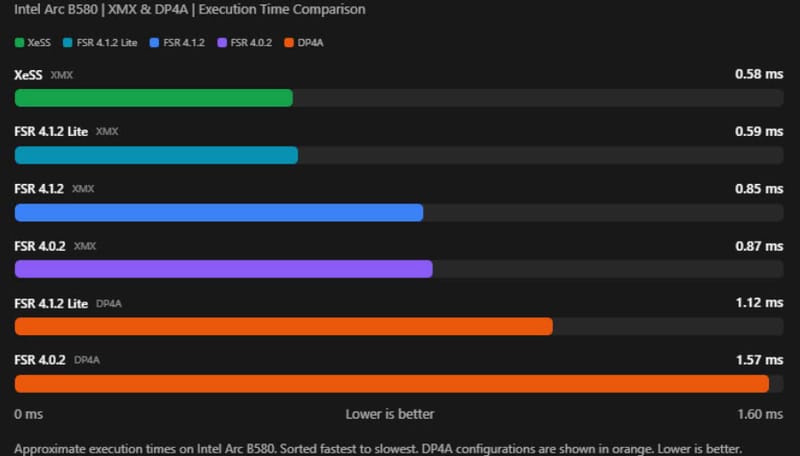
A Reddit user going by DarkerThanLpDark ran the modded FSR 4.1.2 Lite build on an Intel Arc B580 inside Clair Obscur: Expedition 33, a game demanding enough to expose real differences in upscaler overhead. The comparison pitted the new XMX-accelerated FSR against the game’s native XeSS implementation and against FSR running on the older DP4a fallback.
The results were close. FSR 4.1.2 Lite logged an upscaling time of 0.59 milliseconds, just a fraction behind native XeSS Super Resolution at 0.58 milliseconds. That’s a notable result, given FSR wasn’t designed with Intel hardware in mind at all. It suggests the XMX path genuinely closes most of the performance gap that previously made FSR a weaker choice on Arc cards compared with Intel’s own upscaler.
| Upscaler | Hardware path | Upscaling time (Arc B580) |
|---|---|---|
| XeSS (Super Resolution) | Native XMX | 0.58 ms |
| FSR 4.1.2 Lite (OptiScaler mod) | Modded XMX | 0.59 ms |
| Standard FSR on Arc | DP4a fallback | Noticeably slower |
Why this matters for Arc owners and the wider GPU market
For Intel Arc owners, this is a genuinely useful development. Not every game bothers to implement XeSS, and plenty of newer titles are shipping with FSR 4 support instead, particularly as AMD pushes the format harder across PC and console. Without a mod like this, Arc users dropped into one of those games would have been stuck with the inefficient DP4a fallback, losing frames for no good reason other than driver compatibility.
It also says something about how far cross-vendor modding has come. Tools like OptiScaler exist precisely because upscaler fragmentation is a real pain point for PC gamers, who often have to just hope their specific GPU is supported by whatever a game ships with. Intel has shown broader cooperation in this space too, including its own work on bringing XeSS support to Proton on Linux, so there’s precedent for Intel hardware benefiting from flexible upscaling arrangements even outside official partnerships.
This isn’t an isolated case either. Modders have previously managed a separate mod that brings most of DLSS to AMD Radeon cards, showing there’s a consistent appetite across the community for breaking down the walls between proprietary upscaling ecosystems. AMD, for its part, continues expanding where FSR 4 actually ships, including confirming plans for AMD’s plan to bring FSR 4 to handhelds by the end of 2026, which only increases the number of games likely to default to FSR over other upscalers.
None of this is officially sanctioned by AMD or Intel, and OptiScaler remains a third-party tool that depends on ongoing community maintenance rather than vendor support. Anyone trying it should expect the usual caveats that come with unofficial mods, including possible instability in specific games and the need to keep an eye on updates as both FSR and Intel’s drivers continue to evolve. Checking Intel’s latest Arc GPU driver updates is worth doing before testing a build like this, since driver changes can affect how well these unofficial paths behave.
Frequently asked questions
What is OptiScaler?
OptiScaler is a community-built tool that redirects a game’s upscaling calls to a different GPU vendor’s upscaler than the one it originally shipped with, letting players choose whichever option runs best on their hardware.
Does FSR 4.1.2 on Intel Arc need special hardware?
It relies on Intel’s XMX cores, which are built into Arc GPUs already for native XeSS processing. No extra hardware is required, only the OptiScaler mod itself.
Is this an official AMD or Intel feature?
No. It’s an unofficial community mod, not something either AMD or Intel has endorsed or built support for directly.
Is FSR 4 better than XeSS on Intel Arc GPUs?
Based on early testing, the modded FSR 4.1.2 performs almost identically to native XeSS in terms of upscaling time, though actual image quality and performance can still vary by game.