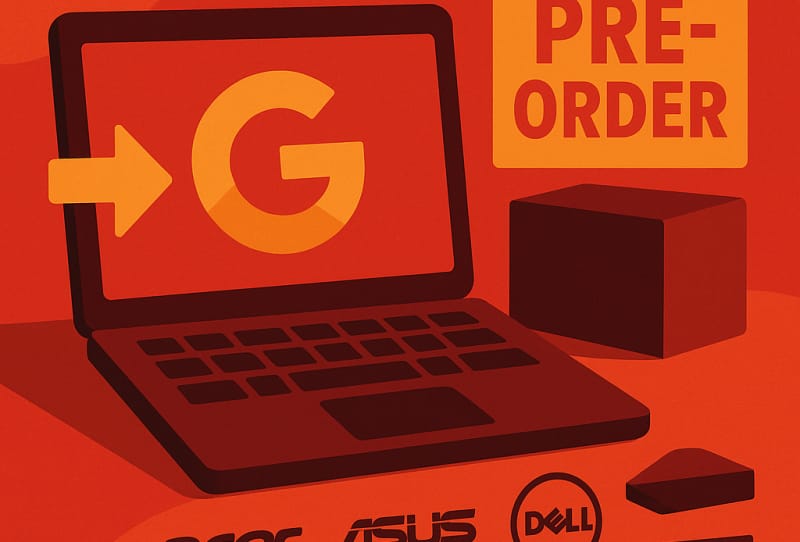
Googlebook pre-orders will officially open on September 21 at 9am ET, according to an email Google sent to people who signed up for updates on the device. The same date has now quietly appeared on Google’s official Googlebook website, making it the first concrete milestone tied to the laptop since the company first teased a fall launch back in May.
Google has spent months positioning Googlebook as the natural successor to the Chromebook, built around its Gemini AI assistant rather than the ageing Chrome OS branding that has defined the category for over a decade. Acer, ASUS, Dell, HP and Lenovo are all confirmed as first-wave manufacturing partners, and several of their machines have already leaked in enough detail to give a clear picture of what buyers can expect.
Table of Contents
What Google has actually confirmed about Googlebook pre-orders
Beyond the date and time, Google has stayed tight-lipped. The company hasn’t said which specific models will be available to pre-order on September 21, nor has it given a firm shipping date. All that’s been confirmed is that units will start arriving sometime this fall, leaving a gap between reservation and delivery that Google hasn’t clarified.
That kind of staggered rollout isn’t unusual for a new hardware category, but it does mean early buyers will be committing to a purchase without knowing exactly which configuration lands in their hands first. Given five manufacturers are involved, pricing and specification tiers are likely to vary significantly between brands, something Google will presumably detail closer to the pre-order window opening.
The leaked hardware paints an unusually premium picture
The Lenovo Googlebook 15 is the most exposed model so far, thanks to renders and specification leaks that surfaced months ahead of launch. It reportedly pairs an Intel Core Ultra 5 325 “Panther Lake” chip with up to 32GB of LPDDR5X memory, a 15.3-inch 120Hz OLED touchscreen, and Google’s signature Glowbar light strip, a colourful accent feature apparently unique to the Googlebook line.
That same Core Ultra 5 325 chip keeps turning up across leaked Acer and ASUS Googlebook models too, which marks a real departure from how Chromebooks have traditionally launched. Entry-level Chromebooks have long relied on budget Intel silicon or ARM-based chips to keep costs down, so seeing a mid-range Panther Lake processor as the common denominator across three separate manufacturers suggests Google wants Googlebook positioned well above the traditional Chromebook price and performance bracket from day one.
| Detail | Reported specification |
|---|---|
| Manufacturer | Lenovo (Googlebook 15) |
| Processor | Intel Core Ultra 5 325 (“Panther Lake”) |
| Memory | Up to 32GB LPDDR5X |
| Display | 15.3-inch OLED touchscreen, 120Hz |
| Distinct feature | Google Glowbar light strip |
| Also seen in | Leaked Acer and ASUS Googlebook models |
How this compares with the Chromebook era it’s replacing
Chrome OS devices built their reputation on being cheap, simple and largely disposable, machines aimed at students, schools and people who mostly live in a browser. Googlebook appears designed to break that association entirely. An OLED touchscreen running at 120Hz, paired with a genuinely modern Intel chip and generous memory headroom, points to a device aimed at general consumers and even some creative or productivity users, not just the education market Chromebooks have historically dominated.

The Gemini integration is the other piece of that shift. Rather than treating AI as a bolt-on feature through a browser extension, Google is reportedly building Gemini into the operating system itself, which would put Googlebook in more direct competition with Copilot-equipped Windows laptops and Apple’s on-device AI features than any previous Chrome OS release ever managed. It’s a considerably more ambitious pitch than “affordable browser machine,” and the hardware leaks so far back that ambition up.
What buyers should watch before September 21
Anyone tempted to jump on Googlebook pre-orders the moment they open should temper expectations around availability. Google has confirmed a date to reserve a spot in line, not a date to receive a laptop, and the company has been explicit that shipping will happen “this fall” without narrowing the window further. Five different manufacturers also means five different launch strategies, so it’s worth waiting for individual brand announcements rather than assuming every configuration will be ready simultaneously.
The bigger question is how Google prices this new category against established Windows and Chromebook competition, and whether Gemini’s integration justifies stepping up from a traditional Chromebook’s price point. With leaked specifications suggesting genuinely capable hardware rather than another budget refresh, Googlebook looks like Google’s most serious attempt yet at competing directly in the mainstream laptop market, rather than carving out a cheaper side lane next to it.