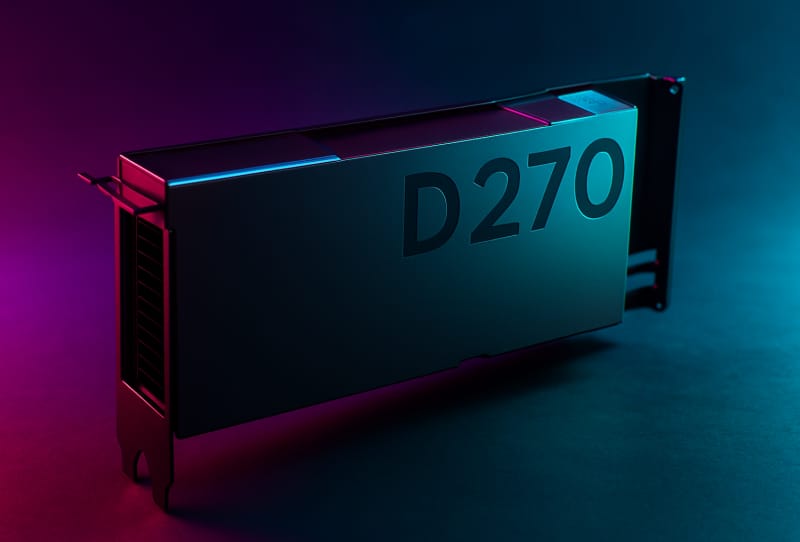
Intel’s Crescent Island GPU has been officially renamed the D-Series, revealing a dedicated AI inference accelerator that can pack up to 480GB of LPDDR5X memory. The announcement confirms what had been an internal codename for months, and it gives shape to Intel’s latest attempt at building a serious data centre chip after earlier AI accelerator projects stalled or were quietly shelved.
Key takeaways
- ✓Intel's Crescent Island GPU is now officially branded the D-Series accelerator.
- ✓The chip packs 32 Xe3P cores, 256 XMX engines and 32MB of unified L2 cache.
- ✓Base cards ship with 160GB of LPDDR5X, with ODM versions scaling to 480GB.
- ✓Intel rates the card at up to 1.3 PetaFLOPS of FP8 performance with FP4 to FP64 support.
- ✓Unlike Intel's gaming GPUs, the D-Series has no graphics output hardware, as it is built purely for AI inference.
Unlike Intel’s Arc gaming cards, the D-Series is not designed to render a single frame. It has no graphics output hardware at all. Instead, every part of the silicon is aimed at AI inference, the process of running a trained model to generate answers, images, or agentic actions rather than training the model from scratch.
Table of Contents
Inside the D-Series Crescent Island GPU specs
The headline numbers are substantial for a first full public showing. The D-Series Crescent Island GPU is built around 32 Xe3P cores, Intel’s purpose-built variant of its Xe3 graphics architecture, paired with 256 dedicated XMX matrix engines and 32MB of unified L2 cache shared across the chip.
Intel rates the card at up to 1.3 PetaFLOPS of FP8 performance, with broad numerical format support spanning FP4 right through to FP64. That range matters because different AI workloads favour different precision levels. Lower-precision formats like FP4 and FP8 speed up large language model inference, while higher precision such as FP64 still matters for scientific and engineering computation.
| Specification | Detail |
|---|---|
| Xe3P cores | 32 |
| XMX engines | 256 |
| Unified L2 cache | 32MB |
| Base memory | 160GB LPDDR5X |
| Maximum ODM memory | 480GB LPDDR5X |
| Peak FP8 performance | Up to 1.3 PetaFLOPS |
| Format support | FP4 to FP64 |
| Media engine | 4 encoders, 4 decoders |
Intel-branded cards come with 160GB of memory as standard, a configuration exclusive to Intel’s own boards. The company is also letting its ODM partners build versions with up to 480GB of LPDDR5X, aimed at customers who need to load enormous models or long context windows into memory without constantly shuffling data from storage.
Why the Xe3P pipeline redesign matters
The more interesting story sits beneath the headline specifications. Intel has substantially reworked the XMX engine pipeline for Xe3P compared with the standard Xe3 architecture found in its consumer graphics parts. The regular Xe3 design uses a four-deep systolic array for its matrix math. Xe3P pushes that to 16-deep processing, a change that should let each engine push more data through per cycle during sustained AI workloads.
Each Xe3P core carries a sizeable 1MB register file and 512KB of L1 cache, both generous allocations that help keep data close to the compute units rather than waiting on slower memory fetches. Across the full chip, Intel has arranged 256 Vector engines alongside the 256 XMX engines, split into groups of eight per core. That pairing of general-purpose vector compute with dedicated matrix acceleration is a common pattern in modern AI silicon, since real workloads mix matrix-heavy inference with other processing steps.
The inclusion of a beefed-up media engine, four encoders and four decoders, is a smaller but telling detail. Multimodal AI systems increasingly need to ingest and generate video alongside text, and dedicated hardware encoding avoids bogging down the compute cores with that work.
How the D-Series fits Intel’s broader AI ambitions
Intel has tried and abandoned several approaches to AI accelerators in recent years, and the Crescent Island project follows that uneven history. Giving the chip a formal D-Series name alongside concrete specifications is a signal that Intel intends to actually ship it, rather than let it fade away as a research exercise. It also slots alongside Intel’s wider chip roadmap, which includes Intel’s upcoming Nova Lake CPUs aimed at desktop and laptop buyers rather than data centres.
Memory capacity is where the D-Series tries to differentiate itself from rivals. Nvidia and AMD’s top AI accelerators typically rely on HBM memory, which is fast but expensive and limited in total capacity per card. Intel’s decision to lean on LPDDR5X, scalable up to 480GB through ODM partners, trades some bandwidth for much larger pools of memory at a lower cost per gigabyte. That approach echoes a broader industry trend toward near-GPU memory designs aimed at AI workloads, where manufacturers look for ways to keep enormous models resident without the price tag of pure HBM setups.
For data centre operators, that could make the D-Series an attractive option for workloads that need huge context windows or large mixture-of-experts models, even if raw throughput trails the fastest HBM-equipped accelerators from Nvidia. Intel has also continued refining its consumer graphics software, including Intel’s Arc GPU driver updates, suggesting the company is investing across its whole graphics stack rather than treating AI silicon as an isolated side project. More detail on Intel’s own AI hardware push is likely to arrive as the D-Series moves closer to general availability.
Frequently asked questions
What is the Intel Crescent Island GPU used for?
It is a dedicated AI inference accelerator built for data centres, designed to run trained AI models efficiently rather than to render graphics or train new models from scratch.
How much memory does the D-Series Crescent Island GPU have?
Intel-branded cards ship with 160GB of LPDDR5X memory as standard. Intel allows its ODM partners to build versions with up to 480GB for customers who need larger memory pools.
Does the Crescent Island GPU support gaming or graphics output?
No. The Xe3P architecture used in the D-Series has no graphics processing elements for image output, since the chip is built purely for AI inference tasks such as long-context and agentic workloads.
When will the Intel D-Series GPU be available?
Intel has not confirmed a specific release or availability date. The company has only revealed the official D-Series name and core specifications so far.