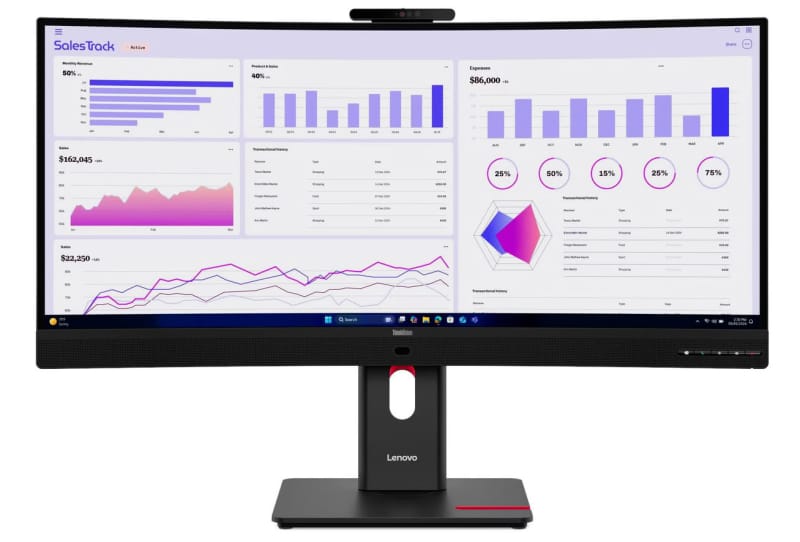
The ThinkVision T34WD-4v monitor is Lenovo’s new 34-inch curved ultrawide display built for office and professional desks, and it folds a full USB-C docking station into the same chassis. Lenovo first showed the panel at IFA 2026, and the company has now published the complete spec sheet on its Product Specifications Reference site, confirming details that were only partially known before.
Key takeaways
- ✓The ThinkVision T34WD-4v monitor uses a 34-inch curved VA panel at 3440 x 1440 resolution.
- ✓Refresh rate runs 48 to 120Hz with 4ms response time in Extreme mode.
- ✓It doubles as a USB-C dock, delivering up to 100W power plus Ethernet and multiple USB ports.
- ✓A 5MP RGB+IR camera, dual microphones and 5W stereo speakers are built in for video calls.
- ✓Lenovo flagged a December debut after IFA 2026, with wider global availability slipping into early 2027.
For anyone juggling a laptop, a webcam, external drives and a wired network connection, a monitor that handles all of that through one cable is a genuine convenience rather than a gimmick. The T34WD-4v leans into that idea, combining a wide curved screen with enough ports to replace a separate dock entirely.
Table of Contents
What the ThinkVision T34WD-4v monitor actually offers
At the centre of the display is a 34-inch VA panel running 3440 x 1440 resolution with a 1500R curve, the kind of gentle wraparound that suits spreadsheets, timelines and multiple windows side by side more than it suits fast-paced gaming. Refresh rate scales between 48Hz and 120Hz, which is respectable for a panel pitched at productivity rather than esports.
Response time depends on which mode is active. Extreme mode drops it to 4ms, while Normal mode sits at 6ms. Colour accuracy is where the monitor leans hardest into its professional branding, with 99 percent coverage of both the sRGB and BT.709 gamuts. Peak brightness is rated at 300 nits, which is fine for indoor office lighting but not aimed at HDR content.
Built-in collaboration hardware rounds out the package. A 5MP RGB and infrared camera supports facial recognition logins alongside video calls, backed by dual microphones and a pair of 5W speakers. An ambient light sensor and a time-of-flight sensor also feature, likely helping the display adjust brightness and detect when a user has stepped away.
Specifications at a glance
| Feature | Detail |
|---|---|
| Panel size and type | 34-inch VA, 1500R curve |
| Resolution | 3440 x 1440 |
| Refresh rate | 48Hz to 120Hz variable |
| Response time | 4ms Extreme / 6ms Normal |
| Brightness | 300 nits |
| Colour coverage | 99% sRGB, 99% BT.709 |
| Camera | 5MP RGB+IR with dual microphones |
| Speakers | 2 x 5W |
| USB-C power delivery | Up to 100W |
| Ports | 3 x USB-A 3.2, 2 x USB-C 3.2, Gigabit Ethernet, HDMI 2.1, DisplayPort 1.4, audio combo jack |
A docking station built into the display
The connectivity list is where this monitor separates itself from a typical ultrawide. Three USB-A 3.2 ports and two USB-C 3.2 ports sit alongside Gigabit Ethernet, letting a laptop connect to a wired network without a separate adapter. The standout figure is the 100W power delivery over USB-C, enough to charge most laptops through the same cable that carries video and data.
Video input covers both HDMI 2.1, which supports the full 3440 x 1440 resolution at 120Hz, and DisplayPort 1.4. Between the two, the T34WD-4v covers most docking and multi-device scenarios an office setup is likely to need, without forcing a buyer to source a separate dock or hub.
Physical touches add to the usability case. A headphone hook keeps a desk tidy, and Lenovo has given the stand full adjustability, which typically means height, tilt, swivel and pivot on monitors in this product line. None of these extras are flashy, but they are the kind of detail that professional buyers tend to notice after a few weeks of daily use.
How it stacks up and what comes next
Ultrawide curved monitors have become common in both gaming and productivity segments, and Lenovo’s panel sits firmly on the productivity side of that divide. It trades the extreme refresh rates seen in other ultrawide monitors chasing high refresh rates for stronger colour accuracy and built-in collaboration tools, a trade-off that makes sense for a display aimed at offices rather than competitive play.
It also follows a broader trend of monitors absorbing functions once handled by separate accessories, similar to monitors that switch between resolution and refresh modes to suit different tasks on one screen. Panel technology keeps moving quickly elsewhere in the market too, with newer OLED panels pushing brightness further and manufacturers like TCL already working on far higher refresh ceilings for future releases.
Lenovo had initially flagged a December release following the IFA 2026 unveiling, though broader global availability looks set to stretch into early 2027. That staggered rollout is fairly typical for Lenovo’s professional ThinkVision range, which often lands in select markets before reaching others. Anyone weighing up a purchase should keep an eye on Lenovo‘s regional availability pages as the launch date approaches, since specifications confirmed now can sometimes shift slightly by the time retail stock actually arrives.
Frequently asked questions
What resolution does the ThinkVision T34WD-4v monitor support?
It runs a 3440 x 1440 resolution on a 34-inch curved VA panel, with HDMI 2.1 and DisplayPort 1.4 both able to drive that resolution at up to 120Hz.
Can the ThinkVision T34WD-4v monitor charge a laptop?
Yes. Its USB-C ports support up to 100W of power delivery, which is enough to charge most laptops through the same cable used for video and data.
Is the ThinkVision T34WD-4v a gaming monitor?
Not primarily. Its 48-120Hz refresh range and colour-accurate VA panel are aimed at professional and office use, with built-in camera, microphones and speakers for video calls rather than competitive gaming features.
When will the ThinkVision T34WD-4v be available?
Lenovo indicated a December release following its IFA 2026 debut, though wider global availability is expected to extend into early 2027 depending on the region.