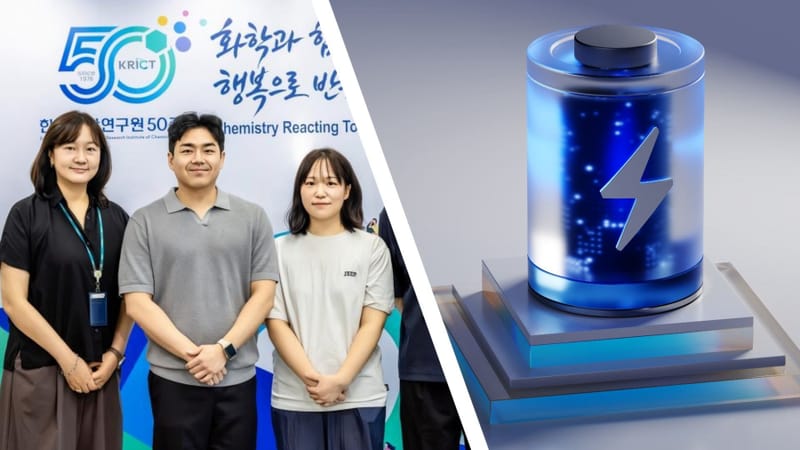
A team of South Korean scientists says it has achieved a lithium-ion battery breakthrough that could let laptops, drones, robots and electric vehicles draw far more power without losing as much of their total capacity. The discovery comes from the Korea Research Institute of Chemical Technology (KRICT), whose researchers found that mixing a small amount of a material called graphitic carbon nitride into a battery’s cathode dramatically improves how well it handles heavy, sudden power draws.
The finding, first reported by The Korea Times, tackles a problem that has quietly limited battery design for years. It could eventually mean gaming laptops, drones and EVs that hold onto their performance and range even when pushed hard.
Table of Contents
How the lithium-ion battery breakthrough actually works
Inside a lithium-ion cell, ions move from the cathode through an electrolyte to the anode during charging, then flow back the other way when the battery is powering a device. One obvious way to pack more energy into a battery of the same size is to make the cathode thicker. The trouble is that a thicker cathode makes it harder for ions to move quickly, which chokes off performance exactly when a device needs a sudden burst of power.
KRICT’s approach adds graphitic carbon nitride to the cathode material itself, effectively easing that bottleneck. Ions can move more freely even under demanding conditions, which means the battery can sustain a high power draw for longer before its usable capacity starts dropping away.
The numbers behind the claim
Early lab results are striking. According to KRICT, the modified cathode delivered a 166 percent increase in capacity during high-rate discharge, alongside a power density increase of up to 2.85 times compared with a standard lithium-ion cathode. Those figures do not represent a bigger battery in raw mAh terms. Instead, they describe how much of that stored energy the battery can actually deliver when something is drawing power quickly, rather than losing capacity to the strain of a heavy load.
| Metric | Result reported by KRICT |
|---|---|
| Capacity during high-rate discharge | Up to 166% increase |
| Power density | Up to 2.85x increase |
| Testing stage | Early laboratory research, not yet commercialised |
It is worth being clear that this is early-stage research rather than a finished product. KRICT has not yet tested whether the same technique can be paired with a thicker cathode to boost total mAh capacity as well as power delivery, though the institute believes that combination is achievable.
Why this lithium-ion battery breakthrough matters for everyday gadgets
Plenty of devices suffer when a battery cannot keep up with a sudden demand for power. An electric vehicle accelerating hard, a drone lifting off, or a gaming laptop suddenly spinning up its graphics card under a heavy workload all place a similar strain on a battery pack. If the cell cannot deliver that energy efficiently, the device either throttles performance or burns through capacity faster than expected.
A battery chemistry that copes better with these spikes would let an EV sustain harder acceleration without sacrificing as much range, and it would help a home battery keep up when appliances like washing machines draw a lot of power quickly. For smaller devices, the same principle applies. Drones could handle demanding manoeuvres more efficiently, while gaming laptops that blur the line with workstations could hold onto performance for longer during intensive rendering or gaming sessions rather than watching battery life collapse under load.
KRICT President Shin Seok-min has described the technique as broadly applicable across electric vehicles, energy storage systems and robotics, suggesting it is best suited to devices with physically larger batteries rather than the smallest gadgets. That said, the underlying principle of better managing how how lithium-ion battery chemistry works under load has relevance well beyond any single product category.
What happens next
The next hurdle is scaling the technology up from a laboratory result to something manufacturers can actually build into commercial cells. That process typically takes years, and there is no guarantee every promising battery chemistry breakthrough makes it into a shipping product. Battery research has a long history of impressive lab results that never quite reach mass production, often due to cost, manufacturing complexity or durability issues that only appear once a technique moves beyond small test cells.

Still, the scale of the reported improvement makes this one worth watching. Anyone who has felt a laptop throttle mid-task or watched an EV’s range estimate drop faster than expected during a fast drive knows the practical value of a battery that handles power spikes more gracefully. For manufacturers already juggling power delivery in everything from choosing a power supply for a gaming PC to connecting gaming PC power cables correctly, a more efficient battery chemistry at the cell level would be a welcome complement to better engineering elsewhere in the system.
For now, the research from the Korea Research Institute of Chemical Technology remains a promising early step rather than a confirmed product roadmap. If the approach scales as hoped, it could quietly reshape how much performance future devices can squeeze from a battery pack of the same physical size.