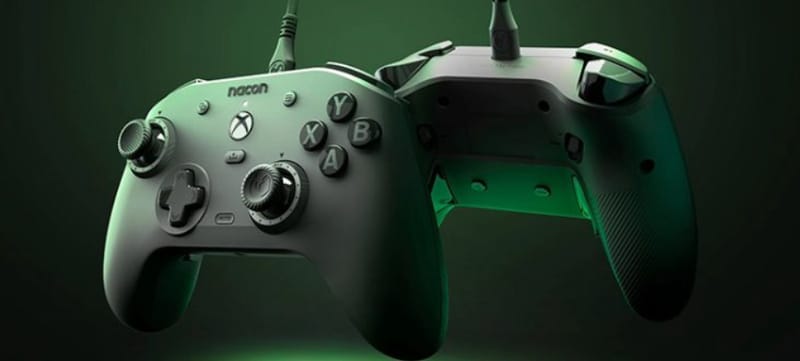
Nacon Revo controllers are the company’s attempt to bring Hall Effect sticks and triggers, a feature usually reserved for premium gamepads, down to budget and mid-range price points for Xbox, PC and Smart TV players. The new Revo family spans four models at launch, with a fifth due in 2027, and every one of them ditches traditional potentiometer sticks for magnetic sensors designed to resist the dreaded stick drift that has plagued controllers for years.
Key takeaways
- ✓Nacon's Revo lineup brings Hall Effect sticks and triggers to budget and mid-range gamepads.
- ✓Four models launch now: Revo, Revo X, Revo Max and Revo X Max, covering PC, Xbox and Smart TV use.
- ✓The Revo Max adds adjustable stick tension, micro-switch buttons, instant triggers and two rear paddles.
- ✓A Shooter Pro mode on the Max models is designed to remove stick dead zones for faster aiming.
- ✓A further model, the Revo Pro, is confirmed to join the range in 2027.
Stick drift happens when the physical components inside an analogue stick wear down over time, causing a controller to register movement even when nobody is touching it. Hall Effect sticks use magnets and sensors instead of physical contact points, so there’s nothing to wear out in the same way. The technology has spread quickly through mechanical keyboards and premium controllers over the past two years, and Nacon is now betting that it can work just as well in cheaper hardware.
Table of Contents
What’s inside the Nacon Revo lineup
The entry point is simply called the Revo, a PC and Smart TV controller with Hall Effect joysticks and triggers built around an asymmetrical stick layout, similar to a standard Xbox pad. Buyers who want Xbox Series X|S and Xbox One compatibility instead get the Revo X, which adds that platform support along with either dual or quad vibration motors depending on the exact configuration.
Sitting above both is the Revo Max, which keeps the Hall Effect foundation but adds adjustable stick tension, letting players stiffen or loosen the resistance to suit their preference. It also swaps in micro-switch face buttons and a micro-switch D-pad for a crisper click, along with instant triggers for faster response in shooters. Two programmable rear buttons round out the upgrade, and the Max is also sold in matching PC and Xbox versions, the Revo Max and Revo X Max.
Shooter Pro mode and dead zone handling
One of the more interesting additions on the Max models is a dedicated Shooter Pro mode, which Nacon says is built specifically to eliminate stick dead zones. Dead zones are the small area of stick movement a controller ignores before registering input, usually added to stop drift or accidental movement from triggering unwanted actions. Reducing them can make aiming feel more responsive, though it also raises the risk of registering unintended micro-movements if a stick isn’t calibrated well. Pairing that mode with Hall Effect hardware suggests Nacon is confident its sensors are precise enough to handle a tighter response curve without the drawbacks.
The table below breaks down how the four launch models differ.
| Model | Platform | Hall Effect sticks/triggers | Extra features |
|---|---|---|---|
| Revo | PC, Smart TV | Yes | Asymmetrical layout, dual/quad vibration |
| Revo X | Xbox Series X|S, Xbox One, PC | Yes | Asymmetrical layout, dual/quad vibration |
| Revo Max | PC, Smart TV | Yes | Adjustable tension, micro-switch buttons, instant triggers, rear paddles, Shooter Pro mode |
| Revo X Max | Xbox Series X|S, Xbox One, PC | Yes | Adjustable tension, micro-switch buttons, instant triggers, rear paddles, Shooter Pro mode |
How the Revo range compares to rival Hall Effect controllers
Nacon isn’t the first to chase this feature set, but it is arriving at a noticeably lower tier of the market than most competitors. GuliKit popularised magnetic sticks in handheld and third-party pads, while 8BitDo has folded the same tech into 8BitDo’s own Hall Effect controllers, and Razer pushed the concept further upmarket with Razer’s Huntsman V3 HE, a keyboard that shows how far adjustable magnetic sensing can go when paired with a premium price tag.
That broader shift mirrors what’s happened in keyboards, where Hall Effect switches have moved from niche enthusiast boards toward cheaper Hall Effect keyboards aimed at a wider audience. Nacon’s approach with the Revo range looks like the same playbook applied to controllers: take a feature that used to be a premium differentiator and push it down through the lineup until it becomes a baseline expectation rather than a luxury.
It’s also worth noting that retro and licensed hardware makers are leaning on similar ideas elsewhere, as seen with Analogue’s wireless SNES controllers, which shows how quickly improved stick and connectivity technology is spreading across very different corners of the controller market.
What the Revo lineup means for budget gamers
For players who’ve put up with worn-out sticks on cheaper third-party pads, the Revo family offers a reason to expect more durability without jumping straight to a flagship-priced controller. Hall Effect sensors won’t make a controller indestructible, but they remove one of the most common failure points, which matters most for people who game for hours every day or hand controllers down to younger siblings and kids who aren’t gentle with hardware.
The Shooter Pro mode and adjustable tension on the Max models also give competitive players a reason to consider a third-party pad over a first-party Xbox controller, provided the build quality and input latency hold up in practice. Nacon has confirmed a fifth model, the Revo Pro, will join the range in 2027, suggesting the company sees room to keep climbing the market with this same Hall Effect foundation rather than treating it as a one-off gimmick.
Frequently asked questions
What is Hall Effect technology in a controller?
Hall Effect sticks use magnets and sensors to detect stick movement instead of physical contact points. Because there’s no direct contact wearing down over time, they’re far less prone to the drift that affects traditional analogue sticks after months of use.
Which platforms do the Nacon Revo controllers support?
The standard Revo and Revo Max are built for PC and Smart TVs, while the Revo X and Revo X Max add compatibility with Xbox Series X|S, Xbox One and PC, giving buyers a choice depending on which platforms they actually play on.
What makes the Revo Max different from the standard Revo?
The Revo Max adds adjustable stick tension, micro-switch face buttons and D-pad, instant triggers, two programmable rear buttons and a Shooter Pro mode designed to cut down stick dead zones for sharper aiming.
Is there another Nacon Revo controller coming later?
Yes. Nacon has confirmed a Revo Pro model will join the lineup in 2027, though full details on its features haven’t been announced yet.