The Panasonic Let’s Note SC7 is a business laptop that weighs just 919 grams, survives military-grade drop testing, and runs for close to 23 hours on a single charge thanks to a removable battery pack. It is a striking reminder that Japanese manufacturers still lead the world when it comes to squeezing serious durability and battery life into genuinely tiny notebooks.
Key takeaways
- ✓The Panasonic Let's Note SC7 weighs only 919 grams, making it one of the lightest full-spec laptops sold anywhere
- ✓Battery life reaches close to 23 hours thanks to a removable, user-replaceable pack
- ✓The chassis passes military-grade MIL-STD-810H drop and shock testing
- ✓It uses an unconventional round touchpad instead of the usual rectangular design
- ✓The SC7 continues a long line of ultra-portable Japanese business laptops built for durability over style
While much of the laptop industry chases thinness and flashy design, Panasonic has spent decades refining a different formula: rugged, ultra-light machines built for people who actually carry a laptop all day and cannot afford for it to die, crack, or run out of charge halfway through a shift. The SC7 is the latest expression of that philosophy, and it doubles down on several quirks that make the Let’s Note line so distinctive.
Table of Contents
What makes the Panasonic Let’s Note SC7 different
At 919 grams, the SC7 sits comfortably among the lightest full-spec laptops sold anywhere, a category where most rivals with a similar screen size and keyboard land closer to 1.2 or 1.3 kilograms. Panasonic achieves this partly through a magnesium alloy chassis and partly through decades of engineering focused specifically on weight reduction, rather than treating it as an afterthought bolted onto a design built for looks.
The battery is removable, a feature that has all but disappeared from modern laptops as manufacturers glue cells directly into the chassis to save space. On the SC7, a user can swap in a fresh pack in seconds, which matters enormously for people who work in the field, travel constantly, or simply cannot rely on finding a power outlet. Panasonic rates the battery at close to 23 hours, a figure that puts it well ahead of most ultraportables on the market.
Durability is the other pillar of the design. The SC7 has passed MIL-STD-810H testing, the American military standard covering drops, vibration, dust, and extreme temperatures. It is not a marketing gimmick tacked on for a press release; Panasonic has built its reputation among corporate IT departments and government buyers precisely because these machines keep working after the kind of knocks that would crack a typical consumer laptop.
Specifications and the round touchpad
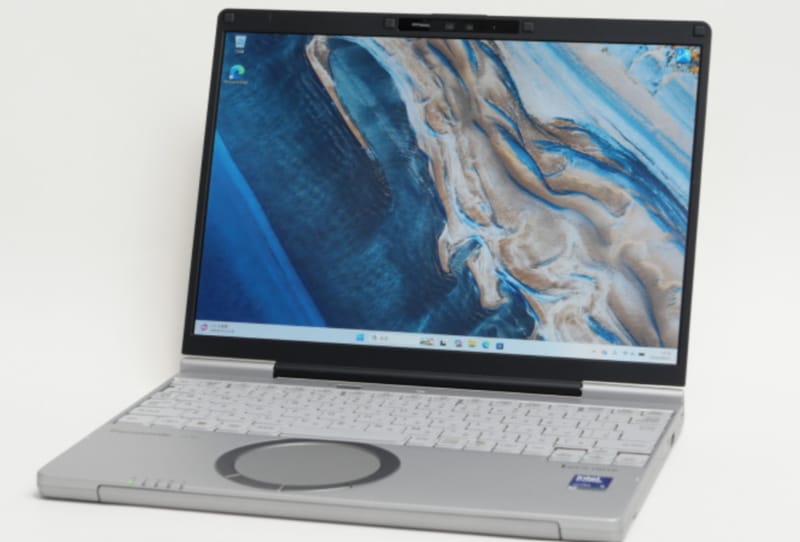
One detail draws immediate attention: the SC7’s touchpad is round rather than the standard rectangle found on virtually every other laptop. It is an unusual choice, and one Panasonic has stuck with across several generations of the Let’s Note range. The circular shape is designed to make cursor movement more intuitive at the edges, though it inevitably takes some adjustment for anyone used to a conventional trackpad.
The rest of the specification sheet reads like a checklist for road warriors rather than a gaming rig, which is exactly the point. Panasonic prioritises longevity, serviceability, and weight over raw graphics performance, and the SC7 is aimed squarely at professionals who need a reliable daily driver rather than a machine built for demanding creative or gaming workloads.
| Feature | Detail |
|---|---|
| Weight | 919 grams |
| Battery life | Up to approximately 23 hours |
| Battery type | Removable, user-replaceable pack |
| Durability rating | MIL-STD-810H drop and shock tested |
| Touchpad | Circular design, unlike standard rectangular pads |
Why the Let’s Note SC7 matters for buyers and the industry
Panasonic rarely sells the Let’s Note line broadly outside Japan, which has helped the range fly under the radar for years despite consistently topping weight and durability benchmarks that Western brands struggle to match. The SC7 is unlikely to change that pattern, but it reinforces why the series still commands a loyal following among Japanese businesses, government agencies, and field workers who need a laptop that survives being dropped, doused, or run flat without complaint.
For readers outside Japan, the SC7 is more of a benchmark than a shopping option, a demonstration of what is technically achievable when a manufacturer refuses to compromise on weight or reliability for the sake of styling. Competing ultraportables from brands with wider global availability still tend to trade away either battery life or ruggedness to hit similar weight figures, which is exactly the gap Panasonic continues to exploit.
The removable battery design also stands out at a moment when repairability has become a genuine talking point across the wider laptop and phone industry. Right-to-repair advocates have spent years pushing manufacturers to make batteries replaceable again, and Panasonic’s approach, born out of practical necessity for its target customers rather than any regulatory pressure, shows the feature was never impossible. It was simply deprioritised elsewhere in favour of thinner designs.
Buyers weighing up any new ultraportable, whether it is the SC7 or a rival model, will still want to think about how the machine fits daily use, including optimising a laptop for demanding tasks once the hardware is out of the box, and steering clear of ongoing frustrations with bloatware on new laptops that can eat into the very battery life manufacturers like Panasonic work so hard to deliver.
Frequently asked questions
Is the Panasonic Let’s Note SC7 available outside Japan?
Panasonic has historically sold the Let’s Note range primarily within Japan, with limited or no official distribution in markets such as Australia, the United States, or Europe, so availability for the SC7 is expected to follow that same pattern.
How does the SC7’s battery life compare to other laptops?
At close to 23 hours, the SC7’s battery life sits well above most mainstream ultraportables, which typically manage somewhere between 10 and 15 hours of real-world use on a single charge.
What does MIL-STD-810H testing actually mean?
MIL-STD-810H is a United States military standard covering resistance to drops, vibration, dust, humidity, and temperature extremes. Passing it indicates a device has been tested against a defined set of physical stress scenarios, rather than simply being marketed as tough.
Why does the Let’s Note SC7 have a round touchpad?
Panasonic has used a circular touchpad across several Let’s Note generations, arguing it improves cursor control near the pad’s edges. It remains a distinctive design choice that sets the range apart from almost every other laptop on the market.