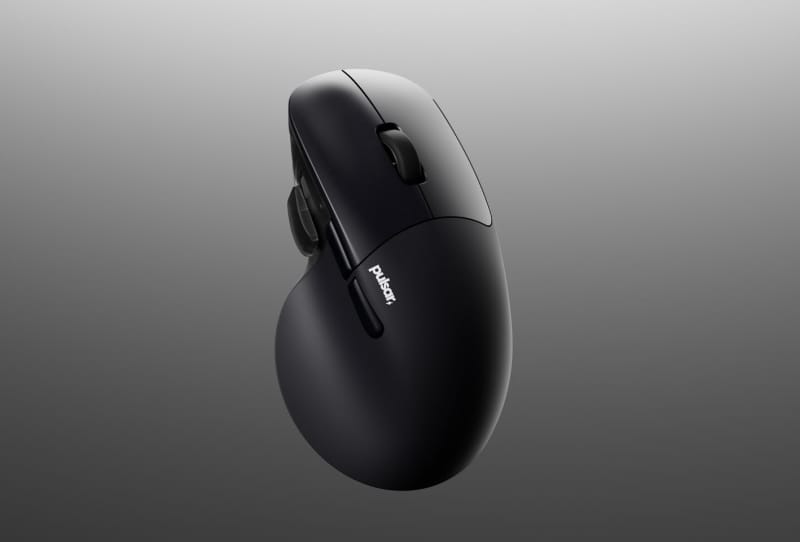
The Pulsar X5 gaming mouse made its first public appearance at Tokyo Game Show, and it marks a notable shift for a brand better known for stripped-back, featherweight esports shells. Rather than chasing the lowest possible weight, Pulsar has built something aimed squarely at gamers with large hands who still want a shape comfortable enough for everyday desk use, not just competitive sessions.
Details are still trickling out rather than arriving via a formal spec sheet. Pulsar has not published official specifications, pricing, or a release window, so most of what’s known so far comes from hands-on photos and impressions shared by attendees at the show. That makes the X5 a genuine work in progress from a reporting standpoint, though the physical design details are consistent across multiple sources on the ground.
Table of Contents
What the Pulsar X5 Gaming Mouse Looks Like
The shell is right-hand biased, with a pronounced thumb shelf and a mid-hump profile. Pulsar has pitched this as a middle ground between two very different ergonomic philosophies. It sits a step more aggressive than Keychron’s M7 8K, which keeps a fairly low, flatter profile, but it stops short of the tall, sculpted hump found on the Logitech MX Master 4, a mouse built primarily for productivity rather than fast-paced play.
Photos shared by X user @jakeufps, who handled the mouse at the event, put the X5’s weight at roughly 62 grams. Several other influencers and journalists at Tokyo Game Show reportedly corroborated that figure and the mouse’s larger-than-average footprint. Pulsar has apparently managed to keep the weight down despite the bigger shell by using an open bottom design, leaving the underside of the mouse partially hollowed out while the top and side panels remain fully solid.
An Extra Thumb Button Sets It Apart
Button layout is where the X5 diverges most clearly from a typical ergonomic mouse. Alongside the usual back and forward buttons mounted on the thumb side, Pulsar has added a third side-mounted button in that same area. That gives the thumb three dedicated inputs instead of the standard two, which should appeal to players who bind extra abilities, macros, or navigation shortcuts to thumb-side controls in fast-paced games.
It’s a similar philosophy to what’s driven demand for mice like Razer’s Naga V2 Pro, which built a following around swappable side panels loaded with extra buttons for MMO and MOBA players. The X5 doesn’t go anywhere near that far, but the extra thumb button suggests Pulsar wants the shape to double as a flexible daily driver rather than a single-purpose competitive tool.
How It Stacks Up Against Rival Shapes
| Mouse | Hump Profile | Reported Weight | Thumb-Side Buttons |
|---|---|---|---|
| Keychron M7 8K | Low, flatter shape | Not covered in this report | Standard back and forward |
| Pulsar X5 | Mid-hump, ergonomic | Around 62g | Back, forward, plus one extra |
| Logitech MX Master 4 | Tall, pronounced hump | Not covered in this report | Multiple customisable buttons |
The comparison highlights how deliberately Pulsar has positioned the X5 in the gap between lightweight gaming shapes and heavier productivity mice. It’s not trying to out-ergonomic the MX Master 4, nor is it trying to match the low-profile speed of something like the M7 8K. Instead, it’s aiming at players who found both extremes uncomfortable for long sessions.
Why Pulsar Is Moving Into Ergonomic Territory
Pulsar built its reputation on symmetric, fingertip-friendly shells such as the Lab X2F, a mouse designed around minimal weight and a compact grip for competitive shooters. The X5 is a departure from that formula, and it reflects a wider trend across the peripheral market. Ergonomic and semi-ergonomic gaming mice have gained traction as more players use the same device for work and play, a shift also visible in products like Razer’s Pro Click V2 Vertical, which blends office comfort with gaming-grade tracking.
Large-hand ergonomic gaming mice remain a relatively thin part of the market compared with the flood of lightweight symmetric shells released over the past few years. By building something with a bigger footprint, an open-bottom weight-saving structure, and an extra thumb input, Pulsar appears to be targeting a segment of buyers that feels underserved rather than competing directly in the crowded fingertip-mouse space where its own X2F already sits.
What’s Still Unconfirmed
Plenty remains unknown about the Pulsar X5 gaming mouse beyond its shape and approximate weight. Pulsar hasn’t confirmed sensor specifications, polling rate, connection type, battery life for a wireless version, or a release date. Pricing also hasn’t been announced. Given that everything public so far comes from hands-on impressions at a trade show rather than an official product page, those details should be treated as pending until Pulsar makes a formal announcement.
What’s already clear is the intent behind the design. Pulsar wants the X5 to work as a comfortable daily mouse for people with larger hands, without abandoning the low weight and precise feel that gaming mice are judged on. Whether it delivers on that balance will depend on details still to come, but the shape and button layout shown at Tokyo Game Show already mark a distinct new direction for the brand.