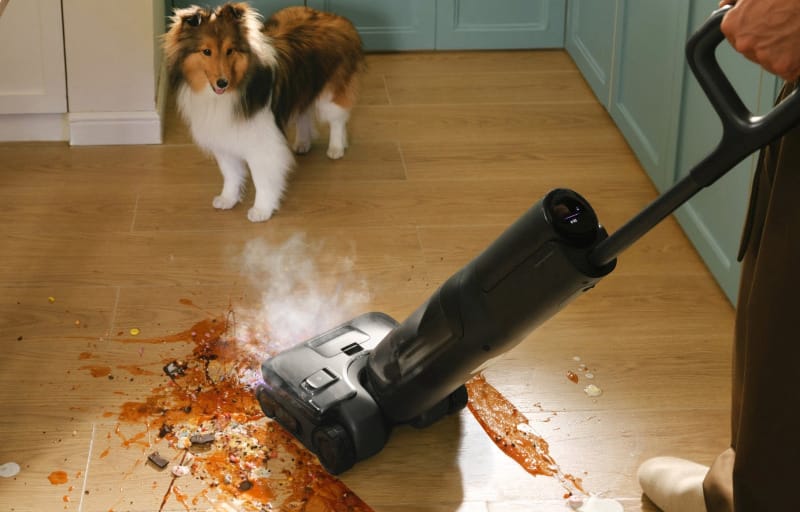
Wet and dry vacuum mops have quietly become one of the more useful gadgets in an Australian household, but most still stick to the same routine: vacuum first, mop second, then go back over the bits that didn’t quite come clean. The Roborock F25 Steam is built around a different idea, one where genuine high-temperature steam and strong suction work together so a single pass is actually enough, even on dried-on grime that would normally need a scrub and a second trip with the mop.
Review summary
Roborock F25 Steam
The Roborock F25 Steam pairs genuine 180°C steam with 25,000 Pa suction to lift dried-on grime, coffee rings and cooking oil splatters in a single pass, removing the usual vacuum-then-mop routine. Its FlatReach 2.0 design lets the body lie completely flat to clean under furniture, while the self-cleaning, self-drying roller and anti-tangle JawScraper design keep upkeep to a minimum. TÜV SÜD-tested hardwood safety and strong hygiene figures add further confidence for everyday Australian households.
Highlights
- ✓Genuine 180°C steam, not warm water
- ✓25,000 Pa suction with 33N downward pressure
- ✓FlatReach 2.0 lies flat for under-furniture access
- ✓Self-cleaning, tangle-resistant roller design
- ✓Up to 80 minutes runtime, 660m² coverage
Rather than relying on warm water, which is how a lot of so-called steam mops on the market actually work, this machine heats water internally to 180°C before it ever reaches the floor. That heat is paired with 25,000 Pa of suction and 33N of downward pressure, plus a roller designed specifically to stop hair from wrapping around it, a low-profile body that lies completely flat to get under furniture, and a roller that cleans and dries itself once the job is done.
This review walks through how all of that comes together in daily use, starting with the physical design and how it feels to steer around a home, before getting into the standout features and how the F25 Steam performed across kitchens, hallways, hardwood floors and everywhere hair tends to collect.
Table of Contents
Design and Functionality
The unit arrives in a glossy black finish that looks more premium than its plastic-and-metal construction might suggest, with a tall, slim body that doesn’t feel out of place standing in a kitchen corner rather than being tucked away after every use. It reads as a considered piece of home hardware rather than a purely functional appliance.


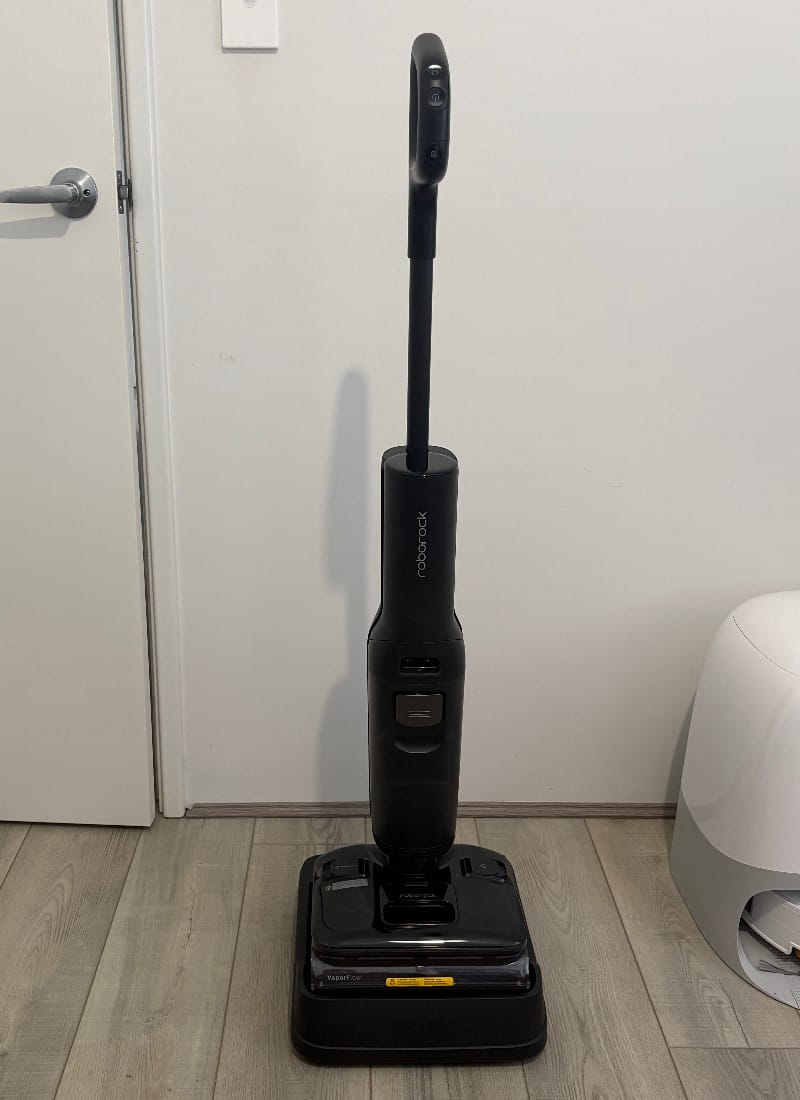

Build quality feels solid throughout, from the water tank latches to the roller housing, without the creaks or flex that sometimes creep into cleaning gear built to a tight cost target. The weight is noticeable when picking it up, but that’s largely explained by the internal boiler needed to generate genuine steam rather than cheap materials.
The standout physical feature is FlatReach 2.0, Roborock’s approach to letting the whole body lie flat against the floor at a full 180 degrees. At its lowest point the unit measures just 12.5 centimetres, low enough to glide under a surprising number of beds, sofas and low cabinets that usually get skipped during a clean.

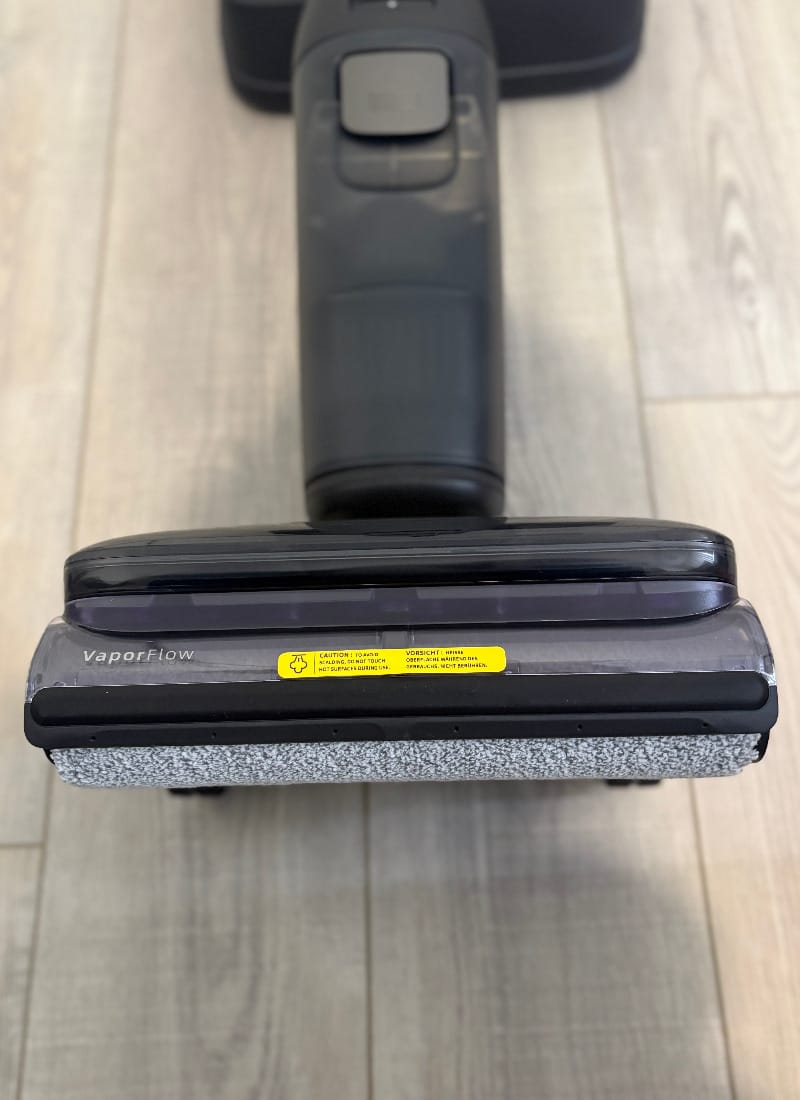
What makes this more than a party trick is that suction doesn’t fall away once the body is lying flat. An internal gyroscope tracks the angle of the head and adjusts performance accordingly, so dust bunnies hiding under the couch get the same treatment as the open floor in the hallway.
Steering is helped along by a 70-degree swivel design at the neck, which makes it noticeably easier to work around table legs, door frames and the tight corners of a bathroom without having to lift and reposition the entire machine. Combined with a bidirectional drive that assists both forward and backward pushes, the F25 Steam moves with far less effort than its roughly 5.2 kilogram weight might suggest.


Controls sit at the top of the handle in the form of three physical buttons alongside a small colour display, and that’s deliberate: there’s no app or Wi-Fi connection to fuss with here. For anyone who just wants to grab a machine and start cleaning without pairing a phone or waiting on a firmware update, that simplicity is a genuine plus rather than a missing feature.

The 1,000 ml clean water tank is integrated low into the body as part of the FlatReach design, which keeps the centre of gravity down and helps the whole unit stay stable when tilted flat. A tank of that size is generous enough to cover a full-home clean without a mid-session refill in most Australian homes.
On the other side sits the dirty water tank, and this is where Roborock has made a genuinely useful change with a detachable wet-and-dry separation module. Being able to pull the two apart for cleaning means less chance of residue building up in awkward corners of the tank, which is usually where odours start.
The roller itself uses what Roborock calls JawScrapers, a structure built around 141 dynamic comb teeth roughly 3mm long with a 30-degree tip angle, working in tandem with a floating straight scraper that stays in constant contact with the roller surface. It’s a fussier piece of engineering than a standard rubber roller, and it shows in how methodically it’s put together.
After each clean the roller runs through a self-cleaning cycle that uses both 180°C steam and 95°C water to scrub away residue from two directions rather than one. It’s a noticeably more thorough approach than the cold-water rinse cycles found on cheaper wet and dry vacuums.
Drying is handled by a sealed heating system rather than an open fan, which matters because it helps contain moisture, bacteria and mould inside the unit instead of blowing it back into the room. There’s a five-minute fast dry mode for quick turnarounds and a slower 30-minute quiet mode that runs at 48 dBA or below for times when noise matters more than speed.
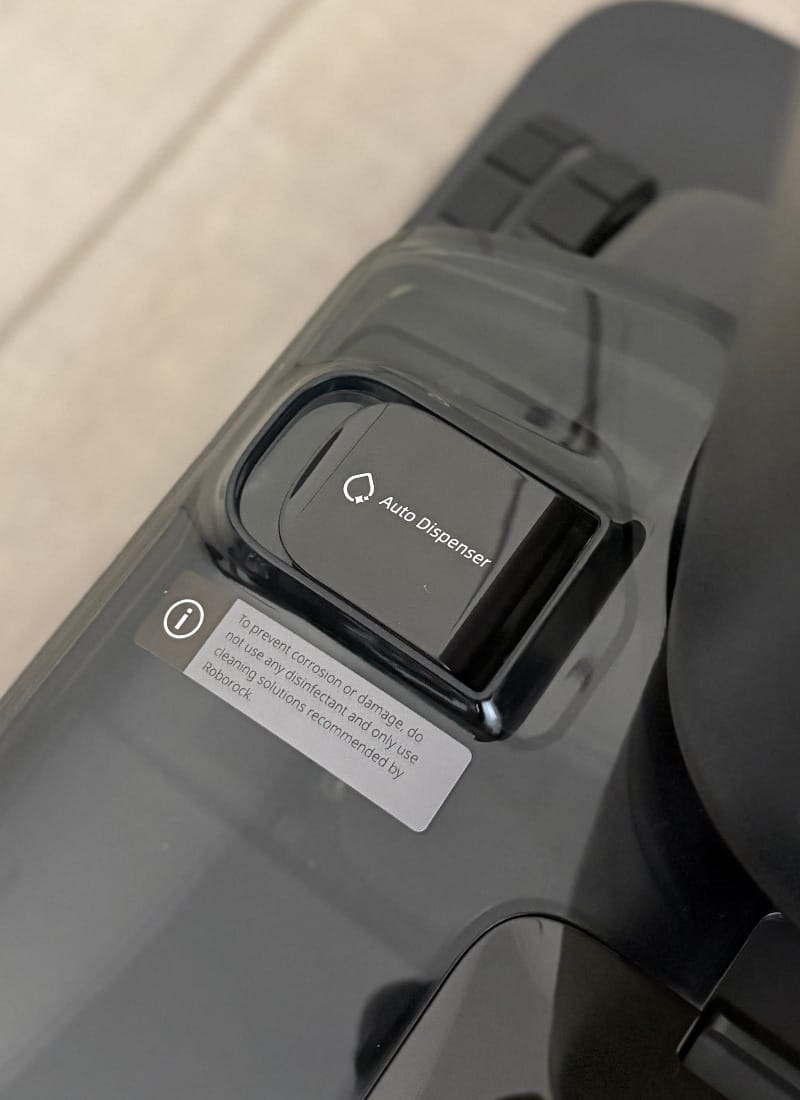
An automatic detergent dispenser draws from a 100ml cartridge and is rated to handle roughly 30 days of dosing without needing a refill, which takes one more manual step out of the regular cleaning routine. It’s a small inclusion, but the kind of thing that adds up over weeks of use.
Blue light illumination built into the head lights up fine dust and debris that’s easy to miss under normal room lighting, particularly in the evening or in rooms with limited natural light. It’s a simple addition, but genuinely changes what you notice on a floor you’d otherwise assume was already clean.
Edge cleaning has been given specific attention through a roller geometry that reaches into corners from both sides, rather than requiring the machine to be angled manually against skirting boards. That’s the kind of detail that only becomes obvious once you’re trying to clean a room with a lot of built-in cabinetry.
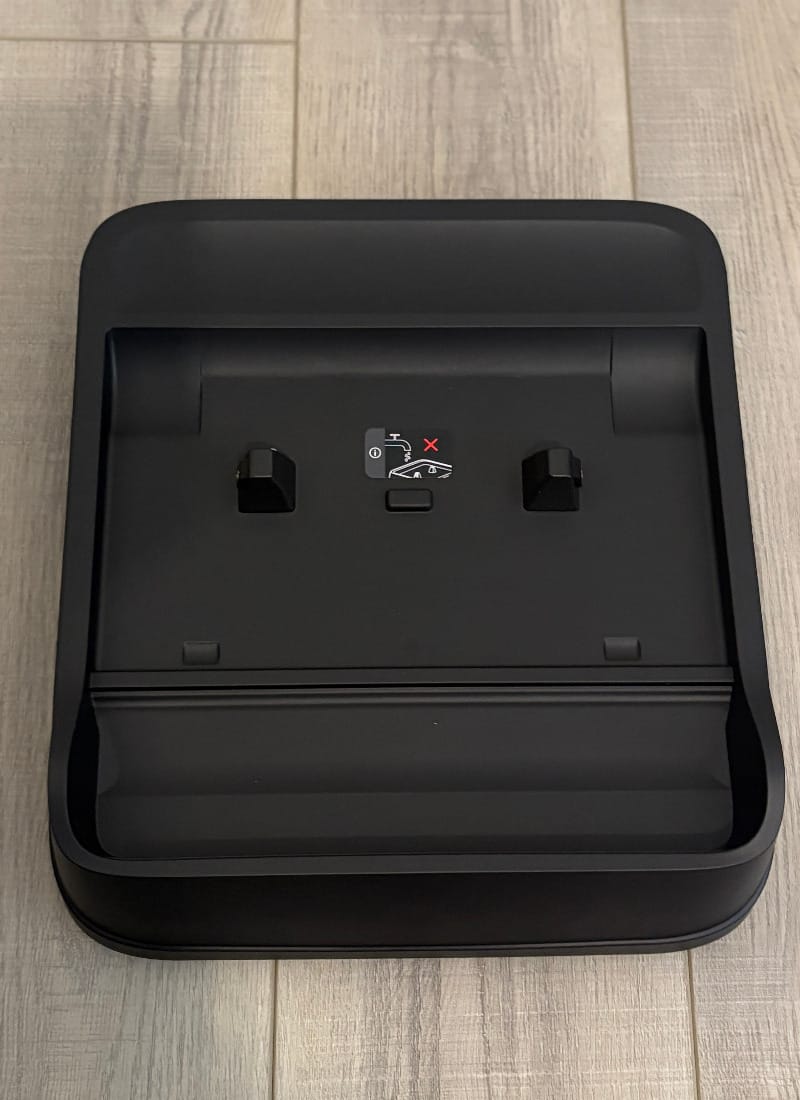
The overall footprint of the charging dock is compact enough to fit into a laundry, hallway cupboard or the corner of a kitchen without becoming an eyesore, which matters for a machine this size that’s likely to live somewhere visible rather than hidden away in a garage.


Taken together, the design choices here consistently point toward reducing the number of manual steps involved in looking after hard floors, whether that’s the self-cleaning roller, the detachable dirty tank, or the auto-dosing detergent cartridge.
Key Features
VaporFlow is the headline feature, and it’s a genuine steam system rather than a warmed-water spray. Water is heated internally to 180°C, and that heat is what allows the machine to target dried-on stains like coffee rings, cooking oil splatters and general grime without needing any added chemicals.
Steam is released through six outlets angled at 48 degrees, delivering a high-volume output of around 2,200mg per minute across the full width of the cleaning path. Activation is rated at as fast as 60 seconds, so there’s minimal waiting once steam mode is switched on.
Roborock has had the wood floor safety question independently tested, with TÜV SÜD simulating five years of cumulative use, equivalent to 18,000 strokes, in steam mode. The solid wood surface used in testing showed no swelling, warping or cracking, which is the kind of reassurance anyone with hardwood or engineered flooring will want before running hot steam over it regularly.
On the hygiene side, Roborock reports a bacteria removal rate above 99.9999% and an allergen removal rate of at least 99.9% in steam mode. For households with young kids crawling around or pets that spend a lot of time at floor level, that’s arguably a more relevant number than raw suction figures.
Suction sits at 25,000 Pa, which is a strong figure for this category and is backed by 33N of downward cleaning pressure and a brush rotation speed of 450 RPM. Together, these numbers are aimed at making sure whatever the steam loosens actually gets picked up rather than pushed around.
Water distribution across the roller is managed through 32 even outlet points, paired with a constant-pressure scraper designed to minimise the watermarks that often get left behind by wet and dry vacuums. Floors are left to dry within seconds of a pass rather than staying visibly damp.
The JawScrapers anti-tangle design deserves its own mention as a feature rather than just a design detail, given Roborock cites a 0% tangle rate from SGS testing. For anyone with long hair in the household, or pets that shed, this is one of the more meaningful specifications on the whole machine.
Battery life is rated at up to 80 minutes on a single charge, translating to coverage of up to 660 square metres in Eco mode. That’s comfortably enough for most Australian homes to be cleaned in one continuous session without needing to stop and recharge partway through.
The 1,000ml clean water tank ties directly into that runtime figure, since a bigger reservoir means fewer interruptions to top it back up during a longer clean. It’s a straightforward feature, but one that directly affects how the machine performs across a full-sized home.
Edge-to-edge cleaning is rated at under 1mm, a spec that speaks to how close the roller and suction path get to skirting boards and corners where dust typically accumulates unseen. It’s a small figure on paper but a noticeable difference in a room with a lot of edges.
The DirTect sensor uses infrared light to continuously read how dirty a section of floor is and adjusts cleaning intensity in response, rather than applying a single fixed setting across the whole home. A light bar shifts from red through to blue as an area gets progressively cleaner, backed up by voice alerts and an onscreen readout.
FlatReach 2.0 also functions as a feature in its own right beyond the physical design, since the gyroscope-assisted suction control at 180 degrees is what actually allows the low profile to be useful rather than just a novelty measurement.
The self-cleaning and drying roller system rounds out the feature set, combining the dual-temperature scrub cycle with a sealed drying process that offers both a fast five-minute option and a quieter 30-minute cycle depending on what’s needed at the time.
None of these features exist in isolation; the steam loosens what suction then removes, the anti-tangle roller keeps performance consistent over time, and the self-cleaning cycle means the machine is ready to go again without manual upkeep after every session.
Experience Using the Product and Performance
Getting started involves charging the unit fully and filling the clean water tank, and the onboard display walks through mode selection clearly enough that no manual is really needed for the basics. Within a few minutes of unboxing, the F25 Steam was ready for its first run around a tiled kitchen.
That first clean was also the quickest way to notice the steam activation claim holds up in practice, with visible steam appearing at the roller well within that quoted 60-second window rather than requiring an extended warm-up period.
A dried splash of cooking oil near the stove, the kind that normally needs a scrub with a cloth, came up in a single pass under steam mode. The heat visibly softened the residue before the roller and suction combination lifted it away, without any pre-treatment or chemical spray involved.
Coffee rings on a tiled section of flooring behaved the same way, disappearing on the first stroke rather than needing the machine to go back over the same spot a second or third time, which is the exact multi-pass routine this machine is designed to avoid.
Not needing to reach for a chemical cleaner or spray bottle before running the vacuum over these spots is a genuinely different way of cleaning than most households are used to, and it becomes a habit fairly quickly once the steam mode proves it can handle stains on its own.
Suction performance held up well even when switching between wet and dry messes without changing modes, with dry crumbs on a hallway runner and a small spill in the kitchen both handled in the same pass without the machine seeming to favour one type of mess over the other.
Running the head right along skirting boards in a hallway confirmed the edge-to-edge cleaning claim is more than a marketing number, with noticeably less dust left clinging to the join between floor and wall compared to a standard upright vacuum used previously in the same spot.
Long hair testing came from a household member who sheds more than most vacuums seem to appreciate, and after several passes across a bathroom floor there was no visible wrapping around the roller, matching the anti-tangle claim rather than falling short of it as some “tangle-free” rollers tend to.
Lying the body flat to get under a bed frame was one of the more satisfying moments of testing, since the suction genuinely didn’t seem to drop off once the head was horizontal. Dust that had clearly been sitting undisturbed for a while came up just as effectively as it did on open floor.
The 70-degree swivel made itself useful almost immediately around dining chair legs and a cluttered study, cutting down on the amount of backing up and repositioning that’s usually needed with bulkier upright machines.
Despite the roughly 5.2 kilogram weight, the bidirectional drive assistance meant pushing and pulling the unit around a living room didn’t feel like a workout, even during a longer session covering multiple rooms back to back.
A full clean across a mid-sized home used a meaningful chunk of the rated 80-minute battery life but didn’t come close to draining it entirely, which lines up with the 660 square metre coverage figure Roborock quotes for Eco mode.
The 1,000ml water tank comfortably lasted through that same session without needing a top-up, which made it possible to move from room to room without pausing to refill partway through, something smaller-tanked machines tend to demand.
Once cleaning wrapped up, docking the unit triggered the self-cleaning cycle automatically, and the combination of steam and hot water visibly cleared residue from the roller rather than just rinsing the surface with cold water as some rival machines do.
Choosing the fast five-minute dry mode after a quick clean got the machine ready to go again almost immediately, while the quieter 30-minute cycle was a better fit for evening use when the extra noise of the fast mode would have been more noticeable in a quiet house.
Noise levels throughout regular operation stayed reasonable for a machine of this type, and the quiet drying mode in particular kept things low-key enough to run late at night without disturbing anyone in nearby rooms.
Watching the DirTect light bar shift from red to blue as a particularly grimy section of tile got progressively cleaner was a small but genuinely useful bit of feedback, taking away the guesswork of whether a spot needed another pass.
The blue light illumination proved its worth in a dimly lit laundry, revealing a scattering of fine dust near the skirting that would have otherwise gone unnoticed under the room’s regular ceiling light.
Detergent dosing from the 100ml cartridge felt consistent across multiple sessions, with no noticeable over or under-application, and the cartridge showed no sign of needing a refill well before the rated 30-day mark.
Emptying the dirty water tank after a session was noticeably less unpleasant than expected thanks to the detachable wet-and-dry separation module, which let solids and liquid be dealt with separately rather than sloshing around together in one compartment.
Switching between Auto, Eco, Steam and Sponge modes was straightforward via the onboard display, with Auto proving the easiest default for mixed rooms and Steam reserved specifically for kitchens, bathrooms and other areas prone to dried-on messes.
Sponge mode, which stops active water supply, came in handy when dealing with a larger spill near the fridge, letting the roller absorb excess liquid rather than pushing it further across the floor.
Running the steam mode repeatedly across a small section of hardwood over several sessions showed no visible change to the finish, which lines up with the TÜV SÜD wood-safety certification and offers real reassurance for homes with timber flooring rather than just tile.
The hygiene angle became more noticeable over time than expected, with floors in high-traffic areas feeling less sticky underfoot days after a steam clean compared to previous routines using a standard mop and bucket.
Not having an app to manage was a relief rather than a limitation in daily use, since every mode and setting needed was accessible directly from the display without hunting through a smartphone interface first.
Compared with the older, non-steam standard Roborock F25 review covered previously on this site, the addition of genuine steam is the single biggest jump in capability, particularly for stains that a plain wet and dry vacuum simply pushes around rather than lifts.
It also sits in an interesting spot next to the Roborock F25 Ultra review, which offers app connectivity and a slightly different suction figure, whereas the F25 Steam trades that smart connectivity for a simpler, button-driven approach focused squarely on steam performance.
Set against the Roborock F25 Ace Pro review, which leans on JetFoaming technology rather than steam, the F25 Steam feels like the option built specifically for households dealing with dried-on kitchen and bathroom grime rather than general everyday dust and spills.
The charging dock’s footprint made it easy to tuck away in a laundry between sessions, and docking itself was quick enough that the self-cleaning and drying process felt like part of the natural end of a cleaning session rather than an extra chore.
Transitioning between tile in the kitchen and timber in the hallway didn’t require switching modes manually in most cases, with Auto mode reading the change in surface and adjusting suction and steam output without needing input.
Across repeated use, the JawScrapers roller showed no build-up of hair or fibres even after cleaning a home with a shedding pet, which suggests the anti-tangle design holds up beyond a single test run rather than only working when the roller is brand new.
Conclusion
The Roborock F25 Steam delivers on the idea it’s built around: genuine 180°C steam paired with strong suction that can handle dried-on stains, everyday spills and stubborn hair in a single pass rather than the usual vacuum-then-mop routine.
The FlatReach 2.0 design, self-cleaning and drying roller, and simple button-and-display control scheme all point to a machine built around removing friction from a chore most households would rather spend less time on.
Independent TÜV SÜD testing on wood floor safety, along with the quoted bacteria and allergen removal figures, add a layer of reassurance that matters most in homes with young kids or pets spending time at floor level.
For anyone tired of scrubbing at the same stubborn marks every week or picking hair out of a vacuum roller by hand, this machine addresses those specific frustrations directly rather than simply adding another spec sheet number to the category.