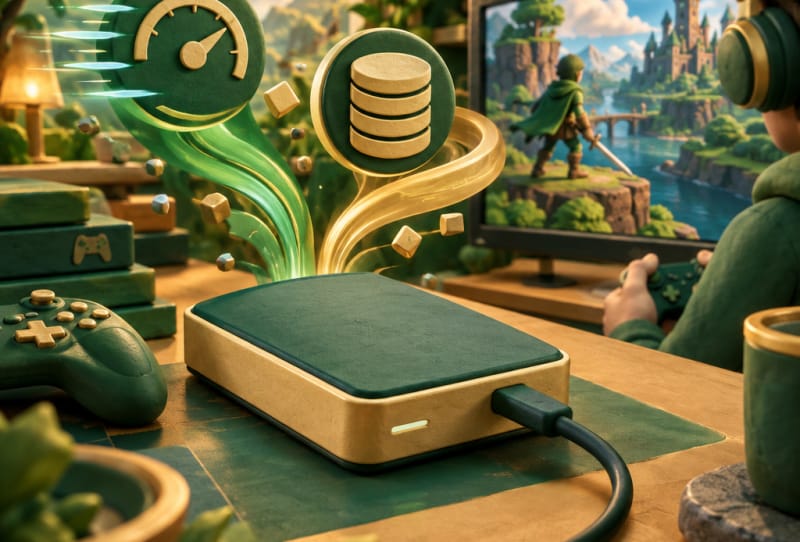
The Seagate FireCuda Forge 20TB is a new external hybrid drive built to let gamers store and play large game libraries without first copying them back to an internal SSD. It pairs a solid-state cache with spinning mechanical platters in one enclosure, a combination Seagate is pitching squarely at players who have run out of room on their console or PC but don’t want to sacrifice snappy load times.
Key takeaways
- ✓Seagate's FireCuda Forge 20TB is a hybrid external drive combining solid-state caching with mechanical platters.
- ✓It is built around UASP, letting games run directly from the drive instead of being copied back to internal storage.
- ✓20TB of capacity makes it one of the largest external gaming drives Seagate has released.
- ✓The hybrid design targets players who need bulk capacity without giving up responsive load times.
- ✓It sits alongside Seagate's existing FireCuda SSD and HDD lines rather than replacing them.
External storage has long been treated as a holding pen rather than a place to actually run games from. Copy a title across, then copy it back when it’s time to play: that was the accepted workflow for years. The FireCuda Forge is built around the idea that this extra step shouldn’t be necessary anymore, and it leans on a technology called UASP to make that case.
Table of Contents
What makes the FireCuda Forge different
Traditional external hard drives communicate over USB using a protocol called mass storage, which adds latency every time the drive reads or writes data. UASP, short for USB Attached SCSI Protocol, replaces that older method with something closer to how an internal drive talks to a PC. The result is lower overhead and noticeably better responsiveness, even on a drive that still relies on spinning platters for most of its capacity.
Seagate has taken that foundation and added a solid-state element on top. Rather than being a pure hard drive, the FireCuda Forge uses flash storage as a fast front end, caching frequently accessed data so the drive feels quicker in everyday use than its mechanical heart would suggest. The mechanical platters still do the heavy lifting on capacity, which is how Seagate gets to 20TB in a single external unit without the price and heat of an equivalent all-flash drive.
Specifications and what’s confirmed
Seagate has positioned the FireCuda Forge as part of its gaming-focused storage family, sitting alongside existing FireCuda SSDs and hard drives rather than replacing them. The table below summarises what’s known about the drive’s design intent.
| Feature | Detail |
|---|---|
| Capacity | 20TB |
| Storage type | Hybrid, solid-state cache plus mechanical HDD |
| Connection protocol | USB with UASP support |
| Target use case | External gaming storage, play without copy-back |
| Product family | Seagate FireCuda |
Seagate hasn’t published every granular spec for the FireCuda Forge publicly at the time of writing, so figures like exact sustained transfer speeds and the precise size of the flash cache are best confirmed through Seagate’s own product documentation rather than assumed.
Why external gaming storage finally works
Modern game installs routinely stretch past 100GB, and a handful of titles on a PC or current-generation console can fill an internal drive in short order. Until UASP became common on external enclosures, gamers had three options: delete titles to make room, pay a premium for bigger internal storage, or accept sluggish load times from older external drives that weren’t built for active use.
A hybrid drive like the FireCuda Forge threads that needle. Because it behaves closer to native storage thanks to UASP, and because the solid-state cache smooths over the slower parts of mechanical access, it can realistically host a game library that gets played directly from the drive rather than treated as cold storage. That matters more for console players, who often can’t add a second internal drive at all, than for PC users who can usually slot in another SSD.
How it stacks up against other external options
Compared with all-flash external drives, including portable SSDs built around USB4 speed, the FireCuda Forge trades some raw performance for a much larger capacity footprint at a given size and heat budget. A 20TB all-SSD external drive would be considerably more expensive to produce, which is exactly the gap Seagate’s hybrid approach is designed to fill.
Buyers chasing the fastest possible load times, especially for demanding open-world titles, may still prefer high-capacity NVMe drives aimed at gaming libraries, or look at external SSD enclosures built for speed and connectivity if they want flash performance in a portable form. The FireCuda Forge instead targets players whose priority is fitting an entire library in one place without constant juggling, with speed as a secondary but still meaningful benefit over a plain mechanical drive.
What it means for buyers
The FireCuda Forge 20TB signals that hybrid designs still have a role to play even as flash storage keeps getting cheaper. For anyone weighing up options, a guide to picking the right SSD for gaming is worth a read alongside this announcement, since the right choice depends heavily on whether capacity or raw speed matters more for a given setup.
For console owners juggling a growing backlog, or PC gamers who have simply run out of internal bays, a drive that lets a 20TB library live externally and still launch titles promptly is a meaningful shift from the copy-back routine of previous generations. Full performance figures and availability details are best checked directly through Seagate’s official site, since Seagate’s own documentation will be the authoritative source as the drive reaches retail.
Frequently asked questions
What does UASP do for an external hard drive?
UASP, or USB Attached SCSI Protocol, reduces the overhead of older USB storage commands, allowing an external drive to respond more like internal storage. It’s the key reason the FireCuda Forge can realistically run games rather than just store them.
Is the FireCuda Forge a solid-state drive or a hard drive?
It’s a hybrid. Mechanical platters provide the bulk of the 20TB capacity, while a solid-state cache handles frequently accessed data to keep everyday performance responsive.
Why choose a hybrid drive over a pure SSD for gaming storage?
A hybrid design can offer far more capacity for the same size and cost as an all-flash drive. It suits players who need to store large libraries rather than chase the absolute fastest load times on a handful of titles.
Can the FireCuda Forge be used with a games console?
External hybrid drives with UASP support are generally well suited to consoles that allow external storage for game libraries, though players should confirm compatibility and supported capacities through their console maker’s official guidance before buying.