
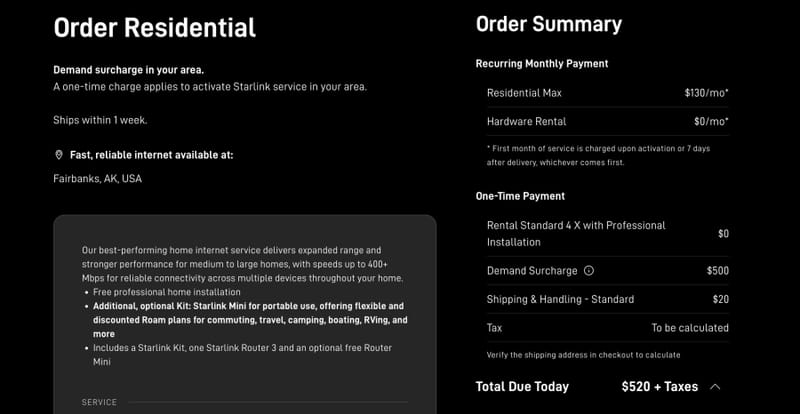
Starlink has quietly cut its one-time demand surcharge in parts of Alaska from as much as $1,500 down to $500, opening the door for residents who previously could not afford to join the satellite internet service. The Starlink demand surcharge now sits lower in at least a dozen Alaskan cities, according to the company’s own coverage map.
Key takeaways
- ✓Starlink cut its one-time demand surcharge in at least a dozen Alaskan cities from $1,500 to $500
- ✓Anchorage, Fairbanks, Wasilla and Kasilof were among the areas hit hardest earlier this year
- ✓The surcharge applies only to new sign-ups in areas where local network capacity is tight
- ✓Lower fees should make satellite broadband reachable for more remote Alaskan households
- ✓Starlink has not explained publicly why the surcharge dropped in these specific locations
The change has not been formally announced. It surfaced through updates to the sign-up pricing shown on Starlink’s official site when prospective customers check availability at their address. For a service that has become the main broadband option in many parts of rural Alaska, the drop is significant.
Table of Contents
What the Starlink demand surcharge actually is
Starlink charges a one-time demand surcharge in certain locations where its local satellite capacity is close to being maxed out. Rather than closing sign-ups entirely once a cell is full, the company adds an upfront fee designed to slow the rate of new connections while still allowing determined customers to join.
The surcharge sits on top of the regular hardware cost and monthly subscription, and it only applies to new accounts. Existing subscribers are not affected when a surcharge appears or changes in their area. Because the fee is tied to local network congestion rather than a fixed national policy, it can vary enormously from suburb to suburb and can rise or fall as Starlink adds satellites or shifts capacity between regions.
Where the fee has dropped in Alaska
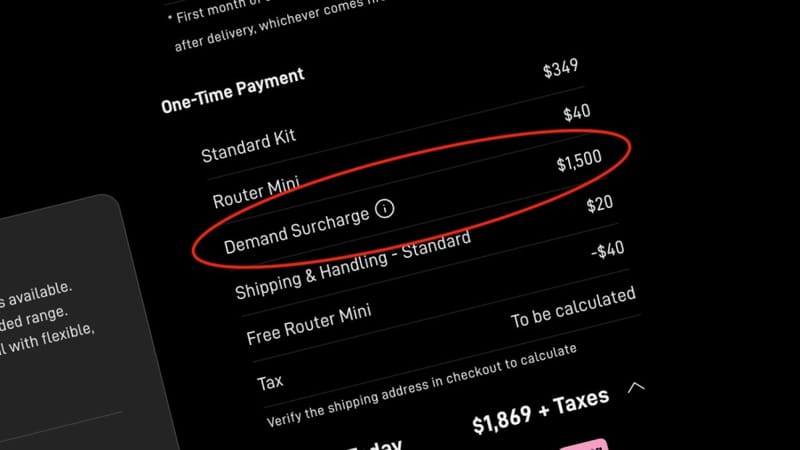
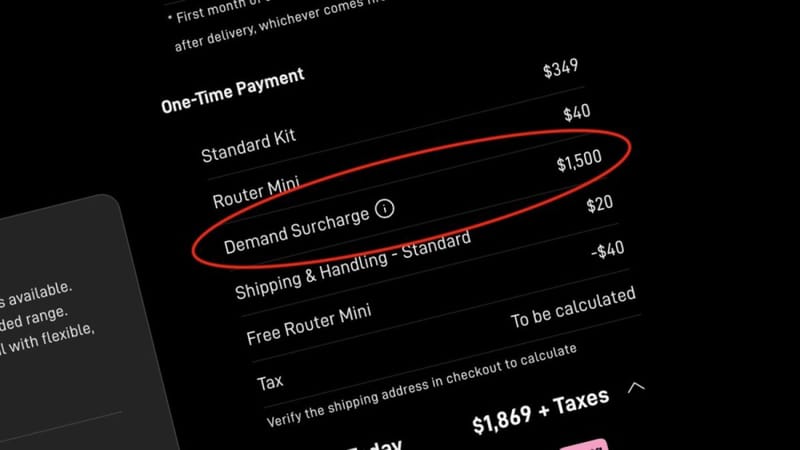
Earlier this year, the surcharge reached $1,500 in several high-demand Alaskan centres, including Anchorage, Fairbanks, Wasilla and Kasilof. That figure placed Starlink well out of reach for many households already dealing with the state’s higher cost of living and limited terrestrial broadband alternatives.
Those same cities, along with roughly eight other locations across the state, now show a $500 surcharge instead. That is still a meaningful upfront cost, but it is a third of what residents faced only months ago. Alaska has consistently appeared among the US states with the steepest Starlink demand surcharges, largely because of its sparse wired infrastructure and heavy reliance on satellite connections for everyday internet access.
Why the pricing model exists at all
Satellite capacity is not unlimited. Each Starlink satellite can only support a certain number of active connections in a given area before speeds degrade for everyone using that cell. Rather than running a strict waitlist, Starlink uses price as a throttle, a method increasingly common across industries that need to balance limited supply against surging demand.
The approach resembles how other hardware sectors manage supply shocks. Storage manufacturers, for example, have faced other hardware makers scrambling to keep pace with sudden demand driven by AI infrastructure build-outs, prompting production increases rather than price signals. Starlink’s surcharge achieves a similar outcome from the demand side rather than the supply side, discouraging new sign-ups in saturated cells until the company can add capacity through new satellite launches or network upgrades.
Understanding how companies forecast demand to avoid costly shortfalls helps explain why Starlink’s fees move so unpredictably. Satellite internet providers must predict where rural and underserved populations will concentrate their sign-up requests, then price accordingly to avoid oversubscribing a cell before new capacity arrives.
What it means for Alaskan households
For residents weighing satellite broadband against patchy DSL or no fixed-line service at all, a lower surcharge removes one of the biggest barriers to entry. Alaska has some of the least developed wired broadband infrastructure in the United States, and Starlink has become a default option in many towns that larger telecoms have not prioritised for fibre or cable upgrades.
It is worth watching whether the reduced $500 figure holds or continues shifting as Starlink expands satellite coverage over the northern hemisphere. Because the surcharge is reactive rather than fixed, prospective subscribers in Alaska and other high-demand regions should check pricing at their specific address before assuming a quoted figure will still apply when they are ready to order.
Starlink has not detailed the technical reason behind the sudden reduction in these specific cities, nor has it indicated whether similar cuts are coming to other high-surcharge regions in the contiguous United States. The pattern suggests the company has added meaningful capacity over Alaska in recent months, whether through new satellite launches, rebalanced coverage, or a drop in local demand itself.
Frequently asked questions
What is Starlink’s demand surcharge?
It is a one-time fee Starlink adds to new sign-ups in areas where local satellite capacity is nearly full. The charge is separate from the regular hardware and subscription costs and only applies once, at sign-up.
Why was the Starlink demand surcharge so high in Alaska?
Alaska has limited wired broadband infrastructure, so many residents rely heavily on satellite internet. That concentrated demand pushed several Alaskan cities, including Anchorage and Fairbanks, to the highest surcharge tier Starlink has used, reaching $1,500 earlier this year.
Does the surcharge affect existing Starlink customers?
No. The demand surcharge only applies to new account sign-ups in a congested area. Current subscribers keep their existing pricing regardless of how the local surcharge changes afterward.
Will the Starlink demand surcharge keep dropping?
There is no guarantee. The fee is tied to live network capacity in each area, so it can rise again if sign-ups surge or fall further if Starlink adds satellites over a region. Checking current pricing at a specific address remains the only reliable way to know the live figure.