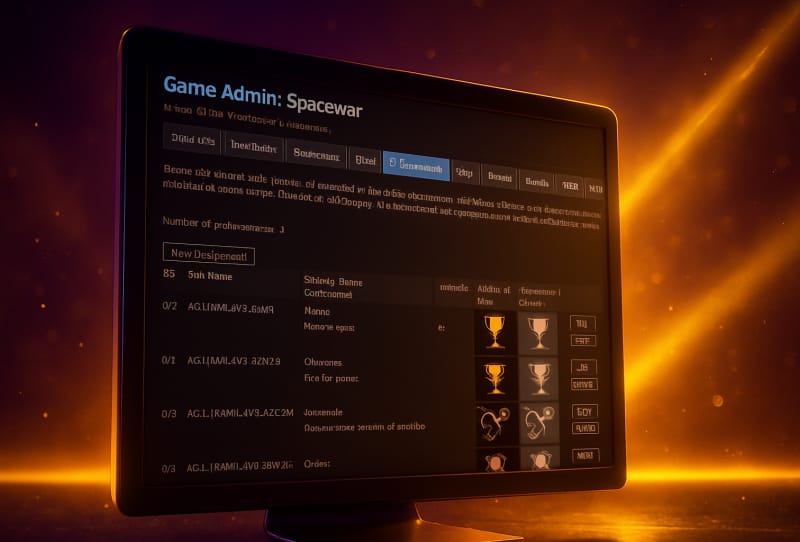
Valve has rolled out a new Steam achievement sets feature that lets developers split a game’s trophies, including those tied to expansions and DLC, into separate groups rather than one sprawling list. Each set gets its own progress bar, so a base game and its add-ons no longer get mashed together into a single, confusing percentage.
Key takeaways
- ✓Valve has launched Steam achievement sets, letting developers group achievements into separate lists.
- ✓Each set, such as a base game or a DLC pack, gets its own progress bar.
- ✓Players still earn achievements by playing normally; sets only change how progress is displayed.
- ✓The feature targets long-running games and titles with heavy post-launch content.
- ✓Developers must opt in and configure sets through Steamworks before the change appears.
The change is purely cosmetic in terms of how achievements are earned. Players still unlock them by playing the game exactly as they always have. What changes is how Steam presents that progress afterwards. Instead of scrolling through one long, undifferentiated list that blends a base campaign with every piece of paid or free content released since, players browsing their achievement history will see everything organised into clearly labelled sets.
Table of Contents
What Steam achievement sets actually change
For games that support the feature, Steam will display separate sections for each configured set, with its own completion bar sitting alongside the overall total. A role-playing game with three expansion packs, for example, could show one set for the core story and three more for each expansion, letting a completionist see exactly how far through each chunk of content they are.
This matters more than it might sound. Plenty of long-running Steam titles, particularly strategy games, live-service shooters, and sprawling RPGs, accumulate dozens of achievements over several years of post-launch support. Lumping a 2016 base game achievement in with one added by a 2025 expansion has always made the overall list harder to parse, especially for anyone picking up a game years after release with a backlog of DLC already bundled in.

Valve has also been clear that sets are opt-in. A developer has to actively configure them through Steamworks, Valve’s backend tools for managing a game’s store page, updates, and now achievement structure. Games that don’t bother will simply keep displaying achievements the old way, as one continuous list.
Why Valve is bothering to fix achievement lists now
Achievements have quietly become one of the more social, competitive corners of PC gaming. Completion percentages get shared, compared, and shown off, and Steam profiles display them prominently. As games ship more downloadable content over longer life spans, the flat list format has started to show its age, particularly for titles that treat DLC as a major content pillar rather than an occasional bonus.
Separating achievements into sets gives developers a cleaner way to signal what’s part of the core experience and what belongs to optional extras. It also gives players a more honest sense of progress. A 60 percent completion rate on a base game sitting next to a separate 10 percent rate on a newly released expansion is far more useful information than a single blended number that hides how much of the unfinished content is actually paid DLC the player hasn’t bought yet.
It fits a broader pattern of Valve quietly refining Steam’s back-end tools for developers rather than chasing flashy consumer-facing features. The company has made similar moves before, including sharing real Steam Deck performance data with developers so they can better tune games for handheld hardware. Achievement sets reads as another behind-the-scenes improvement aimed squarely at the people building games on the platform, rather than a headline feature meant to draw new players in.

What it means for developers and players
For developers, the upside is organisational. Games with multiple DLC packs, season-style content drops, or standalone expansions sold through the same Steam page can now map achievements to the content they actually belong to. That’s particularly useful for publishers running long post-launch roadmaps, where a game released years ago might still be accumulating new achievement sets with every content update.
For players, the practical benefit is clarity rather than anything that changes how achievements are earned or counted toward existing totals. Nobody loses progress, and nothing needs to be re-earned. The sets simply reorganise the display, which should make it easier to track exactly what’s left to finish in a specific expansion without wading through achievements from unrelated content.
It’s a small change in isolation, but it’s the kind of refinement that tends to matter more the longer a game stays active on Steam. Live-service titles, long-tail strategy games, and anything with a healthy DLC pipeline stand to benefit the most, while smaller, self-contained games with no expansions are unlikely to need the feature at all.
Frequently asked questions
Do Steam achievement sets change how achievements are earned?
No. Players still unlock achievements through normal gameplay. Sets only change how those achievements are grouped and displayed afterwards, splitting a base game and its DLC into separate progress bars instead of one combined list.

Do all games automatically get achievement sets?
No. Developers need to configure sets manually through Steamworks, Valve’s developer tools. Games that don’t set this up will continue to show achievements as a single flat list, as they always have.
Will existing achievement progress be affected?
No existing progress is lost or recalculated. Achievement sets are a display change, so previously earned achievements simply get sorted into whichever set a developer assigns them to once the feature is enabled for that game.
Which games benefit most from achievement sets?
Games with multiple expansions, long post-launch content pipelines, or live-service style updates benefit the most, since their achievement lists tend to grow large and mix base-game and DLC content over time.